


A helicopter carrying Iranian President Ebrahim Raisi suffered a “hard landing” on Sunday, Iranian state media reported, without elaborating. Some began urging the public to pray for Raisi and the others on board as rescue crews sped through a misty, rural forest where his helicopter was believed to be.
The likely crash comes as Iran under Raisi and Supreme Leader Ayatollah Ali Khamenei launched an unprecedented drone-and-missile attack on Israel just last month and has enriched uranium closer than ever to weapons-grade levels. Meanwhile, Iran has faced years of mass protests against its Shiite theocracy over an ailing economy and women’s rights — making the moment that much more sensitive for Tehran and the future of the country as the Israel-Hamas war inflames the wider Middle East.
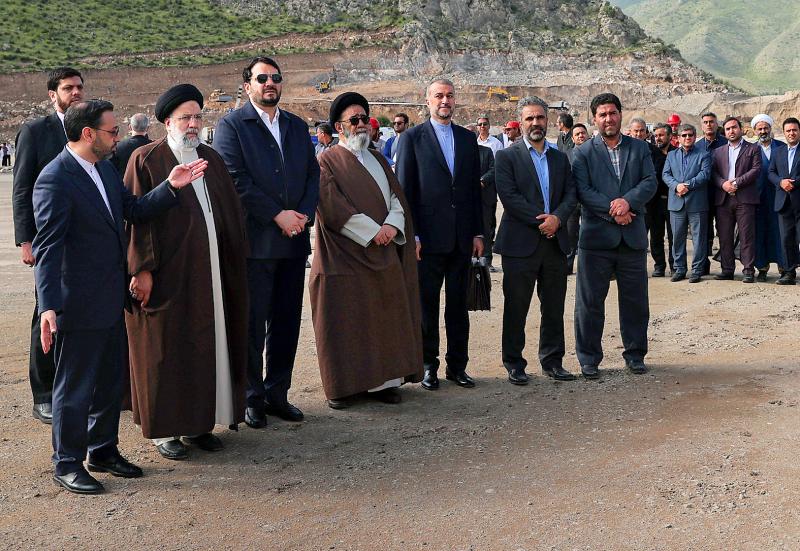
Photo: EPA
Raisi was traveling in Iran’s East Azerbaijan province. State TV said the incident happened near Jolfa, a city on the border with with the nation of Azerbaijan, some 600 kilometers (375 miles) northwest of the Iranian capital, Tehran. Later, state TV put it farther east near the village of Uzi, but details remained contradictory.
Traveling with Raisi were Iran's Foreign Minister Hossein Amirabdollahian, the governor of Iran's East Azerbaijan province and other officials and bodyguards, the state-run IRNA news agency reported. One local government official used the word “crash” to describe the incident, but he acknowledged to an Iranian newspaper that he had yet to reach the site himself.
Neither IRNA nor state TV offered any information on Raisi’s condition in the hours afterward. However, hard-liners urged the public to pray for him. State TV later aired images of the faithful praying at Imam Reza Shrine in the city of Mashhad, one of Shiite Islam's holiest sites, as well as in Qom and other locations across the country.
“The esteemed president and company were on their way back aboard some helicopters and one of the helicopters was forced to make a hard landing due to the bad weather and fog," Interior Minister Ahmad Vahidi said in comments aired on state TV. "Various rescue teams are on their way to the region but because of the poor weather and fogginess it might take time for them to reach the helicopter.”
He added: "The region is a bit (rugged) and it’s difficult to make contact. We are waiting for rescue teams to reach the landing site and give us more information.”
Rescuers were attempting to reach the site, state TV said, but had been hampered by poor weather conditions. There had been heavy rain and fog reported with some wind. IRNA called the area a “forest” and the region is known to be mountainous as well. State TV aired images of SUVs racing through a wooded area.
A rescue helicopter tried to reach the area where authorities believe Raisi's helicopter was, but it couldn't land due to the heavy mist, emergency services spokesman Babak Yektaparast told IRNA.
Raisi had been on the border with Azerbaijan early Sunday to inaugurate a dam with Azerbaijan’s President Ilham Aliyev. The dam is the third one that the two nations built on the Aras River. The visit came despite chilly relations between the two nations, including over a gun attack on Azerbaijan's Embassy in Tehran in 2023, and Azerbaijan's diplomatic relations with Israel, which Iran's Shiite theocracy views as its main enemy in the region.
Iran flies a variety of helicopters in the country, but international sanctions make it difficult to obtain parts for them. Its military air fleet also largely dates back to before the 1979 Islamic Revolution.
Raisi, 63, is a hard-liner who formerly led the country’s judiciary. He is viewed as a protege of Khamenei and some analysts have suggested he could replace the 85-year-old leader after his death or resignation from the role.
Raisi won Iran's 2021 presidential election, a vote that saw the lowest turnout in the Islamic Republic’s history. Raisi is sanctioned by the U.S. in part over his involvement in the mass execution of thousands of political prisoners in 1988 at the end of the bloody Iran-Iraq war.
Under Raisi, Iran now enriches uranium at nearly weapons-grade levels and hampers international inspections. Iran has armed Russia in its war on Ukraine, as well as launched a massive drone-and-missile attack on Israel amid its war against Hamas in the Gaza Strip. It also has continued arming proxy groups in the Mideast, like Yemen's Houthi rebels and Lebanon's Hezbollah.
Meanwhile, mass protests in the country have raged for years. The most recent involved the 2022 death of Mahsa Amini, a woman who had been earlier detained over allegedly not wearing a hijab, or headscarf, to the liking of authorities. The monthslong security crackdown that followed the demonstrations killed more than 500 people and saw over 22,000 detained.
In March, a United Nations investigative panel found that Iran was responsible for the “physical violence” that led to Amini’s death.
The U.S. State Department said it was “closely following reports of a possible hard landing of a helicopter in Iran carrying the Iranian president and foreign minister.”
It added: “We have no further comment at this time.”

Right-wing political scientist Laura Fernandez on Sunday won Costa Rica’s presidential election by a landslide, after promising to crack down on rising violence linked to the cocaine trade. Fernandez’s nearest rival, economist Alvaro Ramos, conceded defeat as results showed the ruling party far exceeding the threshold of 40 percent needed to avoid a runoff. With 94 percent of polling stations counted, the political heir of outgoing Costa Rican President Rodrigo Chaves had captured 48.3 percent of the vote compared with Ramos’ 33.4 percent, the Supreme Electoral Tribunal said. As soon as the first results were announced, members of Fernandez’s Sovereign People’s Party
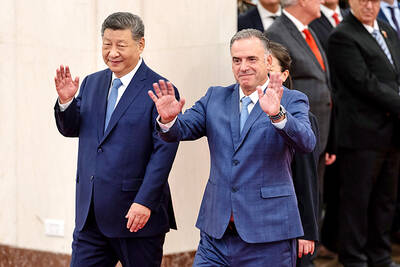
EMERGING FIELDS: The Chinese president said that the two countries would explore cooperation in green technology, the digital economy and artificial intelligence Chinese President Xi Jinping (習近平) yesterday called for an “equal and orderly multipolar world” in the face of “unilateral bullying,” in an apparent jab at the US. Xi was speaking during talks in Beijing with Uruguayan President Yamandu Orsi, the first South American leader to visit China since US special forces captured then-Venezuelan president Nicolas Maduro last month — an operation that Beijing condemned as a violation of sovereignty. Orsi follows a slew of leaders to have visited China seeking to boost ties with the world’s second-largest economy to hedge against US President Donald Trump’s increasingly unpredictable administration. “The international situation is fraught
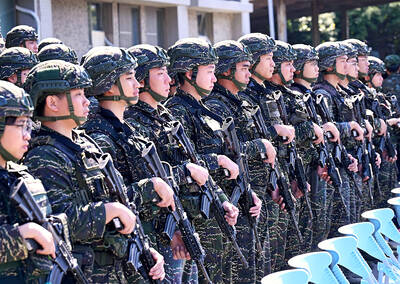
MORE RESPONSIBILITY: Draftees would be expected to fight alongside professional soldiers, likely requiring the transformation of some training brigades into combat units The armed forces are to start incorporating new conscripts into combined arms brigades this year to enhance combat readiness, the Executive Yuan’s latest policy report said. The new policy would affect Taiwanese men entering the military for their compulsory service, which was extended to one year under reforms by then-president Tsai Ing-wen (蔡英文) in 2022. The conscripts would be trained to operate machine guns, uncrewed aerial vehicles, anti-tank guided missile launchers and Stinger air defense systems, the report said, adding that the basic training would be lengthened to eight weeks. After basic training, conscripts would be sorted into infantry battalions that would take
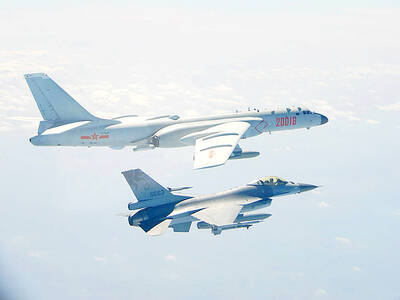
GROWING AMBITIONS: The scale and tempo of the operations show that the Strait has become the core theater for China to expand its security interests, the report said Chinese military aircraft incursions around Taiwan have surged nearly 15-fold over the past five years, according to a report released yesterday by the Democratic Progressive Party’s (DPP) Department of China Affairs. Sorties in the Taiwan Strait were previously irregular, totaling 380 in 2020, but have since evolved into routine operations, the report showed. “This demonstrates that the Taiwan Strait has become both the starting point and testing ground for Beijing’s expansionist ambitions,” it said. Driven by military expansionism, China is systematically pursuing actions aimed at altering the regional “status quo,” the department said, adding that Taiwan represents the most critical link in China’s


 RSS
RSS