


Philippine National Security Adviser Eduardo Ano yesterday called for Chinese diplomats to be expelled over an alleged leak of a phone conversation with a Filipino admiral in a significant escalation of a bitter row over the South China Sea.
China’s embassy in Manila had orchestrated “repeated acts of engaging and dissemination of disinformation, misinformation and malinformation,” with the objective of sowing discord, division and disunity, Ano said in a statement.
Those actions “should not be allowed to pass unsanctioned without serious penalty,” he said.
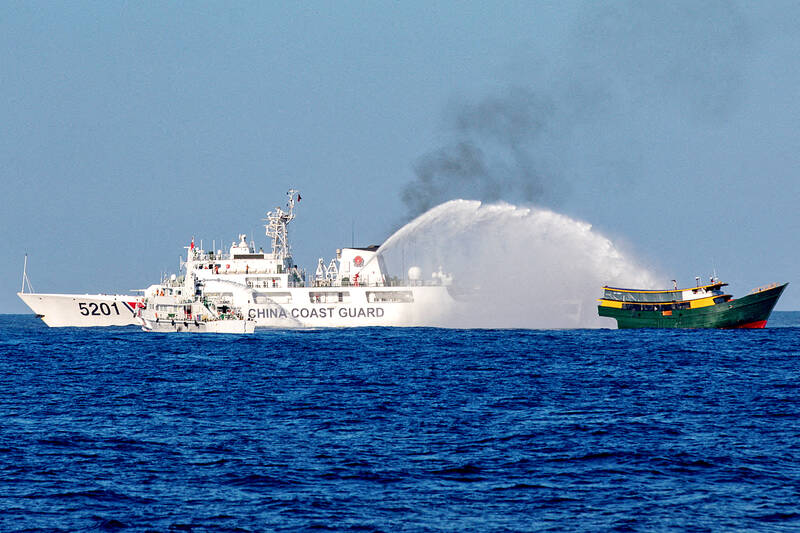
Photo: Reuters
Chinese Ministry of Foreign Affairs spokesman Lin Jian (林劍) called the comments provocative and said Chinese diplomats in the Philippines had to be allowed to do their job.
“China solemnly requests the Philippine side to effectively safeguard the normal performance of duties by Chinese diplomatic personnel, stop infringing and provoking, and refrain from denying the facts,” Lin told a regular press briefing in Beijing.
The office of Philippine President Ferdinand Marcos Jr and the foreign affairs department did not immediately respond to requests for comment.
The two countries have been embroiled in a series of heated standoffs this past year in disputed areas of the South China Sea. China has accused the Philippines of trespassing and of treachery, while Manila has scolded Beijing for what it says is a policy of aggression and dangerous maneuvering inside its exclusive economic zone.
The expelling of diplomats could intensify a row that has so far seen heated exchanges, diplomatic protests and the ramming and water-cannoning of Philippine ships at two disputed shoals.
Ano was referring to a news report this week of an alleged leak of a call between a Chinese diplomat and a Filipino admiral discussing a dispute over the South China Sea, which carried a transcript that showed the admiral agreeing to concessions with China.
According to the transcript published by the Manila Times, the admiral agreed to China’s proposal of a “new model,” where the Philippines would use fewer vessels in resupply trips to marines stationed at a grounded warship at the disputed Second Thomas Shoal (Renai Shoal, 仁愛暗沙), and notify Beijing about the missions in advance.
Reuters has not heard the reported phone conversation and could not verify the contents of the published transcript.
The report said the conversation had taken place in January and the transcript was provided by a “ranking Chinese official,” which it did not name.
Ano said he backed the defense secretary’s call for the foreign affairs department to take appropriate action against embassy officials, who he claimed recorded an alleged phone conversation in contravention of Philippine laws, as well as serious breaches of diplomatic protocols.
“Those individuals in the Chinese embassy ... and those responsible for these malign influence and interference operations must be removed from the country immediately,” he said.
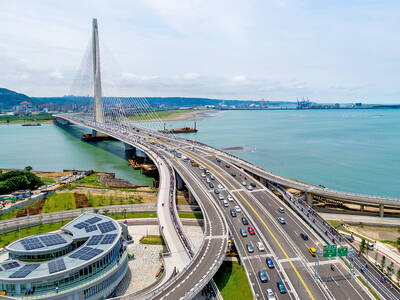
The Ministry of Transportation and Communications yesterday inaugurated the Danjiang Bridge across the Tamsui River in New Taipei City, saying that the structure would be an architectural icon and traffic artery for Taiwan. Feted as a major engineering achievement, the Danjiang Bridge is 920m long, 211m tall at the top of its pylon, and is the longest single-pylon asymmetric cable-stayed bridge in the world, the government’s Web site for the structure said. It was designed by late Iraqi-British architect Zaha Hadid. The structure, with a maximum deck of 70m, accommodates road and light rail traffic, and affords a 200m navigation channel for boats,
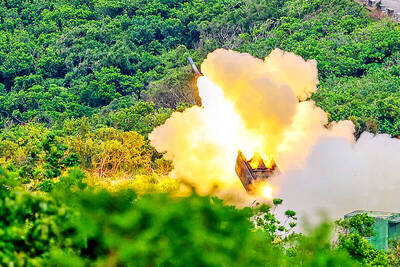
PRECISION STRIKES: The most significant reason to deploy HIMARS to outlying islands is to establish a ‘dead zone’ that the PLA would not dare enter, a source said A High Mobility Artillery Rocket System (HIMARS) would be deployed to Penghu County and Dongyin Island (東引) in Lienchiang County (Matsu) to force the Chinese military to retreat at least 100km from the coastline, a military source said yesterday. Taiwan has been procuring HIMARS and Army Tactical Missile Systems (ATACMS) from the US in batches. Once all batches have been delivered, Taiwan would possess 111 HIMARS units and 504 ATACMS, which have a range of 300km. Considering that “offense is the best defense,” the military plans to forward-deploy the systems to outlying islands such as Penghu and Dongyin so that

Taiwan Semiconductor Manufacturing Co (TSMC, 台積電), the world’s largest foundry service provider, yesterday said that global semiconductor revenue is projected to hit US$1.5 trillion in 2030, after the figure exceeds US$1 trillion this year, as artificial intelligence (AI) demand boosts consumption of token and compute power. “We are still at the beginning of the AI revolution, but we already see a significant impact across the whole semiconductor ecosystem,” TSMC deputy cochief operating officer Kevin Zhang (張曉強) said at the company’s annual technology symposium in Hsinchu City. “It is fair to say that in the past decade, smartphones and other mobile devices were

‘CLEAR MESSAGE’: The bill would set up an interagency ‘tiger team’ to review sanctions tools and other economic options to help deter any Chinese aggression toward Taiwan US Representative Young Kim has introduced a bill to deter Chinese aggression against Taiwan, calling for an interagency “tiger team” to preplan coordinated sanctions and economic measures in response to possible Chinese military or political action against Taiwan. “[Chinese President] Xi Jinping [習近平] has directed the People’s Liberation Army to be ready to invade Taiwan by 2027. China has a plan. America should have one too,” Kim said in a news release on Thursday last week. She introduced the “Deter PRC [People’s Republic of China] aggression against Taiwan act” to “ensure the US has a coordinated sanctions strategy ready should


 RSS
RSS