


Taiwan’s economy last quarter expanded 6.51 percent from a year earlier, beating the government’s February prediction by 0.59 percentage points, thanks to stronger-than-expected exports, the Directorate-General of Budget, Accounting and Statistics (DGBAS) said yesterday, citing its advance estimate report.
The showing was the best in 11 quarters and would raise GDP growth for this year from 3.43 percent to 3.57 percent in the absence of major shocks, DGBAS official Wang Tsui-hua (王翠華) said.
The statistics agency is due to revise its official growth projection later this month.
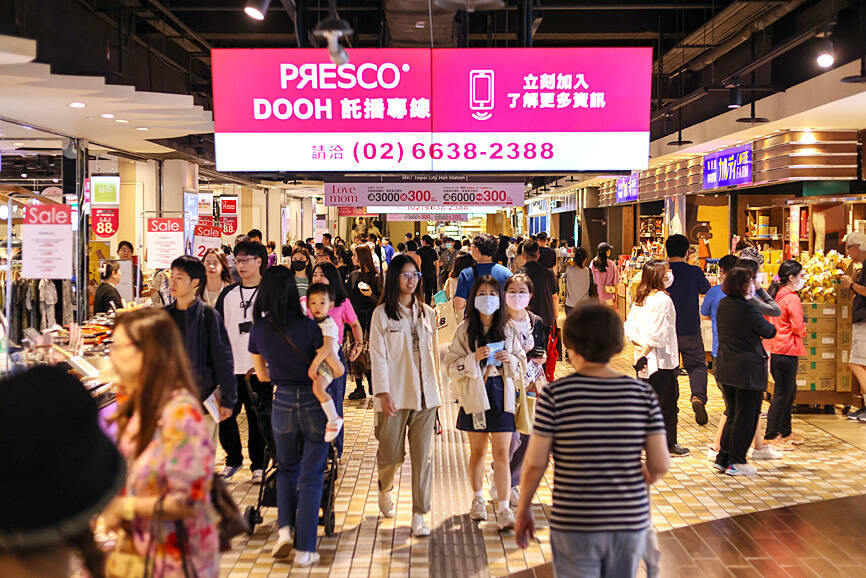
Photo: Ritchie B. Tongo, EPA-EFE
Exports of goods and services surged 10.21 percent during the January-to-March period, higher than the forecast by 2.8 percentage points, as global demand for artificial intelligence applications flourished, Wang told a news conference in Taipei.
Imports expanded 2.16 percent, reversing an expected decline, as firms bought more raw materials for export manufacturing, DGBAS said.
In all, external demand contributed 5.46 percentage points to the first-quarter economic performance, Wang said.
Domestically, private consumption grew 4.14 percent, as retail sales increased 3.1 percent while restaurant revenues hiked 8.08 percent, buoyed by the Lunar New Year holiday, she said.
A pickup in property deals gave a boost to the sales of home appliances, furniture and decoration products, while an equity rally drove up incomes and brokerage fees for securities houses, Wang said.
Outbound travel soared 93.97 percent in terms of tourist visits, but the surge had a very limited impact on GDP, she said.
Taiwan has consistently displayed a tourism deficit, except during the COVID-19 pandemic when border controls were in place, Wang said.
Outbound travel last year recovered 85 percent of its pre-pandemic volume should continue to improve, she said, adding that the uptrend would squeeze domestic tourism.
Government spending and capital formation underperformed with a small increase of 1.26 percent and a decline of 4.47 percent respectively, the DGBAS said.
In particular, purchases of capital equipment shrank 18.67 percent year-on-year, indicating that Taiwanese companies were cautious about capital expenditures due to lukewarm end-market demand, Wang said.
Altogether, domestic demand registered a mild 1.16 percent increase, leaving exports to be the main growth driver.
Compared with the preceding quarter, GDP growth expanded 1.13 percent after seasonal adjustments, the agency said.
The impressive year-on-year advance also had to do with a low base that would fade away quarter by quarter, Wang said.
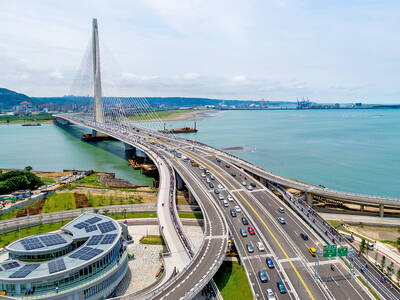
The Ministry of Transportation and Communications yesterday inaugurated the Danjiang Bridge across the Tamsui River in New Taipei City, saying that the structure would be an architectural icon and traffic artery for Taiwan. Feted as a major engineering achievement, the Danjiang Bridge is 920m long, 211m tall at the top of its pylon, and is the longest single-pylon asymmetric cable-stayed bridge in the world, the government’s Web site for the structure said. It was designed by late Iraqi-British architect Zaha Hadid. The structure, with a maximum deck of 70m, accommodates road and light rail traffic, and affords a 200m navigation channel for boats,
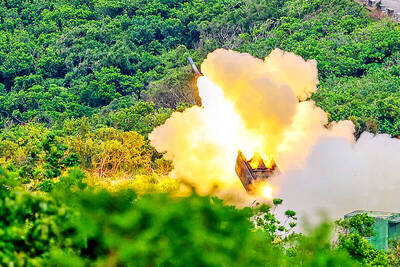
PRECISION STRIKES: The most significant reason to deploy HIMARS to outlying islands is to establish a ‘dead zone’ that the PLA would not dare enter, a source said A High Mobility Artillery Rocket System (HIMARS) would be deployed to Penghu County and Dongyin Island (東引) in Lienchiang County (Matsu) to force the Chinese military to retreat at least 100km from the coastline, a military source said yesterday. Taiwan has been procuring HIMARS and Army Tactical Missile Systems (ATACMS) from the US in batches. Once all batches have been delivered, Taiwan would possess 111 HIMARS units and 504 ATACMS, which have a range of 300km. Considering that “offense is the best defense,” the military plans to forward-deploy the systems to outlying islands such as Penghu and Dongyin so that
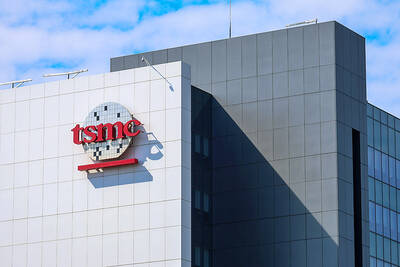
Taiwan Semiconductor Manufacturing Co (TSMC, 台積電), the world’s largest foundry service provider, yesterday said that global semiconductor revenue is projected to hit US$1.5 trillion in 2030, after the figure exceeds US$1 trillion this year, as artificial intelligence (AI) demand boosts consumption of token and compute power. “We are still at the beginning of the AI revolution, but we already see a significant impact across the whole semiconductor ecosystem,” TSMC deputy cochief operating officer Kevin Zhang (張曉強) said at the company’s annual technology symposium in Hsinchu City. “It is fair to say that in the past decade, smartphones and other mobile devices were
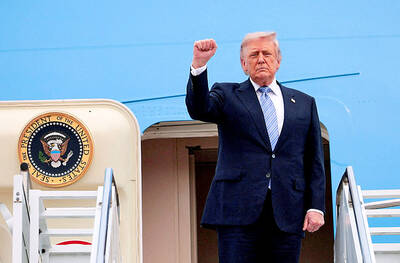
US-CHINA SUMMIT: MOFA welcomed US reassurance of no change in its Taiwan policy; Trump said he did not comment when Xi talked of opposing independence US President Donald Trump yesterday said he has not made a decision on whether to move forward with a major arms package for Taiwan after hearing concerns about it from Chinese President Xi Jinping (習近平). Trump’s comments on Taiwan came as he flew back to Washington after wrapping up critical talks in which both leaders said important progress was made in stabilizing US-China relations even as deep differences persist between the world’s two biggest powers on Iran and Taiwan. “I will make a determination,” Trump said, adding: “I’ll be making decisions. But, you know, I think the last thing we need right


 RSS
RSS