


President-elect William Lai (賴清德) yesterday said that he would push forward the net zero transition, and accelerate geothermal and hydrogenic energy developments after taking office next month.
Lai made the remarks in a prerecorded video played at the opening session of the Earth Solutions 2024 Sustainable Design Action Conference held in Taipei on Earth Day yesterday.
The transition to net zero is an urgent task, and Taiwan must speed up its pace and strengthen its competitiveness in sustainable development to keep up with the global trend, Lai said.
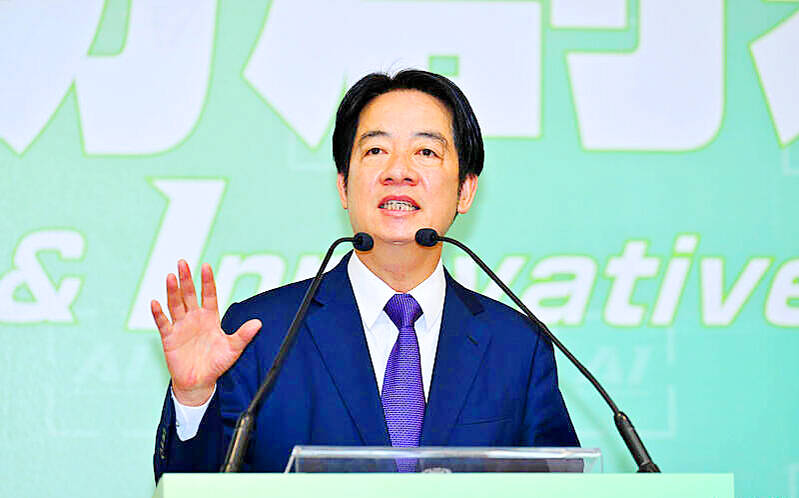
Photo: Chen Yu-fu, Taipei Times
Taiwan has laid a good foundation in the past few years and has competitive advantages, he said, adding that therefore, if the nation makes good use of its advantages in the information and communication technology industry, as well as the strength of its financial sector, it can make swift progress and establish a new international paradigm in facing the challenges of climate change.
He said he would push forward with the net zero transformation using five main strategies.
The first is to initiate a second energy transition by creating a smart and shared green energy strategy, including accelerating the development of geothermal, hydrogenic, biomass and marine energies; and maximizing the use of green energy in Taiwan while at the same time speeding up carbon reduction by implementing carbon capture and storage technologies, he said.
The second is to push the biaxial transformation of the digital and green industries, Lai said, adding that he would use technologies to boost industrial development, establish a net zero innovation and technology platform, build smart energy systems, promote green manufacturing and expand the circular economy.
He also plans to establish a green banking system, improve carbon disclosure, enhance sustainable finance, and speed up industry’s low-carbon transition through carbon pricing and market mechanisms, Lai said.
Third is to promote net zero sustainable green living, including a zero-waste, low-carbon diet, environmentally friendly green fashion, energy saving green buildings, low-carbon transportation networks and promoting buying services instead of buying products, he said, adding that communication with the public is needed to implement a low-carbon lifestyle.
Fourth is to have the government provide strong backing for the net zero transformation, including forming global information advisory groups, industrial technical service teams, setting up digital service platforms and publicizing net zero action guidelines regularly, to assist industries transition to net zero while reducing the negative impact on them, he said.
Fifth is to ensure a “just transition” to net zero, meaning that the government would not leave any industry, company or individual behind in the process of transformation, he added.
Lai said that according to a report by market research firm Kantar Taiwan, 84 percent of consumers want to lead a sustainable lifestyle, but only 27 percent are changing their behavior.
Therefore, how to design more creative and humane systems to reduce the gap between value and action, allowing people to live sustainably without paying a heavy toll in their daily lives, is something that every participant of the conference can help with, he said.
“Let’s find new ways of solving old problems, and good ways of solving new problems,” he said.
Lai, in his capacity as vice president, later yesterday joined President Tsai Ing-wen (蔡英文) at the Presidential Office to meet with representatives of environmental groups.
Lai expressed gratitude for their contribution to environmental protection and pledged his new administration would work with them to safeguard the environment.

‘NO SECURITY RISK’: The Railway Bureau reassured the public that the technicians’ activities were limited to technical guidance and did not involve sensitive systems The Railway Bureau yesterday said it had invited eight Chinese technicians to assist with an airport MRT construction project. The bureau issued the confirmation after an Internet user said Chinese nationals had entered the construction zone of Taiwan Taoyuan International Airport’s Terminal 3 project. They asked why “individuals from an enemy state” were allowed access to such a major national infrastructure project, which raised serious concerns over Taiwan’s industrial safety, sensitive systems and information security. The bureau’s Northern Region Engineering Branch Office said subcontractor Taiwan Handle Industrial Co (台灣手把工業) of the Taoyuan airport MRT’s “Contract No. CU05 Project A14 Station Civil, MEP &

A US uncrewed surface vessel (USV) encountered multiple Chinese warships during an autonomous transit of the Taiwan Strait, US defense company Seasats said in a statement on Wednesday. Seasats announced that a Lightfish USV had completed the first autonomous transit of the Taiwan Strait. Over five days, the USV traversed the entire length of the Strait while constantly monitoring surface vessel traffic, the company said. The Lightfish encountered multiple Chinese warships, one of which was a Chinese People’s Liberation Army Navy (PLAN) Type 056 corvette, it said. The Chinese vessels were operating “well within Taiwan’s exclusive economic zone without transmitting their identity via the
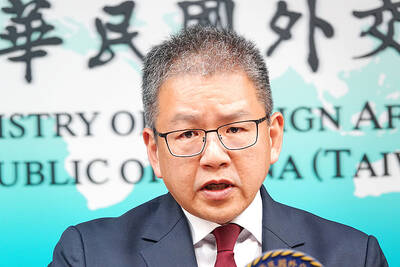
Taiwan is still in the process of assessing the possibility of recruiting workers from Eswatini, the Ministry of Foreign Affairs said yesterday, adding that its goal is to help Eswatini upgrade its vocational training centers. If there are plans to recruit workers from Eswatini, safeguarding national security, protecting public health and ensuring the employment rights of Taiwanese would be prerequisites, Department of West Asian and African Affairs Director-General Yen Chia-liang (顏嘉良) told a news conference. Key considerations would also include filling labor shortages in specific industries, and fostering bilateral professional and technical exchanges, he said. Yen was asked about the progress of labor
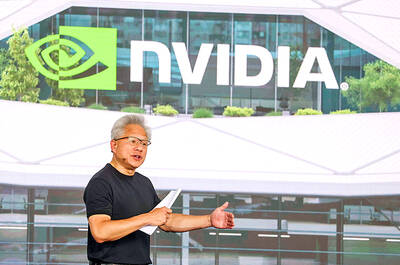
‘BOOMING’: ’ The number of partners we have here is incredible. You can see from their stock prices. They’re doing so well, they’re so happy,’ Jensen Huang said Nvidia Corp’s spending in Taiwan has ballooned to about US$150 billion a year, 10 times the US$10 billion to US$15 billion the company spent five years ago, Nvidia chief executive officer Jensen Huang (黃仁勳) said yesterday, suggesting Taiwan’s strategic importance in the global artificial intelligence (AI) supply chain. “Taiwan is the epicenter of the AI revolution. This is where the chips come, packaging comes. This is where the systems are made. This is where AI supercomputers were created,” Huang said at a meeting for the company’s employees in Beitou-Shilin Technology Park (北投士林科技園區) in Taipei, the planned site of Nvidia’s Taipei headquarters. “Taiwan


 RSS
RSS