


Representative to the US Alexander Yui was invited by US Representative Michael McCaul, chairman of the US House of Representatives Committee on Foreign Affairs, to listen to Japanese Prime Minister Fumio Kishida’s address to the US Congress on Friday, the Taipei Economic and Cultural Representative Office (TECRO) in Washington said.
Before Kishida’s address, Yui visited McCaul and discussed how to promote Taiwan-US cooperation in several fields, TECRO said.
“A pleasure to meet with Ambassador Yui of Taiwan, my guest to @JPN_PMO’s [Kishida] address to Congress today. We discussed additional ways in which the U.S. can support our partner Taiwan and promote greater cooperation and prosperity in the Indo-Pacific,” McCaul wrote on X.

Photo: Screen grab from US Representative Michael McCaul’s X account
Yui responded on X, saying: “Thank you Chairman @RepMcCaul for the kind invitation. I look forward to continue working with you to promote our shared values and common interests in the Indo-Pacific region.”
Kishida’s address at a joint meeting of the US Congress on Friday was titled “For the Future: Our Global Partnership.”
“As the geopolitical landscape changed and as Japan grew in confidence, we expanded our outlook beyond that of being America’s closest ally. We first became a regional partner of the United States, and now we have become your global partner,” Kishida said.

Photo: EPA-EFE
He said freedom and democracy are under threat around the globe.
“China’s current external stance and military actions present an unprecedented and the greatest strategic challenge, not only to the peace and security of Japan but to the peace and stability of the international community at large.”
“Ukraine of today may be East Asia of tomorrow,” he added.

Photo courtesy of the Ministry of Foreign Affairs
In other news, the Taipei Economic and Cultural Office in Canada, the US embassy in Ottawa and the University of Ottawa’s Information Integrity Lab on Friday held a Global Cooperation and Training Framework event titled “Building Democratic Resiliency Against Disinformation: Elections in Taiwan and Beyond” in the capital of Canada.
Opening remarks were given by Representative to Canada Harry Tseng (曾厚仁), US Ambassador to Canada David Cohen and Australian High Commissioner to Canada Scott Ryan.
Tseng said that Canada’s Indo-Pacific Strategy includes countering disinformation as a core issue, and facing complicated cognitive warfare tactics, Taiwan is ready to contribute to defending freedom and democracy with its democratic allies.
Cohen affirmed Taiwan’s achievements in countering disinformation, and quoted US Secretary of State Antony Blinken, who once said that “Taiwan is a powerful affirmation of democracy.”
The US is committed to maintaining cross-strait peace and stability and the peaceful resolution of differences without coercion and pressure, Cohen said, adding that Taiwan-US partnership is based on shared democratic values.
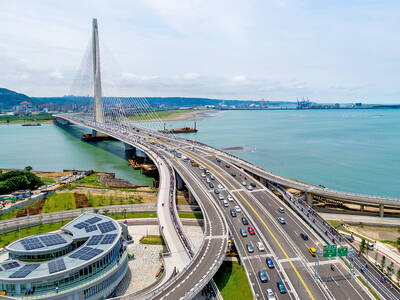
The Ministry of Transportation and Communications yesterday inaugurated the Danjiang Bridge across the Tamsui River in New Taipei City, saying that the structure would be an architectural icon and traffic artery for Taiwan. Feted as a major engineering achievement, the Danjiang Bridge is 920m long, 211m tall at the top of its pylon, and is the longest single-pylon asymmetric cable-stayed bridge in the world, the government’s Web site for the structure said. It was designed by late Iraqi-British architect Zaha Hadid. The structure, with a maximum deck of 70m, accommodates road and light rail traffic, and affords a 200m navigation channel for boats,
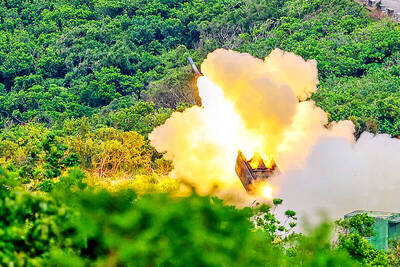
PRECISION STRIKES: The most significant reason to deploy HIMARS to outlying islands is to establish a ‘dead zone’ that the PLA would not dare enter, a source said A High Mobility Artillery Rocket System (HIMARS) would be deployed to Penghu County and Dongyin Island (東引) in Lienchiang County (Matsu) to force the Chinese military to retreat at least 100km from the coastline, a military source said yesterday. Taiwan has been procuring HIMARS and Army Tactical Missile Systems (ATACMS) from the US in batches. Once all batches have been delivered, Taiwan would possess 111 HIMARS units and 504 ATACMS, which have a range of 300km. Considering that “offense is the best defense,” the military plans to forward-deploy the systems to outlying islands such as Penghu and Dongyin so that

Taiwan Semiconductor Manufacturing Co (TSMC, 台積電), the world’s largest foundry service provider, yesterday said that global semiconductor revenue is projected to hit US$1.5 trillion in 2030, after the figure exceeds US$1 trillion this year, as artificial intelligence (AI) demand boosts consumption of token and compute power. “We are still at the beginning of the AI revolution, but we already see a significant impact across the whole semiconductor ecosystem,” TSMC deputy cochief operating officer Kevin Zhang (張曉強) said at the company’s annual technology symposium in Hsinchu City. “It is fair to say that in the past decade, smartphones and other mobile devices were
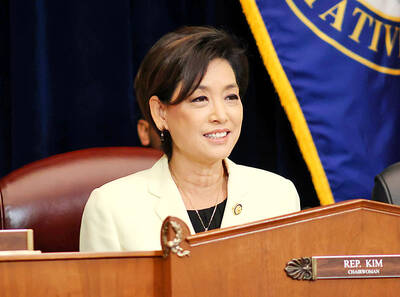
‘CLEAR MESSAGE’: The bill would set up an interagency ‘tiger team’ to review sanctions tools and other economic options to help deter any Chinese aggression toward Taiwan US Representative Young Kim has introduced a bill to deter Chinese aggression against Taiwan, calling for an interagency “tiger team” to preplan coordinated sanctions and economic measures in response to possible Chinese military or political action against Taiwan. “[Chinese President] Xi Jinping [習近平] has directed the People’s Liberation Army to be ready to invade Taiwan by 2027. China has a plan. America should have one too,” Kim said in a news release on Thursday last week. She introduced the “Deter PRC [People’s Republic of China] aggression against Taiwan act” to “ensure the US has a coordinated sanctions strategy ready should


 RSS
RSS