


UPDATE: 5:10pm
The whole of Taiwan was jolted by a magnitude 7.2 earthquake that struck just off the coast of Hualien County at 7:58am on Wednesday, the largest quake to hit the nation in 25 years.
As of 4:30pm, the death toll had reached nine. A total of 821 people were injured, and 127 were still trapped or stranded.
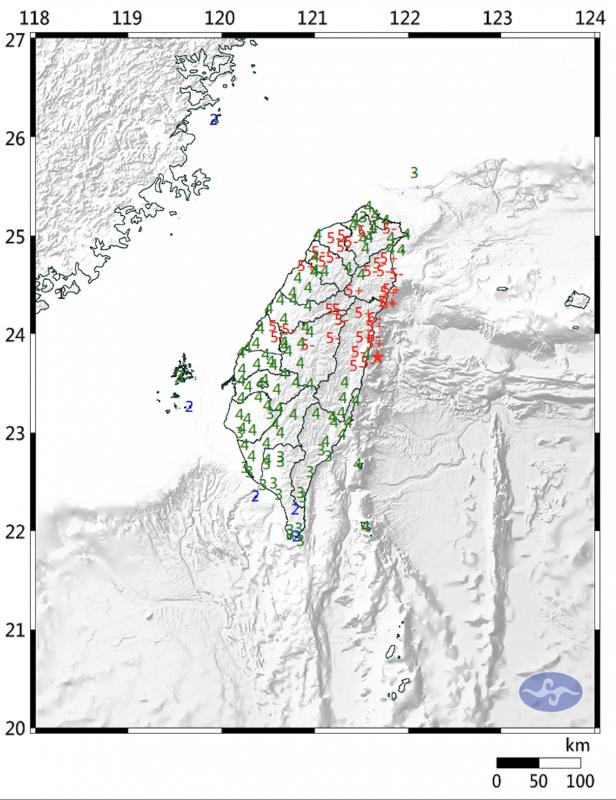
Photo courtesy of the Central Weather Administration
According to the Central Weather Administration (CWA), the epicenter was 25km south-southeast of Hualien County Hall at a depth of 15.5km.
The highest intensity of 6 was felt in Hualien, while Yilan and Miaoli counties registered over 5.
Intensities of just under 5 were felt in Taipei, New Taipei City, Taichung and Taoyuan, as well as Nantou, Hsinchu and Changhua counties.

Photo courtesy of a reader
Most of the rest of the country experienced intensities of 4, even as far south as Pingtung County.
Four people reportedly died after being struck by falling rocks in Taroko National Park, three of the whom were hiking the Dekalun Trail (得卡倫步道).
One other hiker along the Xiaozhuilu Trail (小錐麓步道) was missing.
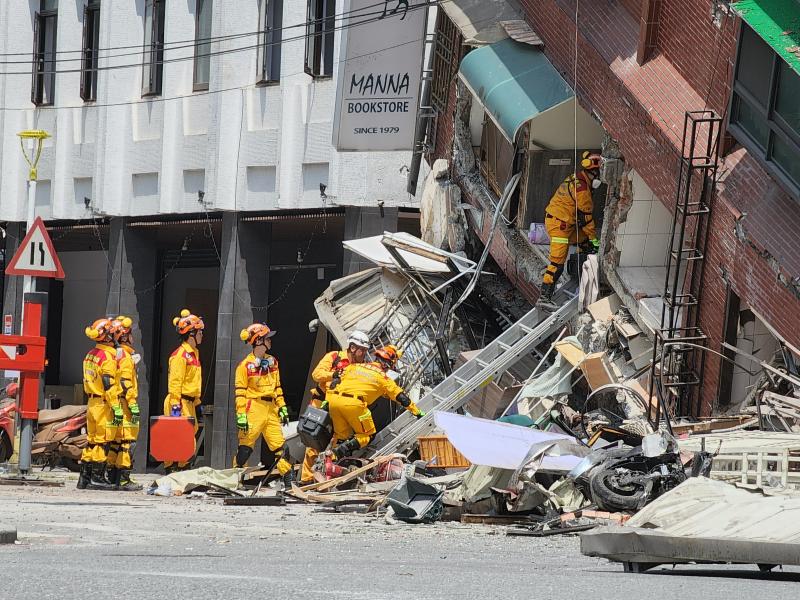
Photo: Hua Meng-ching, Taipei Times
The fourth was accompanying her husband doing roadwork along Provisional Highway No. 8 when rocks fell on her.
Nearby, a truck driver was reportedly killed by a fallen boulder along the Suhua Highway, while another motorist was also hit by falling debris in the Daqingshui Tunnel (大清水隧道).
The seventh casualty was a person working in the Taiwan Cement (台泥) Heren (和仁) mining area who was hit by falling rocks.
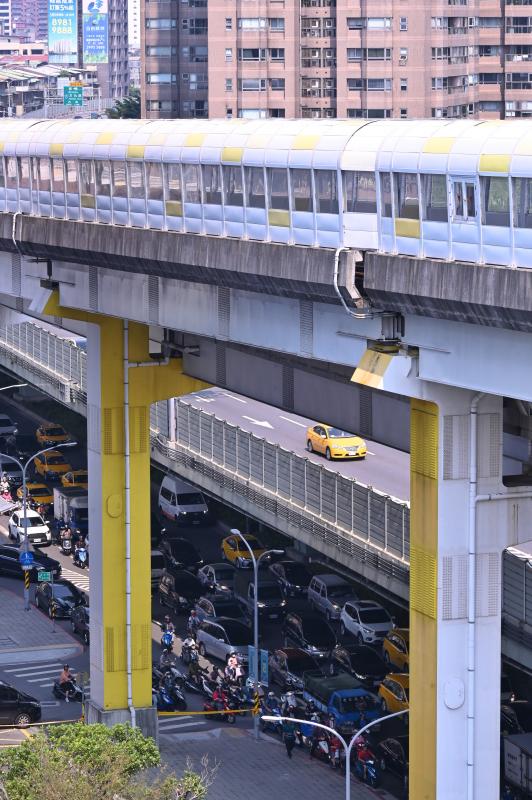
Photo: Liu Hsin-de, Taipei Times
The Hualien County Government announced that school and classes would be suspended on Wednesday following the quake.
Several buildings in Hualien City were tilting at severe angles after the quake, one of which is a large building at the intersection of Zhongshan and Chongqing roads.
Emergency responders had rescued everyone from the building by the late afternoon, but the last person they removed was not showing vital signs.
As of 3:30pm, the Central Emergency Operation Center had reported 28 collapsed buildings: 17 in Hualien, one in Yilan County, two in Keelung and eight in New Taipei City.
AFTERSHOCKS
The CWA warned of the possibility of aftershocks measuring magnitude 6.5 to 7 over the next three to four days.
There were 123 aftershocks recorded as of 4:30pm, nine of which measured between magnitudes 5 and 6, while two exceeded magnitude 6 at 8:11am and 10:14am, CWA data showed.
This morning’s earthquake was felt across Taiwan, as it was both shallow and close to land, CWA Seismological Center Director Wu Chien-fu (吳健富) said.
Initial observations suggest that it was the main quake, although strong aftershocks are possible, Wu said.
This is the strongest earthquake to hit Taiwan since the magnitude 7.3 quake on Sept. 21, 1999, he said, adding that the intensity readings might be adjusted, but it initially appears to be a similar magnitude.
TRANSPORTATION
MRT services in Taipei were suspended for 40 to 60 minutes for routine safety checks, although there were no initial reports of irregularities.
Services on all lines had resumed by 10am.
In New Taipei City, the Department of Rapid Transit Systems said that the Circular Line (Yellow Line) would take a while to repair after the tracks between Zhongyuan and Banxin stations shifted in the quake.
Trains on the line would not restart before the end of the day, so extra bus services would be added, the department said.
The Taichung MRT and high-speed rail also suspended services temporarily along the entire line.
On the Taiwan Railway, the stretch from Yilan County’s Jiaosi Township (礁溪) to Fonglin Township (鳳林) in Hualien County is closed due to damage.
The eastern branch of the Highway Bureau said that parts of the Suhua Highway from Yilan’s Suao Township (蘇澳) to Hualien’s Chongde (崇德) area were closed, as well as the Central Cross-Island Highway from Dayuling Pass (大禹嶺) to Taroko.
A tsunami warning has been issued in Japan’s Okinawa and several provinces in the Philippines.

PROVOCATIVE: Chinese Deputy Ambassador to the UN Sun Lei accused Japan of sending military vessels to deliberately provoke tensions in the Taiwan Strait China denounced remarks by Japan and the EU about the South China Sea at a UN Security Council meeting on Monday, and accused Tokyo of provocative behavior in the Taiwan Strait and planning military expansion. Ayano Kunimitsu, a Japanese vice foreign minister, told the Council meeting on maritime security that Tokyo was seriously concerned about the situation in the East China and South China seas, and reiterated Japan’s opposition to any attempt to change the “status quo” by force, and obstruction of freedom of navigation and overflight. Stavros Lambrinidis, head of the EU delegation to the UN, also highlighted South China Sea
The final batch of 28 M1A2T Abrams tanks purchased from the US arrived at Taipei Port last night and were transported to the Armor Training Command in Hsinchu County’s Hukou Township (湖口), completing the military’s multi-year procurement of 108 of the tanks. Starting at 12:10am today, reporters observed more than a dozen civilian flatbed trailers departing from Taipei Port, each carrying an M1A2T tank covered with black waterproof tarps. Escorted by military vehicles, the convoy traveled via the West Coast Expressway to the Armor Training Command, with police implementing traffic control. The army operates about 1,000 tanks, including CM-11 Brave Tiger

Taiwan Semiconductor Manufacturing Co (TSMC, 台積電), the world’s largest contract chipmaker, said it expects its 2-nanometer (2nm) chip capacity to grow at a compound annual rate of 70 percent from this year to 2028. The projection comes as five fabs begin volume production of 2-nanometer chips this year — two in Hsinchu and three in Kaohsiung — TSMC senior vice president and deputy cochief operating officer Cliff Hou (侯永清) said at the company’s annual technology symposium in Silicon Valley, California, last week. Output in the first year of 2-nanometer production, which began in the fourth quarter of last year, is expected to

Taiwan’s drone exports surged past US$100 million in the first quarter, exceeding last year’s full-year total, with the Czech Republic emerging as the largest buyer, the Ministry of Economic Affairs said. Exports of complete drones reached US$115.85 million in the period, about 1.2 times the total recorded for all of last year, the ministry said in a report. Exports to the Czech Republic accounted for about US$100 million, far outpacing other markets. Poland, last year’s top destination, recorded about US$11.75 million in the first quarter. Taiwan’s drone exports have expanded rapidly in the past few years, with last year’s total


 RSS
RSS