


President-elect William Lai (賴清德) and vice president-elect Hsiao Bi-khim (蕭美琴) yesterday received a briefing on the nation’s defense posture at the Ministry of National Defense as part of preparations for their inauguration on May 20.
On Thursday last week, the pair also visited the Chungshan Institute of Science and Technology, where they were briefed on the nation’s indigenous arms production, including weapons platforms and missiles.
Citing an anonymous source, the Central News Agency said that Lai and Hsiao yesterday met Minister of National Defense Chiu Kuo-cheng (邱國正) and Chief of the General Staff Admiral Mei Chia-shu (梅家樹) before inspecting the Armed Forces Joint Command Center.
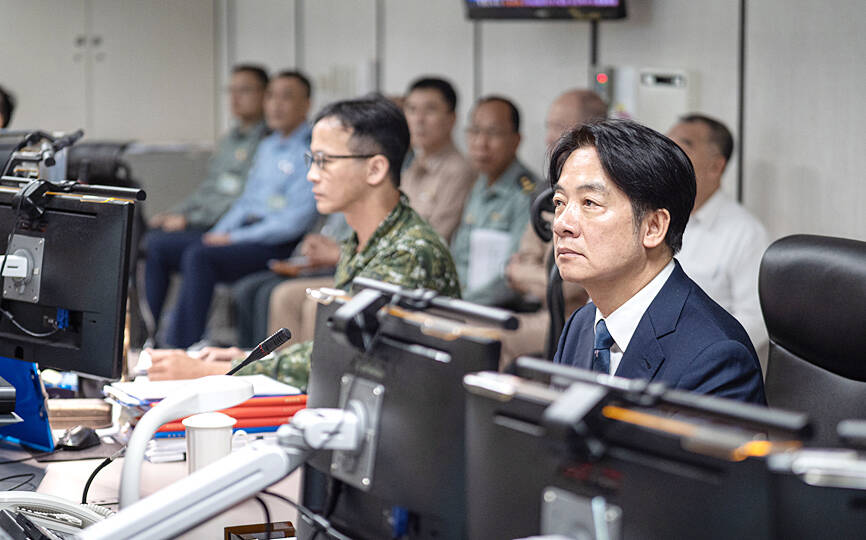
Photo courtesy of the Presidential Office
Lai, Hsiao and top defense officials discussed the military’s strategy and plans for an hour at a briefing at the command center, the source was cited as saying.
The content of the briefing was in line with Chiu’s report on Monday about the ministry’s plans at a meeting of the legislature’s Foreign Affairs and National Defense Committee, they were cited as saying.
An apparent information leak to the media said that retired vice admiral Lee Chung-wei (李仲威) — who is said to be under consideration for minister of national defense — would attend the briefing with Lai at the command center.
A ministry spokesperson told the Chinese-language United Daily News that Lee was not on the list of personnel attending the briefing, but declined to elaborate on what that meant.
Earlier yesterday, Lai visited the machine tool industry conference hosted by Aerospace Industrial Development Corp (AIDC, 漢翔航空工業) in Taipei.
Lai told industry representatives that the machine tool sector is the backbone that underpins Taiwan’s economy, and the incoming administration would take note of their opinions, the Presidential Office said in a news release.
Military defense and the economy are the twin pillars that protect Taiwan’s security, Lai was cited as saying, adding that he has met with and consulted leaders of crucial or emerging industries that are vital to the nation’s economy.
They include leaders of the semiconductor, information and communications technology, uncrewed aerial vehicle, cybersecurity and tourism sectors, Lai said.
Taiwan’s machine tool exports last year totaled US$29.5 billion, down 15 percent from the previous year due to adverse global economic and geopolitical factors, but the industry has since January returned to growth, Lai said.
A meeting with representatives of the machine tool industry would be arranged shortly after the presidential inauguration, he said.
Lai was briefed on the sector’s developments by Industrial Development Administration Director-General Lien Ching-chang (連錦漳) and discussed carbon emissions, energy conservation, exports and emerging markets with industry leaders, the Presidential Office said.
Lai also toured the AIDC composite materials center and the production line for AIDC T-5 Brave Eagle trainer jets, it said.

‘NO SECURITY RISK’: The Railway Bureau reassured the public that the technicians’ activities were limited to technical guidance and did not involve sensitive systems The Railway Bureau yesterday said it had invited eight Chinese technicians to assist with an airport MRT construction project. The bureau issued the confirmation after an Internet user said Chinese nationals had entered the construction zone of Taiwan Taoyuan International Airport’s Terminal 3 project. They asked why “individuals from an enemy state” were allowed access to such a major national infrastructure project, which raised serious concerns over Taiwan’s industrial safety, sensitive systems and information security. The bureau’s Northern Region Engineering Branch Office said subcontractor Taiwan Handle Industrial Co (台灣手把工業) of the Taoyuan airport MRT’s “Contract No. CU05 Project A14 Station Civil, MEP &

A US uncrewed surface vessel (USV) encountered multiple Chinese warships during an autonomous transit of the Taiwan Strait, US defense company Seasats said in a statement on Wednesday. Seasats announced that a Lightfish USV had completed the first autonomous transit of the Taiwan Strait. Over five days, the USV traversed the entire length of the Strait while constantly monitoring surface vessel traffic, the company said. The Lightfish encountered multiple Chinese warships, one of which was a Chinese People’s Liberation Army Navy (PLAN) Type 056 corvette, it said. The Chinese vessels were operating “well within Taiwan’s exclusive economic zone without transmitting their identity via the
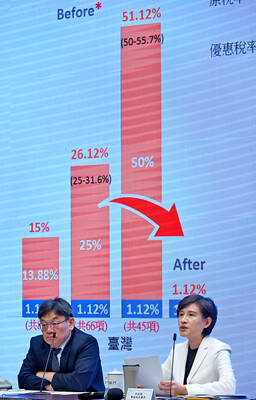
GREATER REACH? Auto parts and wood products would face tariffs of up to 15%, matching those targeting the EU, Japan and South Korea, Vice Premier said The US has announced that preferential tariff treatment for Taiwan’s non-semiconductor Section 232 goods would take effect retroactively from May 1, the Executive Yuan said yesterday. The US government yesterday posted a notice on the Federal Register’s public inspection Web site previewing tariff concessions for Taiwan under a memorandum of understanding (MOU) on Taiwan-US investment after two months of negotiations. The MOU signed on Jan. 15 stipulated three major preferential tariff arrangements: a 15 percent “reciprocal” tariff rate for Taiwan without stacking most-favored nation (MFN) rates; preferential Section 232 treatment for semiconductors and related products; and preferential Section 232 treatment for non-semiconductor

The National Chungshan Institute of Science and Technology yesterday showcased its locally developed variants of the Vision 60 robotic patrol dog, which it plans to deploy on the nation’s outlying territories in the South China Sea. The variants were produced under the Joint Lab project — created by the institute and domestic companies — and assembled with domestically produced motors, lenses and artificial intelligence (AI) systems alongside licensed tech from the US, Missile and Rocket Systems Research Division deputy director Jen Kuo-kang (任國光) told the media event at a military base in Taipei’s Dazhi (大直) area. Taiwan has built up its strengths


 RSS
RSS