


Former president Ma Ying-jeou (馬英九) is to lead a delegation to China next month, his foundation announced yesterday, adding that Ma has not made any arrangements to meet with Chinese officials at this point.
The visit, which would be Ma’s second to China as a civilian, has been arranged amid heightened cross-strait tensions caused by the death of Chinese fishers during a pursuit by a coast guard vessel in waters around Kinmen County.
Foundation executive director Hsiao Hsu-tsen (蕭旭岑) said Beijing invited Ma.
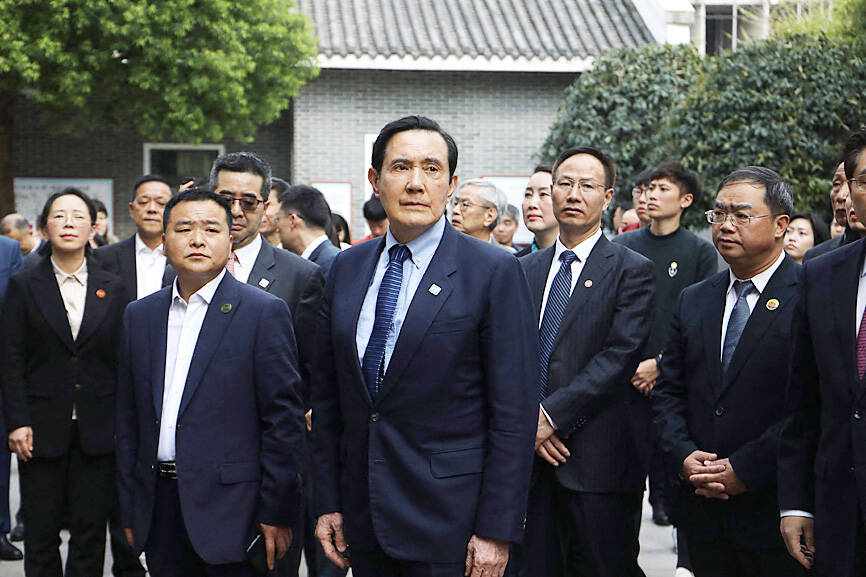
Photo: AFP / Ma Ying-jeou’s Office
The delegation, which would consist mainly of 20 students participating in the foundation’s leadership program, is to leave for China on Monday next week and return on April 11, he said.
The delegation is to visit tourist attractions and corporations in Beijing, as well as in Guangdong and Shaanxi provinces, Hsiao said.
Aside from attending an annual ceremony at the Mausoleum of the Yellow Emperor on Tomb Sweeping Day, Ma and the delegates would have academic exchanges with students at Beijing University and Sun Yat-sen University in Guangdong Province, he said.
Asked about the timing of the tour and whether Ma would meet with Chinese President Xi Jinping (習近平) while in Beijing, Hsiao said that Ma’s visit to China last year occurred at about the same time, adding that the foundation did not have any special consideration about the timing of this year’s visit.
“It has been nine years since the leaders of Taiwan and China met in Singapore. Of course, we hope that old friends could meet, but we respect China’s arrangement in this regard. As guests, we would accept the arrangement and reception that the host has made available for us,” Hsiao said.
Hsiao also reiterated Ma’s belief that exchanges between Taiwanese and Chinese students would help de-escalate cross-strait tensions and lower the possibility for conflict.
Separately yesterday, China’s Taiwan Affairs Office issued a statement welcoming Ma’s planned visit and confirming his itinerary.
Democratic Progressive Party (DPP) Legislator Rosalia Wu (吳思瑤), who also serves as the DPP caucus secretary-general, yesterday said that given the Chinese Nationalist Party’s (KMT) recent push to have President Tsai Ing-wen (蔡英文) visit Itu Aba Island (Taiping Island, 太平島), she hoped Ma would use the trip to “declare sovereignty” over the Taiwan-controlled island, which is also claimed by China, Vietnam and the Philippines.
“We respect the decisions of KMT leaders to visit China, but we want to remind them to be cautious about the people they meet and the statements they make. They should not go against mainstream public opinion by helping China suppress Taiwan,” she said.
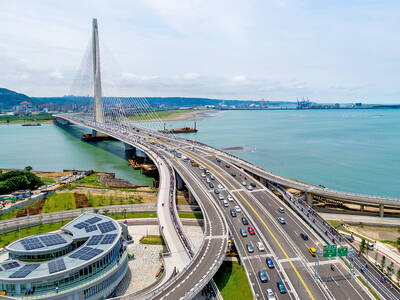
The Ministry of Transportation and Communications yesterday inaugurated the Danjiang Bridge across the Tamsui River in New Taipei City, saying that the structure would be an architectural icon and traffic artery for Taiwan. Feted as a major engineering achievement, the Danjiang Bridge is 920m long, 211m tall at the top of its pylon, and is the longest single-pylon asymmetric cable-stayed bridge in the world, the government’s Web site for the structure said. It was designed by late Iraqi-British architect Zaha Hadid. The structure, with a maximum deck of 70m, accommodates road and light rail traffic, and affords a 200m navigation channel for boats,
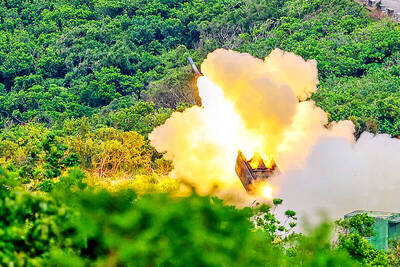
PRECISION STRIKES: The most significant reason to deploy HIMARS to outlying islands is to establish a ‘dead zone’ that the PLA would not dare enter, a source said A High Mobility Artillery Rocket System (HIMARS) would be deployed to Penghu County and Dongyin Island (東引) in Lienchiang County (Matsu) to force the Chinese military to retreat at least 100km from the coastline, a military source said yesterday. Taiwan has been procuring HIMARS and Army Tactical Missile Systems (ATACMS) from the US in batches. Once all batches have been delivered, Taiwan would possess 111 HIMARS units and 504 ATACMS, which have a range of 300km. Considering that “offense is the best defense,” the military plans to forward-deploy the systems to outlying islands such as Penghu and Dongyin so that
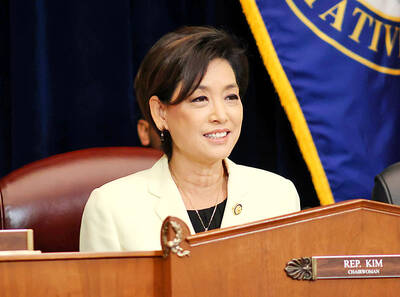
‘CLEAR MESSAGE’: The bill would set up an interagency ‘tiger team’ to review sanctions tools and other economic options to help deter any Chinese aggression toward Taiwan US Representative Young Kim has introduced a bill to deter Chinese aggression against Taiwan, calling for an interagency “tiger team” to preplan coordinated sanctions and economic measures in response to possible Chinese military or political action against Taiwan. “[Chinese President] Xi Jinping [習近平] has directed the People’s Liberation Army to be ready to invade Taiwan by 2027. China has a plan. America should have one too,” Kim said in a news release on Thursday last week. She introduced the “Deter PRC [People’s Republic of China] aggression against Taiwan act” to “ensure the US has a coordinated sanctions strategy ready should

Taiwan Semiconductor Manufacturing Co (TSMC, 台積電), the world’s largest foundry service provider, yesterday said that global semiconductor revenue is projected to hit US$1.5 trillion in 2030, after the figure exceeds US$1 trillion this year, as artificial intelligence (AI) demand boosts consumption of token and compute power. “We are still at the beginning of the AI revolution, but we already see a significant impact across the whole semiconductor ecosystem,” TSMC deputy cochief operating officer Kevin Zhang (張曉強) said at the company’s annual technology symposium in Hsinchu City. “It is fair to say that in the past decade, smartphones and other mobile devices were


 RSS
RSS