


Australian Minister of Foreign Affairs Penny Wong (黃英賢) yesterday expressed her government’s “desire for peace and stability across the Taiwan Strait” in her meeting with Chinese Minister of Foreign Affairs Wang Yi (王毅) in Canberra.
Australia and China, its largest trading partner, are rebuilding ties after a period of strained relations that hit a low in 2020 after Canberra called for an independent investigation into the origin of COVID-19.
Beijing responded by imposing tariffs on billions of dollars of Australian commodity imports, most of which have been lifted since a change of government in Canberra two years ago.

Photo: EPA-EFE
“I look forward to speaking frankly with you about Australians detained in China, human rights, maritime security and safety, as well as regional and international issues, such as the Pacific, Russia’s invasion of Ukraine and the conflict in the Middle East,” Wong said in her opening remarks.
After the meeting, she addressed Chinese and Australian reporters and said the two nations would work to prepare for a visit by Chinese Premier Li Qiang (李強) this year, emphasizing the importance of face-to-face diplomacy to better understand each other.
Australia and China would expand dialogue on the Pacific, and on climate and energy cooperation, Wong said.
“I expressed our serious concern about unsafe conduct at sea, our desire for peace and stability across the Taiwan Strait and in our region,” she said, a reference to friction with China’s navy in the South China Sea.
Regarding China’s sovereignty, dignity and concerns, including Taiwan, Wang said in a in a statement released by the Chinese Ministry of Foreign Affairs that Beijing hopes Canberra would continue to honor the commitments it has made since the establishment of diplomatic relations, and respect and properly handle them.
Beijing’s and Canberra’s interests far outweigh the differences, Wang said, adding that the countries do not have a historical grudge or a fundamental conflict of interest.
“Both sides should adhere to the fundamental principles of international law, such as respecting national sovereignty and territorial integrity,” he said.
Wong said she raised the case of Yang Hengjun (楊恒均), an Australian writer who was given a suspended death sentence by a Beijing court last month, and told Wang that Australians were shocked by the sentence.
In another sign diplomacy was back on track, Wong said it was likely two pandas on loan from China since 2009, and due to return this year, would have their stay in her home city of Adelaide extended.
“We are on a good path there to continued panda presence,” she told reporters after the meeting.

‘NO SECURITY RISK’: The Railway Bureau reassured the public that the technicians’ activities were limited to technical guidance and did not involve sensitive systems The Railway Bureau yesterday said it had invited eight Chinese technicians to assist with an airport MRT construction project. The bureau issued the confirmation after an Internet user said Chinese nationals had entered the construction zone of Taiwan Taoyuan International Airport’s Terminal 3 project. They asked why “individuals from an enemy state” were allowed access to such a major national infrastructure project, which raised serious concerns over Taiwan’s industrial safety, sensitive systems and information security. The bureau’s Northern Region Engineering Branch Office said subcontractor Taiwan Handle Industrial Co (台灣手把工業) of the Taoyuan airport MRT’s “Contract No. CU05 Project A14 Station Civil, MEP &

A US uncrewed surface vessel (USV) encountered multiple Chinese warships during an autonomous transit of the Taiwan Strait, US defense company Seasats said in a statement on Wednesday. Seasats announced that a Lightfish USV had completed the first autonomous transit of the Taiwan Strait. Over five days, the USV traversed the entire length of the Strait while constantly monitoring surface vessel traffic, the company said. The Lightfish encountered multiple Chinese warships, one of which was a Chinese People’s Liberation Army Navy (PLAN) Type 056 corvette, it said. The Chinese vessels were operating “well within Taiwan’s exclusive economic zone without transmitting their identity via the
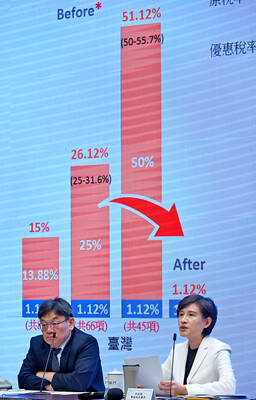
GREATER REACH? Auto parts and wood products would face tariffs of up to 15%, matching those targeting the EU, Japan and South Korea, Vice Premier said The US has announced that preferential tariff treatment for Taiwan’s non-semiconductor Section 232 goods would take effect retroactively from May 1, the Executive Yuan said yesterday. The US government yesterday posted a notice on the Federal Register’s public inspection Web site previewing tariff concessions for Taiwan under a memorandum of understanding (MOU) on Taiwan-US investment after two months of negotiations. The MOU signed on Jan. 15 stipulated three major preferential tariff arrangements: a 15 percent “reciprocal” tariff rate for Taiwan without stacking most-favored nation (MFN) rates; preferential Section 232 treatment for semiconductors and related products; and preferential Section 232 treatment for non-semiconductor

The National Chungshan Institute of Science and Technology yesterday showcased its locally developed variants of the Vision 60 robotic patrol dog, which it plans to deploy on the nation’s outlying territories in the South China Sea. The variants were produced under the Joint Lab project — created by the institute and domestic companies — and assembled with domestically produced motors, lenses and artificial intelligence (AI) systems alongside licensed tech from the US, Missile and Rocket Systems Research Division deputy director Jen Kuo-kang (任國光) told the media event at a military base in Taipei’s Dazhi (大直) area. Taiwan has built up its strengths


 RSS
RSS