


The tabletop portion of this year’s Han Kuang military exercises are to take place over eight days, matching the previous lengthiest exercises held in 2021, a Ministry of National Defense report to the Legislative Yuan said yesterday.
Minister of National Defense Chiu Kuo-cheng (邱國正) is scheduled to report to the legislature’s Foreign and National Defense Committee today.
According to information provided to lawmakers ahead of the meeting, the 40th edition of the Han Kuang computerized war games to be held this year are to last eight days and seven nights.
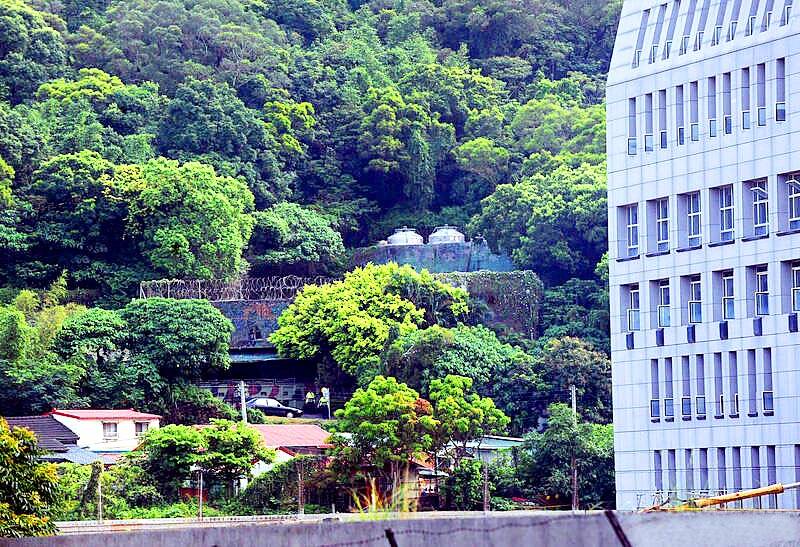
Photo: Aaron Tu, Taipei Times
The goal of the Joint Theater Level Simulation exercises is to verify the military’s response to gray-zone tactics, procedures during each stage of operations and commanders’ operational decisionmaking, the information says.
The annual Han Kuang exercises are run in two phases, with the computerized tabletop portion informing the planning of the later live-fire exercises.
In past years, the first portion typically lasted five to eight days.
The 2021 edition was also held over eight days and seven nights, applying the “most stringent standards” to a “complex campaign.”
Last year, scenarios informed by the war in Ukraine were incorporated in simulated war games lasting five days and four nights.
In related news, jet flight training is to be extended from 9pm to past midnight, the air force headquarters said on Tuesday, as it seeks to improve pilots’ nighttime flying skills.
The first models and bases to implement the new training schedule are the Indigenous Defense Fighters in Tainan, Mirage 2000 jets in Hsinchu and F-16s in Hualien, notices sent by the air force said.
The units on Tuesday called or messaged nearby residents to inform them of the change and apologize for the inconvenience caused by the noise.
The headquarters announced the change in a statement later that evening and urged the public to continue to support the air force as it trains to safeguard the nation’s airspace.
Speaking to legislators yesterday, Veterans Affairs Council Minister Feng Shih-kuan (馮世寬) said that the air force used to frequently run training after midnight.
The minister said that when he was in charge of an air force unit in Tainan in 1993, the public requested that no jets take off after 9pm to avoid disrupting sleep.
However, residents have in recent years come to side with the military, understanding that the sound means the air force is engaging in important national defense tasks, Feng said.
The change comes as the Chinese military ramps up patrols near the median line of the Taiwan Strait and runs tactical drills to the nation’s southwest, day and night.
Chinese warships also frequently sail to the waters east and southeast of Taiwan proper, carrying helicopters that sometimes run drills.
Experts viewed the training enhancements positively, but urged the military to also emphasize troop management and maintenance to ensure safety.
As Chinese tactics to pressure Taiwan have diversified, so must the military’s training, said Lin Yin-yu (林穎佑), an assistant professor at Tamkang University’s Graduate Institute of International Affairs and Strategic Studies.
However, as training becomes more complex, it is necessary for management to consider changes to labor, materials and pilot rest time, he said.
Additional reporting by CNA
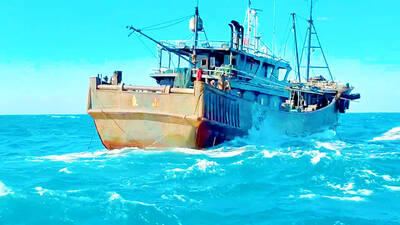
MAKING WAVES: China’s maritime militia could become a nontraditional threat in war, clogging up shipping lanes to prevent US or Japanese intervention, a report said About 1,900 Chinese ships flying flags of convenience and fishing vessels that participated in China’s military exercises around Taiwan last month and in January have been listed for monitoring, Coast Guard Administration (CGA) Deputy Director-General Hsieh Ching-chin (謝慶欽) said yesterday. Following amendments to the Commercial Port Act (商港法) and the Law of Ships (船舶法) last month, the CGA can designate possible berthing areas or deny ports of call for vessels suspected of loitering around areas where undersea cables can be accessed, Oceans Affairs Council Minister Kuan Bi-ling (管碧玲) said. The list of suspected ships, originally 300, had risen to about 1,900 as

Japan’s strategic alliance with the US would collapse if Tokyo were to turn away from a conflict in Taiwan, Japanese Prime Minister Sanae Takaichi said yesterday, but distanced herself from previous comments that suggested a possible military response in such an event. Takaichi expressed her latest views on a nationally broadcast TV program late on Monday, where an opposition party leader criticized her for igniting tensions with China with the earlier remarks. Ties between Japan and China have sunk to the worst level in years after Takaichi said in November that a hypothetical Chinese attack on Taiwan could bring about a Japanese
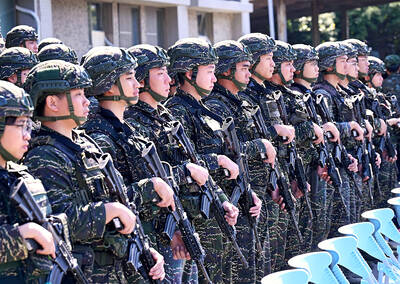
MORE RESPONSIBILITY: Draftees would be expected to fight alongside professional soldiers, likely requiring the transformation of some training brigades into combat units The armed forces are to start incorporating new conscripts into combined arms brigades this year to enhance combat readiness, the Executive Yuan’s latest policy report said. The new policy would affect Taiwanese men entering the military for their compulsory service, which was extended to one year under reforms by then-president Tsai Ing-wen (蔡英文) in 2022. The conscripts would be trained to operate machine guns, uncrewed aerial vehicles, anti-tank guided missile launchers and Stinger air defense systems, the report said, adding that the basic training would be lengthened to eight weeks. After basic training, conscripts would be sorted into infantry battalions that would take
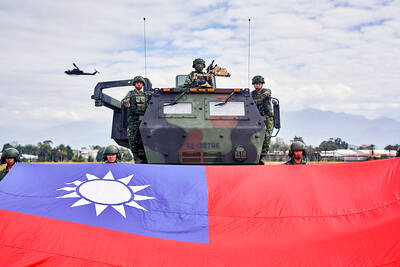
DEEP-STRIKE CAPABILITY: The scenario simulated a PLA drill that turned into an assault on Taiwan’s critical infrastructure, with the launchers providing fire support Taiwan yesterday conducted this year’s first military exercises at Longsiang Base in Taichung, demonstrating the newly acquired High Mobility Artillery Rocket System’s (HIMARS) ability to provide fire support and deep-strike capabilities. The scenario simulated an attack on Penghu County, with HIMARS trucks immediately rolling into designated launch areas and firing barrages at the Wangan (望安) and Cimei (七美) islands, simulating the provision of fire support against invading forces. The HIMARS are supposed to “fire and leave,” which would significantly increase personnel and equipment survivability, a military official said. The drill simulated an exercise launched by the Chinese People’s Liberation Army (PLA) Eastern


 RSS
RSS