

The strategic partnership between Manila and Canberra is more important than ever, with the rule of law and regional peace under threat from China, Philippine President Ferdinand Marcos Jr told the Australian parliament yesterday.
Marcos told a special joint sitting of the two chambers during a state visit that the Philippines would not allow a foreign power to “take even one square inch of our sovereign territory.”
It is a declaration he has often repeated since taking office in 2022 and refers to China’s disputed claims to territory in the South China Sea that Taiwan also claims.

Photo: AFP
Marcos said that Australia and the Philippines need to band together against new challenges to the region’s peace and stability, as they had against Japanese forces during World War II.
“Not one single country can do this by itself. No single force can counter them by themselves,” Marcos said.
“This is why our strategic partnership has grown more important than ever,” he added.
Marcos said that his father, former Philippine president Ferdinand Marcos, and then-Australian prime minister Gough Whitlam reaffirmed that the security of their two countries was bound together in 1974 when they toured the Philippines’ wartime battlefields of Bataan and Corregidor.
Australia and the Philippines for the first time conducted joint sea and air patrols in the South China Sea in November last year.
Marcos Jr said that the Philippines and Australia fought to build a rules-based international order after the war and that they must now fight to protect that order in the South China Sea.
“The protection of the South China Sea as a vital, critical global artery is crucial to the preservation of regional peace and, I dare say, of global peace,” he said.
Australian Prime Minister Anthony Albanese reminded Marcos Jr of his words when the leaders last met: “Prosperity and progress dependent on peace.”
“That is what is so significant about the maritime cooperation activities our two navies completed together for the first time in November last year,” Albanese said. “Our cooperation is an assertion of our national interest and a recognition of our regional responsibility.”
Marcos Jr’ address was interrupted briefly by Australian Senator Janet Rice, who held up a sign that read: “Stop human rights abuses,” an apparent protest against the Philippines’ record on rights.
Rice was later censured by a majority of her colleagues in the Senate with a motion that disapproved of her “unparliamentary and disrespectful conduct” in her protest, and her “disregard for the importance of Australia-Philippines relations.”
The censure is symbolic and carries no consequences for Rice.
Marcos Jr and Albanese also announced new agreements on maritime cooperation, cybersecurity and fair-trade regulation.
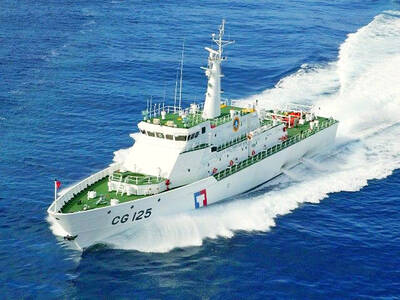
GEOPOLITICAL SIGNIFICANCE: The CGA’s nonmilitary role makes it a tool to avert diplomatic issues, an official said, while confirming the donation of a ship to Manila Coast Guard Administration (CGA) ships are scheduled to sail to the Philippines bearing the words “Taiwan Coast Guard” in a high-profile visit in October next year, the first such visit by a Taiwanese maritime law enforcement vessel to the Southeast Asian nation, the agency said yesterday. The CGA also confirmed that it had donated one of its decommissioned patrol vessels to the Philippines in a rare transfer of a retired ship to a nondiplomatic ally. The Republic of China (ROC) Navy last made such a visit in 1974, shortly before the Philippines switched diplomatic recognition to the People’s Republic of China in
CALL FOR CHANGE: They urged the UN to facilitate Taiwan’s involvement in the body, recognize its peace efforts and to work with members in preventing military conflict Representatives to the UN from five of Taiwan’s diplomatic allies sent a joint letter to UN Secretary-General Antonio Guterres on Friday, calling for the country’s inclusion in the body. Allies in the letter sent ahead of the 81st session of the UN General Assembly General Debate made three demands in support of Taiwan: inclusion, recognition and camaraderie. They implored the UN to seek an appropriate way to facilitate Taiwan’s meaningful involvement in the world governing body, saying that UN Resolution 2758, which accepted the People’s Republic of China (PRC) as a member of the UN, does not exclude Taiwan. Beijing claims that the

‘GLOBAL WARNING’: The infiltration is not just a local problem, as Beijing has been deploying the same tactics worldwide against Western democracies, a report said Between 50,000 and 100,000 Chinese spies are operating in Taiwan, far more than the National Security Bureau’s previous estimate of 5,000, German journalist and author Jurgen Kremb said on Monday. Kremb presented his research, titled “The War of Spies: How China’s Intelligence Services Are Infiltrating Taiwan — and What Europe Must Learn from It,” at a joint event held by the Taiwan offices of the Friedrich Naumann Foundation and the European Values Center for Security Policy. The report was published in June in the Ministry of Justice Investigation Bureau’s Prospect & Exploration Monthly (展望與探索月刊). By spies, he said he was referring to informants,

SOFT TENNIS: Yu Kai-wen and Huang Shih-yuan narrowly defeated their Japanese rivals to capture Taiwan’s first gold at the Asian Games in Nagoya Yu Kai-wen (余凱文) and Huang Shih-yuan (黃詩媛) won Taiwan’s first gold of this year’s Asian Games, defeating a Japanese duo in a nail-biter in the soft tennis mixed doubles final in Nagoya, Japan, while Johnny Sun (孫家閎) won silver in wushu and Shih Cheng-chung (石政中) won bronze in men’s kumite. Yu and Huang narrowly defeated Japan’s Toshiki Uematsu and Rena Temma 5-4 (2-4, 5-3, 4-2, 1-4, 1-4, 4-0, 1-4, 4-1, 7-5) to give Taiwan its first gold in soft tennis mixed doubles at an Asian Games since 2018. Sun secured Taiwan’s first wushu medal at this year’s game, with a combined score


 RSS
RSS