

The Cabinet yesterday approved a bill that if promulgated would allow Taiwanese to vote in national referendums from outside their constituencies.
The bill, proposed by the Central Election Commission (CEC), would apply to people in Taiwan who are unable or unwilling to return to the place of their household registration, but would not include Taiwanese living overseas.
People who want to vote away from their home constituency would have to apply to the CEC in writing or online for permission to vote in absentia in a referendum a minimum of 60 days before the vote, the draft says.
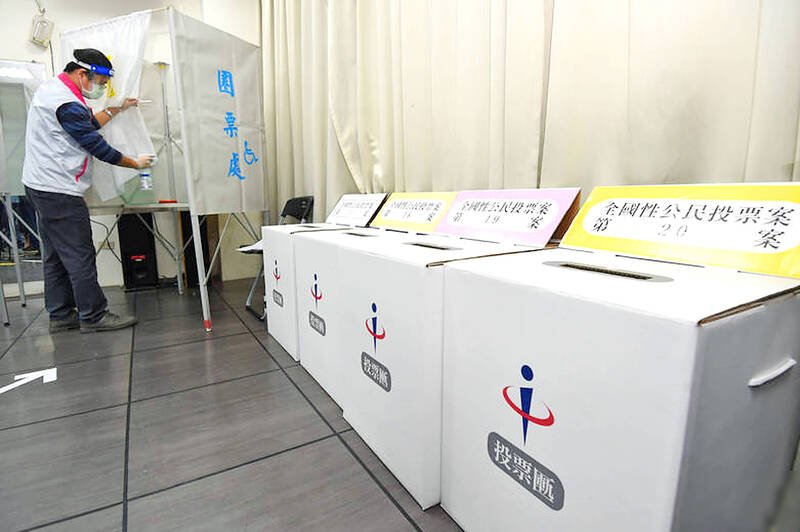
Photo: Taipei Times
The CEC first submitted the bill to the Cabinet in 2020, in accordance with Article 25 of the Referendum Act (公民投票法), which states that absentee voting may be allowed during a national referendum, once it is prescribed in a separate law.
The bill failed to clear the legislative floor before the previous legislature ended its four-year term on Jan. 31, making it necessary to propose the bill again.
Once people complete their registration, the local branch of the CEC would compile a list of absentee voting applicants 55 days ahead of the vote, the bill says.
Household registration offices would inspect the list 50 days before the vote, informing applicants of the outcome of their application, it says.
Those who are approved would have their registration temporarily transferred to the household registration office in the constituency from where they applied 45 days ahead of the vote and their names would be published 15 days before the referendum, it says.
On the day of the referendum, they would be able to cast absentee ballots at the transferred voting station, the bill says.
CEC Vice Chairman Chen Chao-chien (陳朝建) told a news conference after the weekly Cabinet meeting that absentee voting would first be permitted for national referendums, with elections to be a consideration for later.
A law to allow absentee voting would be able to reference experience gained from its implementation in national referendums once a stable procedure is built for it, Chen said.
UNITY: Lai thanked the nations who spoke up for Taiwan, saying that democracies must stand together to face global authoritarian expansion Taiwan yesterday thanked eight European and Indo-Pacific countries for opposing unilateral changes to the “status quo” in the Taiwan Strait in a joint statement earlier this week, as well as three of Taiwan’s allies for speaking up for the nation’s participation in the UN at the body’s General Assembly in New York. Minister of Foreign Affairs Lin Chia-lung (林佳龍) welcomed the support and expressed his appreciation for the countries’ stance, the Ministry of Foreign Affairs said in a statement. Foreign ministers and senior representatives of Australia, France, Germany, Japan, New Zealand, Poland, South Korea and the UK issued a statement on Tuesday

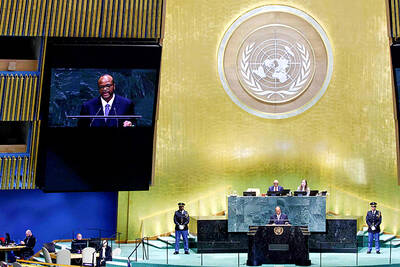
PLEA: How the UN addresses Taiwan’s security issue would be a test of its strength and relevance, Marshall Islands President Hilda Heine told the UN General Assembly Only Taiwan’s elected government can represent the people of Taiwan, Marshall Islands President Hilda Heine said on Friday at the UN General Assembly, calling for the nation’s inclusion in the UN. Taiwan and its 23 million people are a reality, and only its democratically elected government can represent it, Heine said when addressing the 81st session of the UN General Assembly General Debate. Appropriate ways must be found for Taiwan’s substantive participation in UN meetings if the UN is to be truly inclusive and effective in years to come, she said. UN member states would experience pressure to accept a

FACTS DISTORTION: The MAC rejected Xi’s remarks that the US and ‘China’ fought side-by-side during WWII, saying the ROC was Washington’s true ally during the war Taiwan yesterday denounced Chinese President Xi Jinping’s (習近平) comments to US President Donald Trump on the nation’s future, after Xi appeared to push Trump for a subtle change in stance that could erode US support for Taiwan. Xi told Trump in Washington on Thursday that he hoped the US would adhere to the “correct position” of opposing Taiwanese independence, according to a Chinese readout of the talks. That would be a tougher version of Washington’s long-standing formulation that it does not “support” independence. There was no immediate White House readout of the exchange. Xi’s remarks represent “the consistent Chinese approach of distorting facts
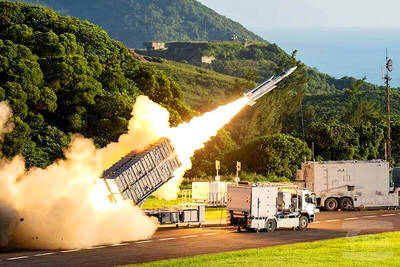
RESILIENCE: Keeping the defense industry’s assembly lines open would prove essential should the nation be involved in a prolonged conflict, a source said The Ministry of National Defense has prepared a NT$22 billion (US$692.3 million) program to acquire about 200 improved Hsiung Feng anti-ship missiles from next year to 2035, a source said. Commenting on condition of anonymity, a high-ranking defense official said the ministry’s plan for enhanced-capability Hsiung Feng II and Hsiung Feng III missiles would be funded as part of the regular defense budget. The 200 missiles would be added on top of the 1,400 missiles being funded via the Sea-Air Combat Power Improvement Plan, they said. The program is not about padding missile numbers, but expanding the capability to defeat


 RSS
RSS