


A Chinese takeover of Taiwan would be a geopolitical catastrophe for the US and its allies, one that would overshadow almost all others over the next decade, US policy experts said.
Andrew Erickson, a professor of strategy in the US Naval War College’s China Maritime Studies Institute; Gabriel Collins, a fellow at Rice University’s Baker Institute for Public Policy; and former US deputy national security adviser Matthew Pottinger issued the warning in an article published on Friday in Foreign Affairs.
Bejing’s invasion or annexation of Taiwan “would be a disaster of utmost importance to the United States, and I am convinced that time is of the essence,” they quoted US general Douglas MacArthur as writing in a secret memorandum dated June 1950, saying that now, his “words ring truer than ever.”
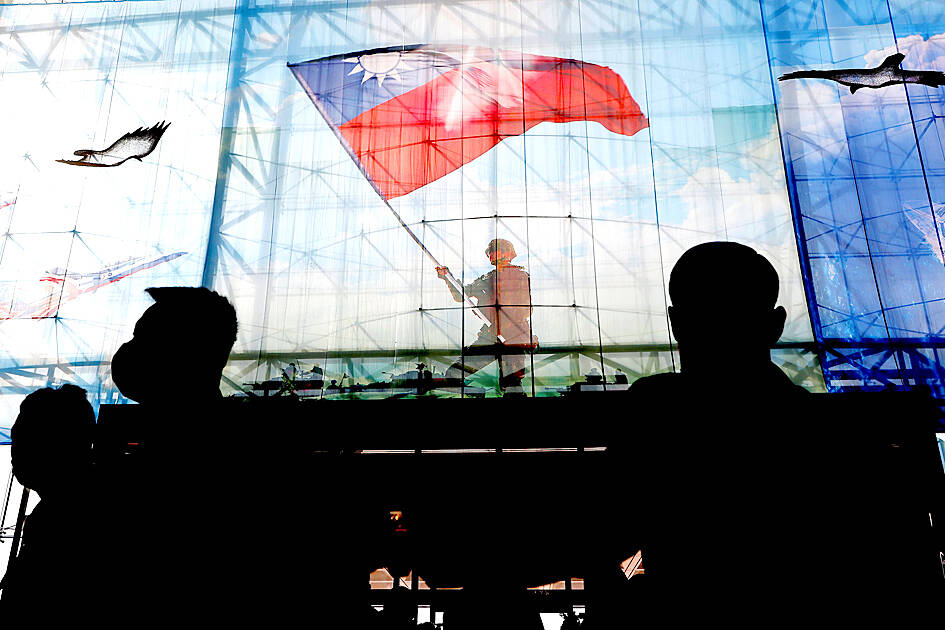
Photo: Ann Wang, Reuters
Taiwan proper is strategically valuable, as it “anchors Japan’s defense and denies China a springboard from which it could threaten US allies in the western Pacific,” they wrote.
Beyond the unchanging influence of geography, developments since MacArthur’s era have made Taiwan more important to global security and prosperity than ever before, they said.
Taiwan’s transition to a full democracy on China’s doorstep further increases its significance, because its “subjugation to Beijing’s totalitarianism would hinder democratic aspirations across the region, including in China itself,” they said.
Taiwan has become a microchip powerhouse, making it indispensable to the global economy, and a conflict could easily result in a global depression, they said.
Although there is a wide network of US allies across the Indo-Pacific region, the countries are reliant on Washington for their security, they said.
A successful Chinese attack on Taiwan would undermine the credibility of US security guarantees, triggering a race for nuclear weapons in the region, they said.
Whether “one cares about the future of democracy in Asia or prefers to ponder only the cold math of realpolitik, Taiwan’s fate matters,” they said.
If Taiwan’s democratic “system were extinguished, Beijing would have erased the world’s first liberal democracy whose founders include many people of Chinese heritage — and, with it, living proof that there is a workable, appealing alternative to Beijing’s totalitarianism,” they said.
Citing the Economist Intelligence Unit, they said Taiwan is ranked the world’s eighth-most fully democratic polity, ahead of every country in Asia, the UK and the US.
Taiwan is also deemed one of the world’s economically equitable societies, despite being among its richest, having overtaken Japan in per capita GDP last year, they added.
Taiwan’s “strong democracy” forms a sharp contrast to China’s political system, where 1.4 billion people sharing many traditions and cultural traditions are subjugated under Beijing’s totalitarian regime, they said.
“Officials in Beijing have long tried to caricature Taiwan as slavishly imitating Western forms of governance,” they said. “But it is actually the Chinese Communist Party that is doing so by clinging to its Marxist-Leninist system, a discredited political model imported from Europe.”
“The loss of Taiwan as a democratic alternative would end the experiment with popular, multiparty self-governance by a society with significant Chinese heritage, with bad tidings for the possibility of democracy in China and far beyond,” they said.
Citing former US president Dwight Eisenhower, they said the fall of Taiwan would trigger a “dangerous chain reaction” by threatening the security of Japan, the Philippines, Thailand and Vietnam and severely harming vital US interests.
“Taiwan’s annexation in the face of US inaction or ineffective action would present US allies in Asia and Europe with a nightmare they have never faced before: Washington proving unable to protect a polity that is an ally in all but name,” they said.
Chinese President Xi Jinping’s (習近平) pressure on Taiwan is no less significant a test of US resolve than the one posed by Joseph Stalin’s blockade of West Berlin in 1948, they said.
“The stakes are equally stark today with Taiwan — and there is no time left to waste,” they said.
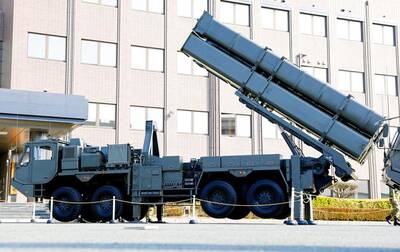
Japan has deployed long-range missiles in a southwestern region near China, the Japanese defense minister said yesterday, at a time when ties with Beijing are at their lowest in recent years. The missiles were installed in Kumamoto in the southern region of Kyushu, as Japan is attempting to shore up its military capacity as China steps up naval activity in the East China Sea. “Standoff defense capabilities enable us to counter the threat of enemy forces attempting to invade our country ... while ensuring the safety of our personnel,” Japanese Minister of Defense Shinjiro Koizumi said. “This is an extremely important initiative for

Chinese Nationalist Party (KMT) Chairwoman Cheng Li-wun (鄭麗文) today accepted an invitation from Chinese President Xi Jinping (習近平) to lead a delegation to China next month, saying she hopes to promote the peaceful development of cross-strait relations and bring stability to the Taiwan Strait. “I am grateful and happy to accept this invitation,” Cheng said in a statement from the KMT chairperson’s office. Cheng said she hopes both sides can work together to promote the peaceful development of cross-strait relations, enhance exchange and cooperation, bring stability to the Taiwan Strait and improve people’s livelihoods. At today's news conference, Cheng said any efforts to
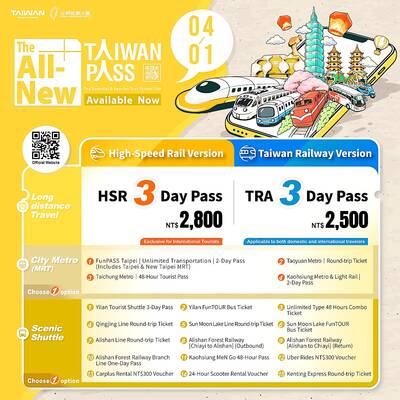
MORE POPULAR: Taiwan Pass sales increased by 59 percent during the first quarter compared with the same period last year, the Tourism Administration said The Tourism Administration yesterday said that it has streamlined the Taiwan Pass, with two versions available for purchase beginning today. The tourism agency has made the pass available to international tourists since 2024, allowing them to access the high-speed rail, Taiwan Railway Corp services, four MRT systems and four Taiwan Tourist Shuttles. Previously, five types of Taiwan Pass were available, but some tourists have said that the offerings were too complicated. The agency said only two types of Taiwan Pass would be available, starting from a three-day pass with the high-speed rail and a three-day pass with Taiwan Railway Corp. The former costs NT$2,800

The nation’s fastest supercomputer, Nano 4 (晶創26), is scheduled to be launched in the third quarter, and would be used to train large language models in finance and national defense sectors, the National Center for High-Performance Computing (NCHC) said. The supercomputer, which would operate at about 86.05 petaflops, is being tested at a new cloud computing center in the Southern Taiwan Science Park in Tainan. The exterior of the server cabinet features chip circuitry patterns overlaid with a map of Taiwan, highlighting the nation’s central position in the semiconductor industry. The center also houses Taiwania 2, Taiwania 3, Forerunner 1 and


 RSS
RSS