


Alexei Navalny, who crusaded against official corruption and staged massive anti-Kremlin protests as Russian President Vladimir Putin’s fiercest foe, died yesterday in the arctic penal colony where he was serving a 19-year sentence, Russia’s prison agency said. He was 47.
The stunning news of Navalny’s death — less than a month before an election that would give Putin another six years in power — brought renewed criticism and outrage directed at the Kremlin leader who has cracked down on all opposition at home.
Navalny felt unwell after a walk and lost consciousness, the Federal Penitentiary Service said. An ambulance arrived, but paramedics failed to revive him. The service said the cause of death was “being established.”
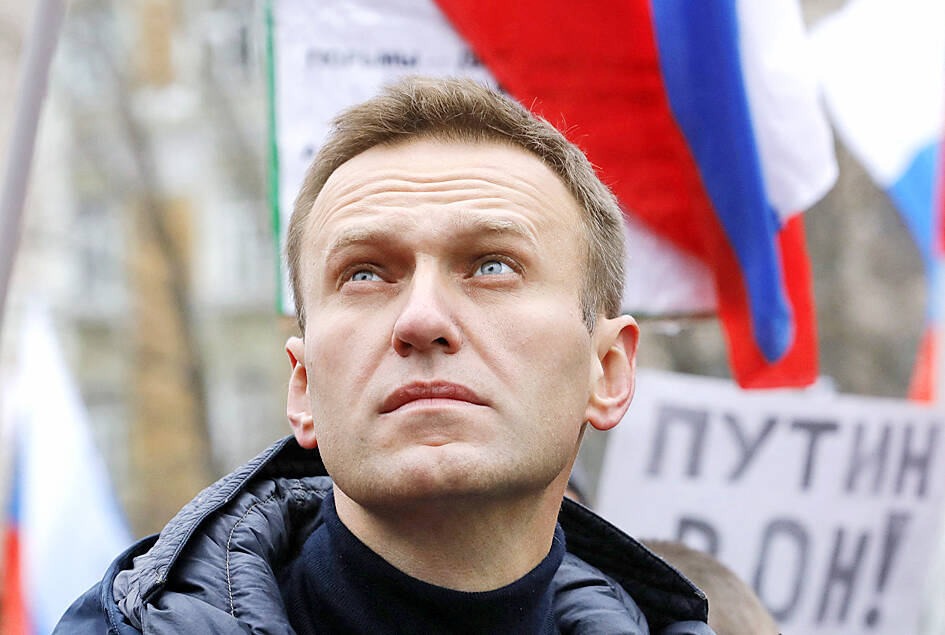
Photo: Reuters
Navalny had been behind bars since January 2021, when he returned to Moscow after recuperating in Germany from nerve agent poisoning that he blamed on the Kremlin. Since then, he received three prison sentences, all of which he rejected as politically motivated.
Praise for Navalny’s bravery poured in from Western leaders and others who have opposed Putin’s rule. The opposition leader’s health has deteriorated recently and the cause of death remains unknown, but many world leaders said they held Russian authorities ultimately responsible for his death.
“His death in a Russian prison and the fixation and fear of one man only underscores the weakness and rot at the heart of the system that Putin has built. Russia is responsible for this,” US Secretary of State Antony Blinken said while at a conference in Germany.
German Chancellor Olaf Scholz said Navalny “has probably now paid for this courage with his life.”
Kremlin spokesman Dmitry Peskov said Putin was informed of Navalny’s death.
The opposition leader’s spokeswoman, Kira Yarmysh, wrote on X that the team had no confirmation yet.
Shortly after the death was reported, the Russian SOTA social media channel shared images of the opposition politician reportedly in court yesterday. In the footage, Navalny is seen standing up and is laughing and joking with the judge via video link.
Navalny was moved in December from a prison in central Russia to a “special regime” penal colony — the highest security level of prisons in the country — above the Artic Circle.
His allies decried the transfer to a colony in the town of Kharp, in a region about 1,900km northeast of Moscow, as yet another attempt to force Navalny into silence.
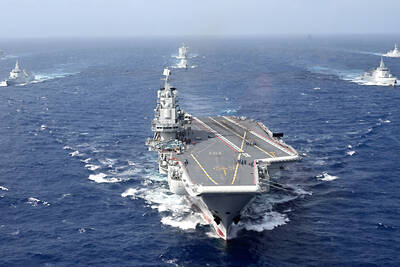
PROVOCATIVE: Chinese Deputy Ambassador to the UN Sun Lei accused Japan of sending military vessels to deliberately provoke tensions in the Taiwan Strait China denounced remarks by Japan and the EU about the South China Sea at a UN Security Council meeting on Monday, and accused Tokyo of provocative behavior in the Taiwan Strait and planning military expansion. Ayano Kunimitsu, a Japanese vice foreign minister, told the Council meeting on maritime security that Tokyo was seriously concerned about the situation in the East China and South China seas, and reiterated Japan’s opposition to any attempt to change the “status quo” by force, and obstruction of freedom of navigation and overflight. Stavros Lambrinidis, head of the EU delegation to the UN, also highlighted South China Sea
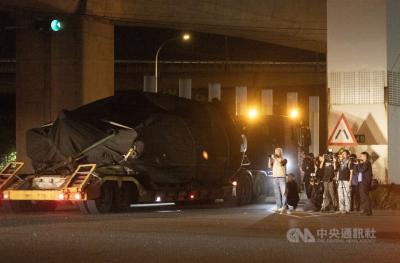
The final batch of 28 M1A2T Abrams tanks purchased from the US arrived at Taipei Port last night and were transported to the Armor Training Command in Hsinchu County’s Hukou Township (湖口), completing the military’s multi-year procurement of 108 of the tanks. Starting at 12:10am today, reporters observed more than a dozen civilian flatbed trailers departing from Taipei Port, each carrying an M1A2T tank covered with black waterproof tarps. Escorted by military vehicles, the convoy traveled via the West Coast Expressway to the Armor Training Command, with police implementing traffic control. The army operates about 1,000 tanks, including CM-11 Brave Tiger
Taiwan Semiconductor Manufacturing Co (TSMC, 台積電), the world’s largest contract chipmaker, said it expects its 2-nanometer (2nm) chip capacity to grow at a compound annual rate of 70 percent from this year to 2028. The projection comes as five fabs begin volume production of 2-nanometer chips this year — two in Hsinchu and three in Kaohsiung — TSMC senior vice president and deputy cochief operating officer Cliff Hou (侯永清) said at the company’s annual technology symposium in Silicon Valley, California, last week. Output in the first year of 2-nanometer production, which began in the fourth quarter of last year, is expected to
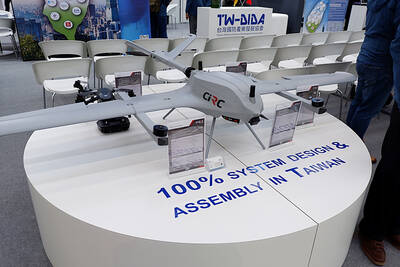
Taiwan’s drone exports surged past US$100 million in the first quarter, exceeding last year’s full-year total, with the Czech Republic emerging as the largest buyer, the Ministry of Economic Affairs said. Exports of complete drones reached US$115.85 million in the period, about 1.2 times the total recorded for all of last year, the ministry said in a report. Exports to the Czech Republic accounted for about US$100 million, far outpacing other markets. Poland, last year’s top destination, recorded about US$11.75 million in the first quarter. Taiwan’s drone exports have expanded rapidly in the past few years, with last year’s total


 RSS
RSS