


Taiwan and Eswatini yesterday signed a declaration to affirm their solid relationship.
Minister of Foreign Affairs Joseph Wu (吳釗燮) signed the declaration with Eswatini Minister of Foreign Affairs and International Cooperation Pholile Shakantu, who is leading a delegation to Taiwan until Sunday.
The document “highlights our long-cherished friendship” and reaffirms the shared desire “to deepen and expand bilateral cooperation,” Wu said.
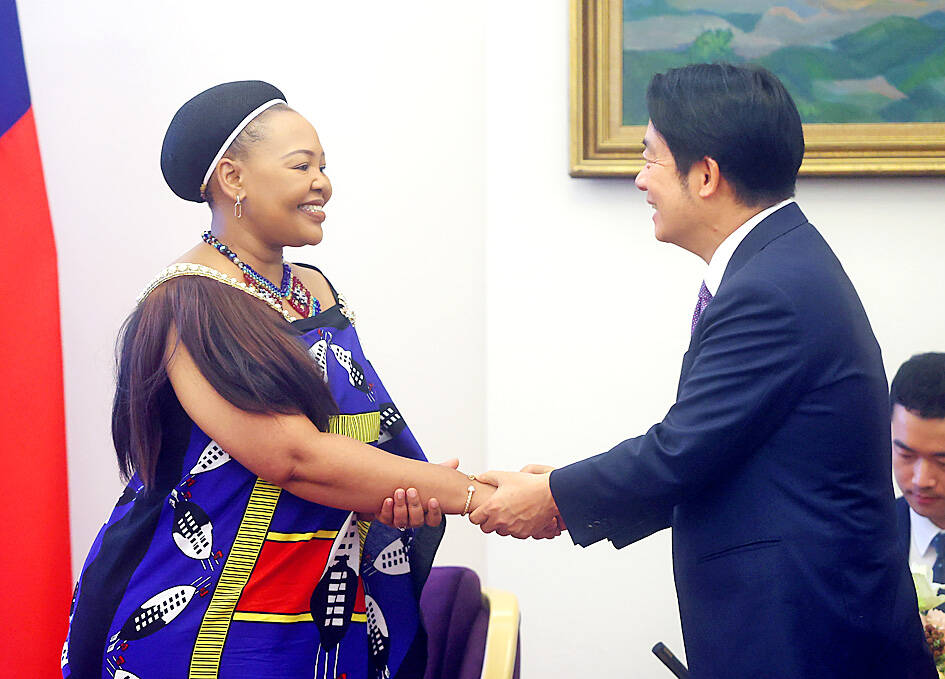
Photo: CNA
The strength of the relationship has been exemplified in the success of numerous state visits in recent years, including King Mswati III visiting Taiwan in October 2022 and President Tsai Ing-wen’s (蔡英文) trip to Eswatini in September last year, he said.
The two governments “remained profoundly committed to creating favorable conditions that will boost bilateral economic, trade and investment cooperation,” he added.
Shakantu said that the trip is to “affirm, strengthen and deepen our diplomatic ties between Taiwan and Eswatini.”
She thanked Taiwan for cooperative projects in the African country that not only “transformed the lives” of many people, but also served as “a turning point for Eswatini as a country.”
After the ceremony, Wu hosted a banquet for Shakantu’s delegation. The two sides exchanged opinions on bilateral cooperation in economic affairs, trade, agriculture and energy, the Ministry of Foreign Affairs said.
Earlier yesterday, Shakantu told president-elect Vice President William Lai (賴清德) that her country would continue to be Taiwan’s strongest ally and would bolster ties.
Since the two sides established official diplomatic relations in 1968, bilateral interaction has grown steadily based on mutual respect and the pursuit of the well-being of the people of both sides, she said.
Taipei-based Overseas Investment & Development Corp (OIDC, 海外投資開發股份) is working with Eswatini National Petroleum Co to build a strategic oil facility in Eswatini, OIDC’s technical missions are assisting the country in improving agricultural development and transformation, and its medical missions are providing high-quality healthcare services to the people of Eswatini, she said.
The African ally would continue to voice support for Taiwan’s participation in multilateral organizations, she said.
Only with Taiwan’s equal participation can the African Union’s Agenda 2063 and the UN Sustainable Development Goals be realized, Shakantu said.
Lai said he hoped that the delegation would have an opportunity to learn more about Taiwan’s diverse society and customs, as well as experience energy and enthusiasm of Taiwanese.
Lai said that he is proud of the long-standing and profound friendship between Taiwan and Eswatini, adding that they are great partners and a family.
Eswatini has constantly supported Taiwan’s international participation, speaking up for the nation at the UN General Assembly, the World Health Assembly, the Interpol General Assembly and the UN Climate Change Conference last year alone, he said.
Lai pledged to continue to pursue Tsai’s steady and practical foreign policy with the aim of consolidating the friendship with Eswatini.

‘NO SECURITY RISK’: The Railway Bureau reassured the public that the technicians’ activities were limited to technical guidance and did not involve sensitive systems The Railway Bureau yesterday said it had invited eight Chinese technicians to assist with an airport MRT construction project. The bureau issued the confirmation after an Internet user said Chinese nationals had entered the construction zone of Taiwan Taoyuan International Airport’s Terminal 3 project. They asked why “individuals from an enemy state” were allowed access to such a major national infrastructure project, which raised serious concerns over Taiwan’s industrial safety, sensitive systems and information security. The bureau’s Northern Region Engineering Branch Office said subcontractor Taiwan Handle Industrial Co (台灣手把工業) of the Taoyuan airport MRT’s “Contract No. CU05 Project A14 Station Civil, MEP &

The National Chungshan Institute of Science and Technology yesterday showcased its locally developed variants of the Vision 60 robotic patrol dog, which it plans to deploy on the nation’s outlying territories in the South China Sea. The variants were produced under the Joint Lab project — created by the institute and domestic companies — and assembled with domestically produced motors, lenses and artificial intelligence (AI) systems alongside licensed tech from the US, Missile and Rocket Systems Research Division deputy director Jen Kuo-kang (任國光) told the media event at a military base in Taipei’s Dazhi (大直) area. Taiwan has built up its strengths

TIT-FOR-TAT: The US allegedly revoked the visa of a Chinese national working at Xinhua News Agency in the US in response to Beijing’s expulsion of Vivian Wang The Presidential Office yesterday condemned China for expelling a New York Times correspondent from Beijing following the newspaper’s interview with President William Lai (賴清德), saying the move highlighted Beijing’s suppression of press freedom and its threat to international news media. Taiwan has noted a series of recent incidents in which Beijing used similar tactics to “threaten and pressure international media outlets and journalists,” Presidential Office spokeswoman Karen Kuo (郭雅慧) said in a statement. “This concerns not only press freedom and freedom of expression, but also the safety of journalists, and Taiwan and relevant partners are paying close attention to the situation,” she
NOT IMMEDIATE: Taiwan has a chance to appeal the proposed 10 percent tariff before it starts, while other countries face a 12.5 percent tariff from the trade office Taiwan is among 60 economies determined by the US to have failed to impose or enforce a ban on the importation of goods produced with forced labor, according to a notice released on Tuesday by the Office of the US Trade Representative (USTR), which proposed imposing an additional 10 percent or more tariff on them. The USTR in a statement said that following an investigation, it had determined under Section 301 of the Trade Act of 1974 that the failure of the 60 economies to impose and effectively enforce a prohibition on the importation of goods produced with forced labor is


 RSS
RSS