


Tennis ace Hsieh Su-wei (謝淑薇) yesterday became the first Taiwanese to win two titles at the same Grand Slam event, after she and Belgian partner Elise Mertens won the women’s doubles title at the Australian Open.
The second-seeded pairing of Hsieh and Mertens beat 11th seeded Jelena Ostapenko of Latvia and Lyudmyla Kichenok of Ukraine 6-1, 7-5. It was Hsieh’s seventh Grand Slam women’s doubles title and Mertens’ fourth, their second together. It was Hsieh’s first in Australia.
The win also makes Hsieh the second-oldest woman to win a Grand Slam doubles title, at 38 years and 24 days.
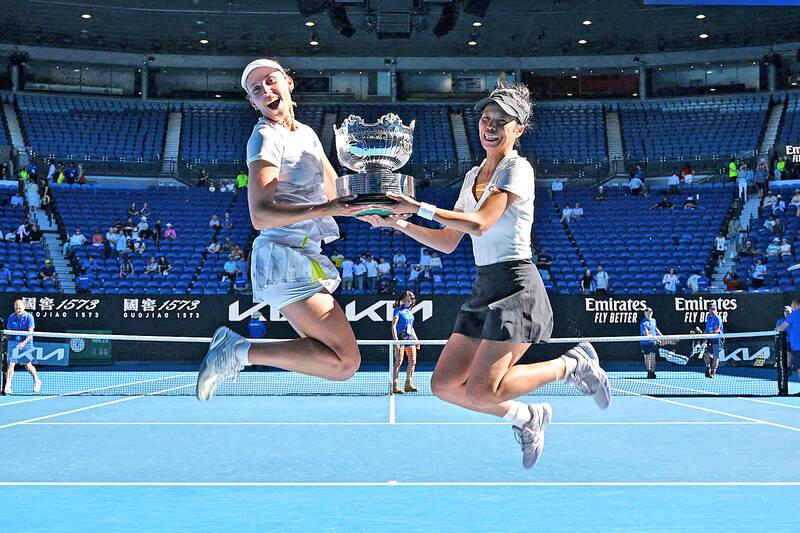
Photo: AFP
She follows Rohan Bopanna of India, who became the oldest men’s champion when he won the men’s doubles title on Saturday with Matthew Ebden of Australia.
American Lisa Raymond was eight days older than Hsieh when she won the 2011 US Open women’s doubles. Martina Navratilova was 49 when she won the mixed doubles at the 2006 US Open with Bob Bryan.
Yesterday’s victory capped a successful fortnight for Hsieh, who also won the Australian Open mixed doubles title on Friday with Jan Zielinski of Poland after overcoming a match point.
She is the first player to have won the Australian Open women’s and mixed doubles titles in the same year since 2000, when Rennae Stubbs of Australia accomplished the feat.
Hsieh and Mertens needed only 1 hour, 33 minutes at Rod Laver Arena to pad their already impressive Grand Slam resumes. They took the first set in just more than 30 minutes. The second set was much tighter as Mertens lost her serve in the opening game. She recovered to serve for the championship at 5-3, but was broken again.
Finally, Hsieh and Mertens took the match when they broke Kichenok in the 12th game. Mertens leapt into the air in delight. Hsieh was more reserved.
The pair, who won the Wimbledon title in 2021, make a formidable combination, Mertens with the stronger serve, Hsieh with skillful touches around the net and flat, strong ground-strokes.
“First of all, congrats girls for a great tournament,” Mertens said to her partner and opponents during her victory speech.
“It was a tough final,” she said. “The second set was really close. It was a really great match for us and we had to stay focused all the time.”
Hsieh, a former women’s doubles world No. 1, is today to rise from No. 6 to No. 2 in the Women’s Tennis Association rankings, while Mertens would return to the world No. 1 spot, the association’s Web site said.
Hsieh had the benefit of being coached by Australian Paul McNamee, who won six Grand Slam doubles titles, including two Australian Opens and was the Australian Open chief executive until 2006.
She has won the women’s doubles titles at Wimbledon four times and the French Open twice.
Hsieh teamed up with China’s Peng Shuai (彭帥) to win her first two women’s doubles Grand Slam titles at Wimbledon in 2013 and the French Open in 2014.
With Chinese partner Wang Xinyu (王欣瑜), Hsieh won the French Open women’s doubles title last year.
With now retired partner Barbora Strycova of the Czech Republic, the Taiwanese won Wimbledon in 2019 and last year.

‘NO SECURITY RISK’: The Railway Bureau reassured the public that the technicians’ activities were limited to technical guidance and did not involve sensitive systems The Railway Bureau yesterday said it had invited eight Chinese technicians to assist with an airport MRT construction project. The bureau issued the confirmation after an Internet user said Chinese nationals had entered the construction zone of Taiwan Taoyuan International Airport’s Terminal 3 project. They asked why “individuals from an enemy state” were allowed access to such a major national infrastructure project, which raised serious concerns over Taiwan’s industrial safety, sensitive systems and information security. The bureau’s Northern Region Engineering Branch Office said subcontractor Taiwan Handle Industrial Co (台灣手把工業) of the Taoyuan airport MRT’s “Contract No. CU05 Project A14 Station Civil, MEP &

A US uncrewed surface vessel (USV) encountered multiple Chinese warships during an autonomous transit of the Taiwan Strait, US defense company Seasats said in a statement on Wednesday. Seasats announced that a Lightfish USV had completed the first autonomous transit of the Taiwan Strait. Over five days, the USV traversed the entire length of the Strait while constantly monitoring surface vessel traffic, the company said. The Lightfish encountered multiple Chinese warships, one of which was a Chinese People’s Liberation Army Navy (PLAN) Type 056 corvette, it said. The Chinese vessels were operating “well within Taiwan’s exclusive economic zone without transmitting their identity via the
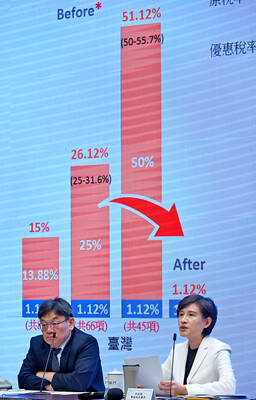
GREATER REACH? Auto parts and wood products would face tariffs of up to 15%, matching those targeting the EU, Japan and South Korea, Vice Premier said The US has announced that preferential tariff treatment for Taiwan’s non-semiconductor Section 232 goods would take effect retroactively from May 1, the Executive Yuan said yesterday. The US government yesterday posted a notice on the Federal Register’s public inspection Web site previewing tariff concessions for Taiwan under a memorandum of understanding (MOU) on Taiwan-US investment after two months of negotiations. The MOU signed on Jan. 15 stipulated three major preferential tariff arrangements: a 15 percent “reciprocal” tariff rate for Taiwan without stacking most-favored nation (MFN) rates; preferential Section 232 treatment for semiconductors and related products; and preferential Section 232 treatment for non-semiconductor

The National Chungshan Institute of Science and Technology yesterday showcased its locally developed variants of the Vision 60 robotic patrol dog, which it plans to deploy on the nation’s outlying territories in the South China Sea. The variants were produced under the Joint Lab project — created by the institute and domestic companies — and assembled with domestically produced motors, lenses and artificial intelligence (AI) systems alongside licensed tech from the US, Missile and Rocket Systems Research Division deputy director Jen Kuo-kang (任國光) told the media event at a military base in Taipei’s Dazhi (大直) area. Taiwan has built up its strengths


 RSS
RSS