


Exports last month increased 11.8 percent to US$39.94 billion compared with the same month a year earlier, benefiting from strong demand for emerging applications such as artificial intelligence, continued inventory depletion in the supply chain and a low comparison base last year, the Ministry of Finance said in a report yesterday.
Last month’s annual growth in outbound shipments accelerated from a 3.8 percent increase the previous month and represented the largest increase in 17 months, ministry data showed. It was better than the ministry’s forecast of 4 to 7 percent growth.
Imports last month fell 6.5 percent year-on-year to US$28.84 billion, following a 14.8 percent decrease the previous month. As a result, the trade surplus last month expanded to US$11.1 billion from US$9.8 billion in November and was 127 percent higher than a year earlier, the report said.
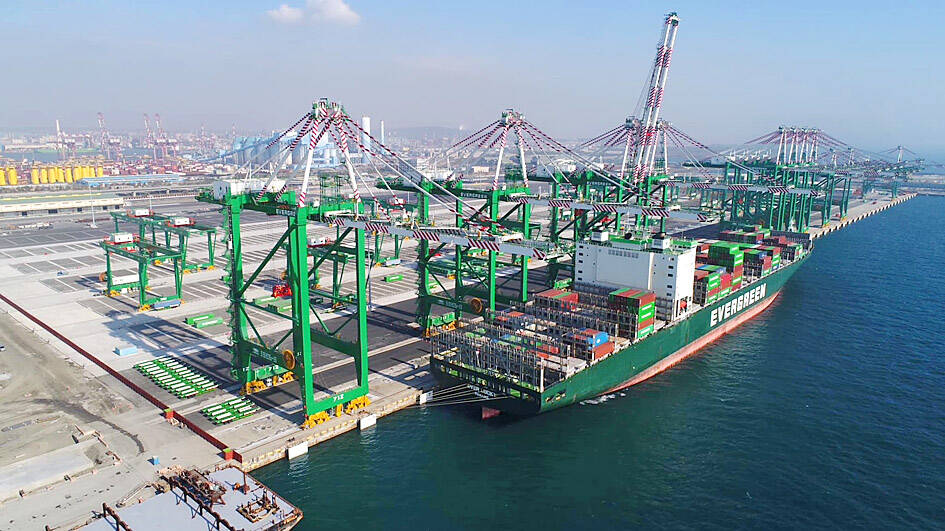
Photo courtesy of Taiwan International Ports Corp via CNA
The nation’s exports for the whole of last year fell 9.8 percent year-on-year to US$432.48 billion, the third-highest on record after US$479.42 billion in 2022 and US$446.37 billion in 2021, while imports dropped 17.8 percent to US$351.62 billion, it said.
That left a full-year trade surplus of US$80.56 billion, up 56.9 percent from a year earlier and also the highest ever, the report said.
The growth in overall customs-cleared exports for a second consecutive month was welcome news for the economy at a time when Taiwan is faced with global macroeconomic uncertainty and geopolitical tensions.
The report said information and communications technology products as well as audio and visual devices remained the largest growth engine for the nation’s exports, with shipments surging 94.7 percent from a year earlier to US$10.11 billion.
A 7.2 percent annual increase in shipments of mineral products last month following declines in previous months also helped boost the nation’s overall exports, while contractions in shipments of electronic components (which mainly comprise semiconductors), base metals, machinery, plastics and rubber products all shrank to the smallest level in the past year, it said.
Last year as a whole, exports of electronic components fell 10.7 percent year-on-year and those of non-technology products were lower than the previous year’s levels by about 20 percent on average, the report said.
Only shipments of information and communications technology products as well as audio and visual devices bucked the downward trend with annual growth of 28.9 percent to US$83.36 billion, setting a new high, it said.
China, including Hong Kong, continued to be the largest export destination for Taiwan last year with US$152.25 billion in shipments, but the value dropped 18.1 percent from a year earlier and its proportion of the nation’s total exports also fell to the lowest in 21 years at 35.2 percent, the report said.
ASEAN and the US market ranked second and third with shipments of NT$76.28 billion and US$76.24 billion respectively, the report said.
Exports to the US accounted for 17.6 percent of total outbound shipments last year, which was the highest level in 21 years, it said.
The ministry said that it remains upbeat about export momentum in the first quarter of this year due to positive demand for artificial intelligence, high-performance computing, automotive electronics and data center-related applications.
Exports this month could increase by 20 to 24 percent from a year earlier to between US$37.8 billion and US$39 billion, it said.
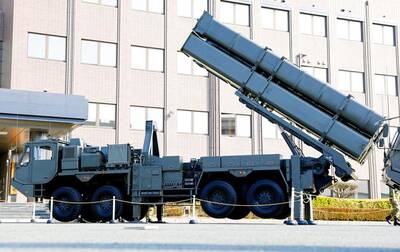
Japan has deployed long-range missiles in a southwestern region near China, the Japanese defense minister said yesterday, at a time when ties with Beijing are at their lowest in recent years. The missiles were installed in Kumamoto in the southern region of Kyushu, as Japan is attempting to shore up its military capacity as China steps up naval activity in the East China Sea. “Standoff defense capabilities enable us to counter the threat of enemy forces attempting to invade our country ... while ensuring the safety of our personnel,” Japanese Minister of Defense Shinjiro Koizumi said. “This is an extremely important initiative for

Chinese Nationalist Party (KMT) Chairwoman Cheng Li-wun (鄭麗文) today accepted an invitation from Chinese President Xi Jinping (習近平) to lead a delegation to China next month, saying she hopes to promote the peaceful development of cross-strait relations and bring stability to the Taiwan Strait. “I am grateful and happy to accept this invitation,” Cheng said in a statement from the KMT chairperson’s office. Cheng said she hopes both sides can work together to promote the peaceful development of cross-strait relations, enhance exchange and cooperation, bring stability to the Taiwan Strait and improve people’s livelihoods. At today's news conference, Cheng said any efforts to
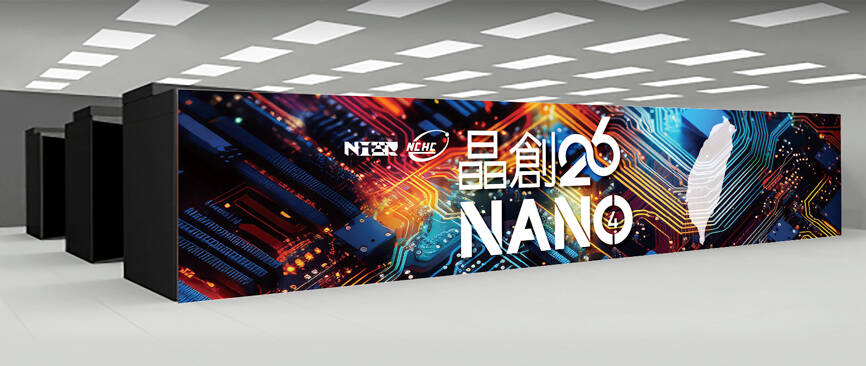
The nation’s fastest supercomputer, Nano 4 (晶創26), is scheduled to be launched in the third quarter, and would be used to train large language models in finance and national defense sectors, the National Center for High-Performance Computing (NCHC) said. The supercomputer, which would operate at about 86.05 petaflops, is being tested at a new cloud computing center in the Southern Taiwan Science Park in Tainan. The exterior of the server cabinet features chip circuitry patterns overlaid with a map of Taiwan, highlighting the nation’s central position in the semiconductor industry. The center also houses Taiwania 2, Taiwania 3, Forerunner 1 and
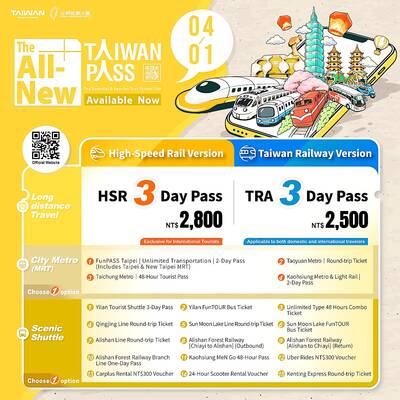
MORE POPULAR: Taiwan Pass sales increased by 59 percent during the first quarter compared with the same period last year, the Tourism Administration said The Tourism Administration yesterday said that it has streamlined the Taiwan Pass, with two versions available for purchase beginning today. The tourism agency has made the pass available to international tourists since 2024, allowing them to access the high-speed rail, Taiwan Railway Corp services, four MRT systems and four Taiwan Tourist Shuttles. Previously, five types of Taiwan Pass were available, but some tourists have said that the offerings were too complicated. The agency said only two types of Taiwan Pass would be available, starting from a three-day pass with the high-speed rail and a three-day pass with Taiwan Railway Corp. The former costs NT$2,800


 RSS
RSS