


North Korea yesterday fired an artillery barrage near two South Korean border islands, the South Korean Ministry of Defense said, prompting a live-fire drill from the South’s military.
Residents of the islands were ordered to evacuate and ferries were suspended as South Korea held a live-fire exercise after the North’s barrage.
The live firing followed repeated warnings from the administration of North Korean leader Kim Jong-un that it was prepared for war against South Korea and the US.
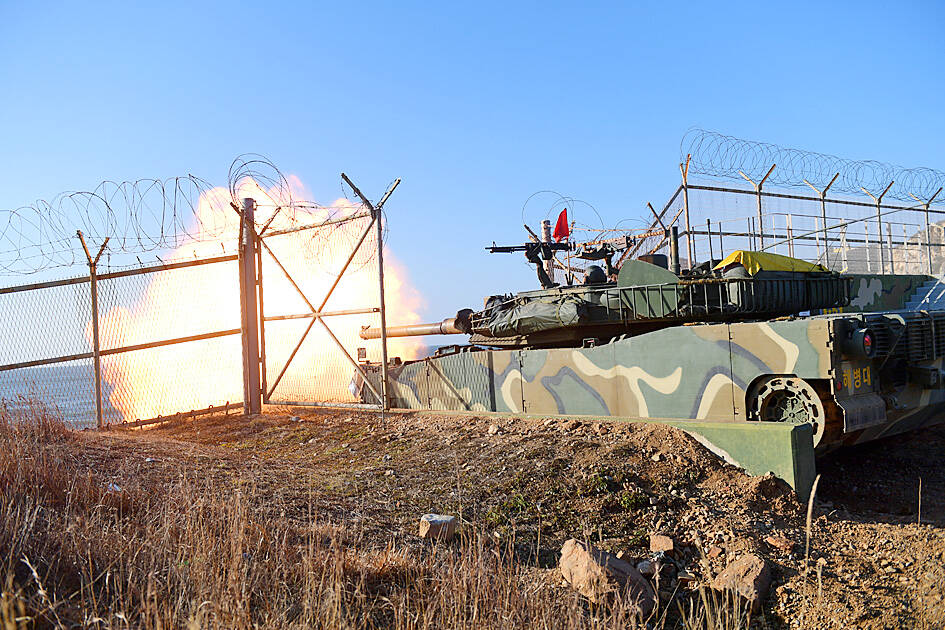
Photo: EPA-EFE
The ministry said that the North’s military fired “over some 200 rounds” of artillery shells near Yeonpyeong and Baengnyeong, two sparsely populated South Korean islands that are just south of a de facto maritime border between the two sides.
The shells landed in the so-called buffer zone along the border, created by a 2018 deal that fell apart in November after Kim’s spy satellite launch.
Resuming artillery fire within the buffer zone “is a provocative act that threatens peace on the Korean Peninsula and escalates tensions,” South Korean Minister of National Defense Shin Won-sik said.
In response to Pyongyang’s actions, Seoul’s military would take “immediate, strong, and final retaliation — we must back peace with overwhelming force,” he said.
China called for “restraint” from all sides.
“We hope that all relevant parties maintain calm and restraint, refrain from taking actions that aggravate tensions, avoid further escalation of the situation, and create conditions for the resumption of meaningful dialogue,” Chinese Ministry of Foreign Affairs spokesman Wang Wenbin (汪文斌) told reporters.
Yeonpyeong, which has about 2,000 residents, is about 115km west of Seoul.
Baengnyeong, with a population of 4,900, is about 210km west of Seoul.
Local officials on both islands told reporters that residents had been told to evacuate, describing the order as a “preventative measure” ahead of the South Korean military drill.
The order was lifted soon afterward, Yonhap news agency reported.

LEVERAGE: China did not ‘need to fire a shot’ to deny Taiwan airspace over Africa when it owns ‘half the continent’s debt,’ a US official said, calling it economic warfare The EU has raised concerns about overflight rights following the delay of President William Lai’s (賴清德) planned state visit to the Kingdom of Eswatini after three African nations denied overflight clearance for his charter at the last minute. Taiwanese allies Paraguay and Saint Kitts and Nevis, as well as several US lawmakers and the Inter-Parliamentary Alliance on China (IPAC) condemned China for allegedly pressuring the countries. Lai was scheduled to fly directly to Taiwan’s only African ally from yesterday to Sunday to celebrate the 40th anniversary of King Mswati III’s accession and his 58th birthday, but Seychelles, Mauritius and Madagascar suddenly revoked
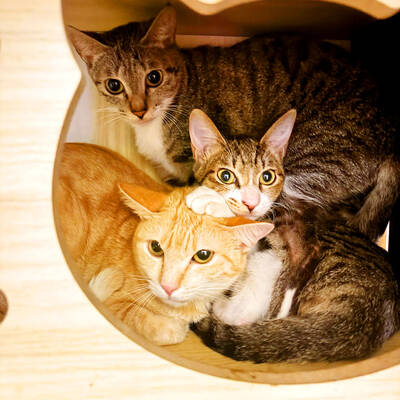
The number of pet cats in Taiwan surpassed that of pet dogs for the first time last year, reaching 1,742,033, a 32.8 percent increase from 2023, the Ministry of Agriculture said yesterday, citing a survey. By contrast, the number of pet dogs declined slightly by 1.2 percent over the same period to 1,462,528, the ministry said. Despite the shift, households with dogs still slightly outnumber those with cats by 1.2 percent. However, while the number of households with multiple dogs has remained relatively stable, households keeping more than two cats have increased, contributing to the overall rise in the feline population. The trend
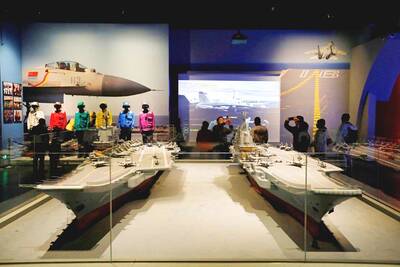
China on Wednesday teased in a video an aircraft carrier that could be its fourth, and the first using nuclear power, while making an allusion to Taiwan and vowing to further build up its islands, as it looks to boost maritime power, secure resources and bolster territorial claims. The video, issued on the eve of the 77th founding anniversary of the Chinese People’s Liberation Army Navy, featured fictional officers with names that are homophones of three commissioned aircraft carriers, the Liaoning (遼寧), Shandong (山東) and Fujian (福建). Titled Into the Deep, it showed a 19-year-old named “Hejian” (何劍) joining the group, sparking
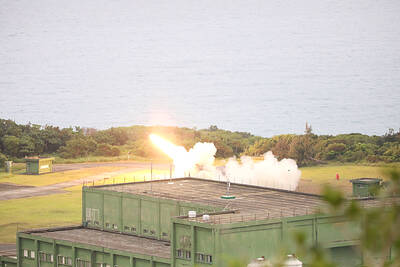
Taiwan has signed six arms procurement offers from the US totaling more than NT$208 billion (US$6.59 billion) covering long-range precision strike systems, missile stockpile replenishment and joint production of large-caliber ammunition, the Ministry of National Defense said yesterday. The government’s proposed NT$1.25 trillion special defense budget has been stalled in the Legislative Yuan as opposition lawmakers question the amount and procurement items, while the Presidential Office and defense ministry say that the full amount is necessary to safeguard Taiwan. Minister of National Defense Wellington Koo (顧立雄) on Monday briefed the legislature’s Foreign Affairs and National Defense Committee on the defense budget for


 RSS
RSS