


Ren Mei-ling (任美玲), wife of Chinese Nationalist Party (KMT) presidential candidate New Taipei City Mayor Hou You-yi (侯友宜), promised to provide subsidies to student renters in their property on Taipei’s Yangmingshan (陽明山), Hou’s campaign staff said yesterday.
Hou has been accused of exploiting renters during his election campaign over his family’s Kaisuan Condominium (凱旋苑) near Chinese Culture University.
At a news conference in Taipei, Hou’s campaign team presented a letter from Ren in which she vowed to convert the 103-room building, which she inherited from her father, into social housing for young people.
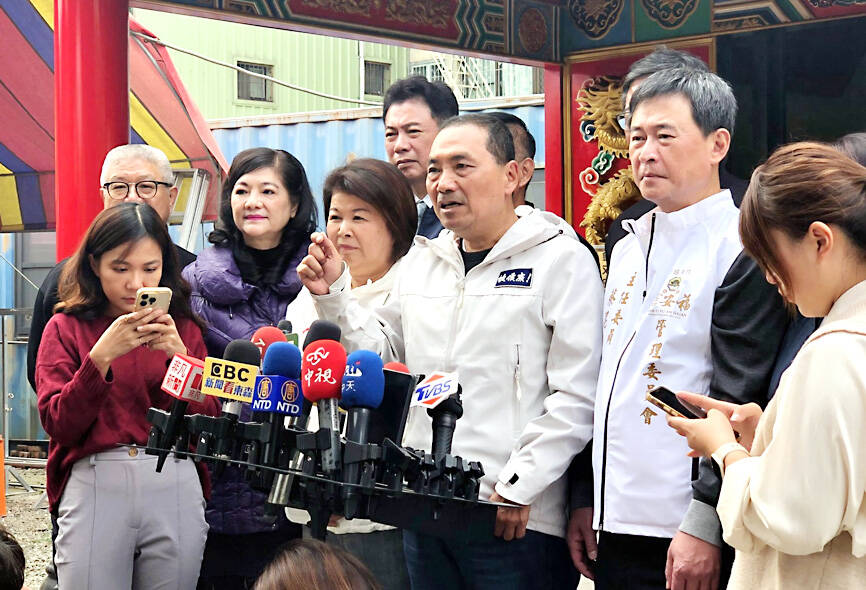
Photo: CNA
“My family has legal ownership of the property, and we legally refurbished it into a condominium,” she wrote in the letter.
Everything related to the property is legal and the family has paid tax on the rental income, she said.
As the property has been managed by Shin-Kong Life Real Estate Service Co (新壽大廈管理維護公司) since 2019, the family has not been involved in increasing rents, she said.
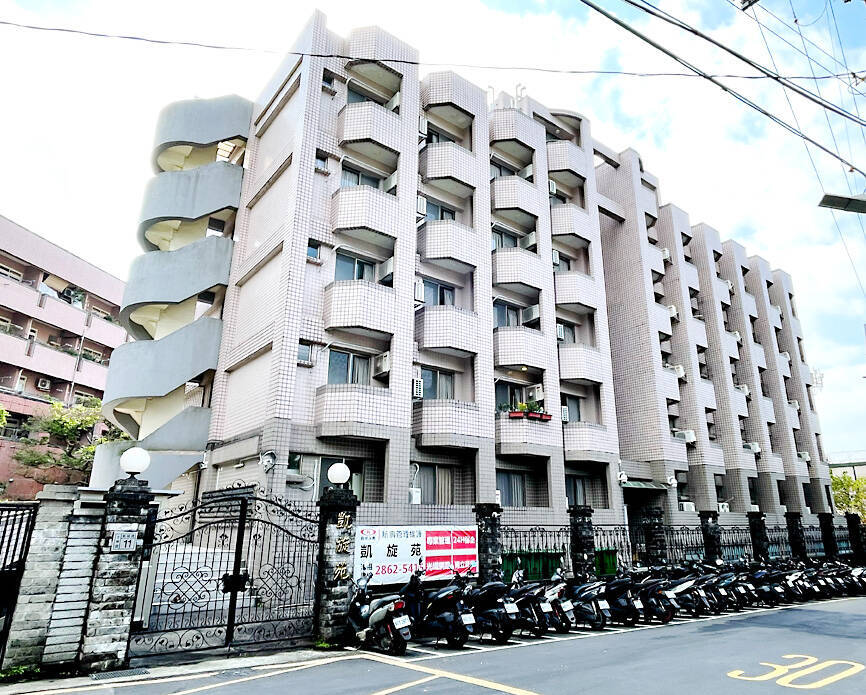
Photo: Chu Pei-hsiung, Taipei Times
When the management agreement ends in June 2026, the family would convert the property into social housing units for young people, she said.
Although the family cannot change the rents under the management contract, they would seek to subsidize a portion of students’ rents with aid of NT$6,000 per month for single rooms and NT$7,000 for doubles, she said.
Students and advocates on Monday protested outside the building, saying that Hou’s family was profiting off of students, with rents rising annually by at least 5 percent.
Democratic Progressive Party (DPP) spokeswoman Michelle Lin (林楚茵) said that Kaisuan Condominium is registered under Yoyu Co Ltd (又昱實業有限公司), which is headed by Hou’s daughter Hou Yu-fan (侯昱帆).
The company in 2011 signed a 15-year contract with Chinese Culture University to provide housing for students, and in that time, Hou You-yi’s family had made more than NT$300 million (US$9.72 million) from the property, Lin said.
She also said that the company subdivided the building into 99 separate addresses to avoid paying property taxes.
“Since obtaining the property’s operating license in 1997, Hou’s family has evaded paying tax for 26 years, for about NT$4 million in total,” she said.
“Many students cannot afford the condominium’s high rent, with its yearly 5 percent increases, so they want to terminate their rental agreements, but Yoyu would not let them,” DPP Legislator Rosalia Wu (吳思瑤) said.
Hou You-yi’s campaign deputy director Hsieh Cheng-ta (謝政達) filed a judicial complaint against DPP members, alleging that they contravened election laws by erecting billboards with photographs of Hou You-yi that said he earned NT$20 million per year from student renters.
DPP spokesman Chang Chih-hao (張志豪) said Hou You-yi should explain how he can support housing justice while also profiting from student renters.
“Hou cannot evade these questions. People are seeking clarification on his family’s properties, which runs contrary to his voiced support for housing justice,” Chang said.
Chang said that yearly rent increases of 5 percent with compound interest would add up to NT$20 million over the past few years, adding that Hou You-yi should explain if that amount is correct.

‘NO SECURITY RISK’: The Railway Bureau reassured the public that the technicians’ activities were limited to technical guidance and did not involve sensitive systems The Railway Bureau yesterday said it had invited eight Chinese technicians to assist with an airport MRT construction project. The bureau issued the confirmation after an Internet user said Chinese nationals had entered the construction zone of Taiwan Taoyuan International Airport’s Terminal 3 project. They asked why “individuals from an enemy state” were allowed access to such a major national infrastructure project, which raised serious concerns over Taiwan’s industrial safety, sensitive systems and information security. The bureau’s Northern Region Engineering Branch Office said subcontractor Taiwan Handle Industrial Co (台灣手把工業) of the Taoyuan airport MRT’s “Contract No. CU05 Project A14 Station Civil, MEP &

A US uncrewed surface vessel (USV) encountered multiple Chinese warships during an autonomous transit of the Taiwan Strait, US defense company Seasats said in a statement on Wednesday. Seasats announced that a Lightfish USV had completed the first autonomous transit of the Taiwan Strait. Over five days, the USV traversed the entire length of the Strait while constantly monitoring surface vessel traffic, the company said. The Lightfish encountered multiple Chinese warships, one of which was a Chinese People’s Liberation Army Navy (PLAN) Type 056 corvette, it said. The Chinese vessels were operating “well within Taiwan’s exclusive economic zone without transmitting their identity via the
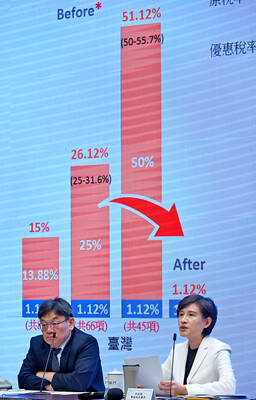
GREATER REACH? Auto parts and wood products would face tariffs of up to 15%, matching those targeting the EU, Japan and South Korea, Vice Premier said The US has announced that preferential tariff treatment for Taiwan’s non-semiconductor Section 232 goods would take effect retroactively from May 1, the Executive Yuan said yesterday. The US government yesterday posted a notice on the Federal Register’s public inspection Web site previewing tariff concessions for Taiwan under a memorandum of understanding (MOU) on Taiwan-US investment after two months of negotiations. The MOU signed on Jan. 15 stipulated three major preferential tariff arrangements: a 15 percent “reciprocal” tariff rate for Taiwan without stacking most-favored nation (MFN) rates; preferential Section 232 treatment for semiconductors and related products; and preferential Section 232 treatment for non-semiconductor

The National Chungshan Institute of Science and Technology yesterday showcased its locally developed variants of the Vision 60 robotic patrol dog, which it plans to deploy on the nation’s outlying territories in the South China Sea. The variants were produced under the Joint Lab project — created by the institute and domestic companies — and assembled with domestically produced motors, lenses and artificial intelligence (AI) systems alongside licensed tech from the US, Missile and Rocket Systems Research Division deputy director Jen Kuo-kang (任國光) told the media event at a military base in Taipei’s Dazhi (大直) area. Taiwan has built up its strengths


 RSS
RSS