

Taiwanese badminton star Tai Tzu-ying yesterday won her fourth BWF World Tour Finals title, beating Spain’s Carolina Marin 12-21, 21-14, 21-18 in the women’s singles final in Hangzhou, China.
Tai is now tied with retired Chinese shuttler Li Lingwei for the second-most women’s singles Finals titles, behind Indonesia’s Susi Susanti.
While Tai, competing in a record-equaling 10th Finals, earned the first point in the opening seconds of their first game, Marin quickly took the lead, forcing Tai to fight hard in the closely matched final.
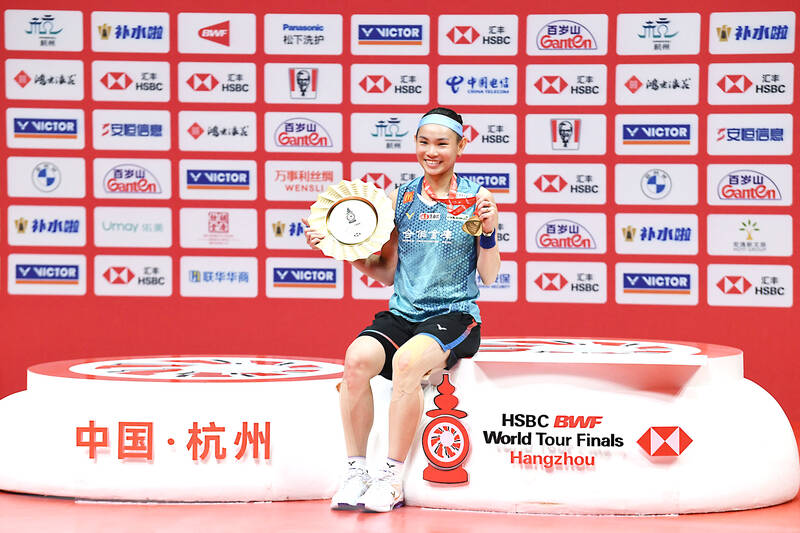
Photo: AFP
World No. 4 Tai and world No. 5 Marin were tied in head-to-head showdowns before the tournament, both having won 11 of their previous 22 matches against each other since 2014. The Spaniard most recently topped the Taiwanese shuttler 19-21, 21-15, 21-18 at the Victor Denmark Open in October, while Tai beat Marin 21-17, 10-21, 21-19 at the Victor China Open the month before that.
It was clear early on that yesterday’s match would be no different. After scoring tit-for-tat points in the opening moments of the first game, Marin went on a streak, taking an 18-9 lead, before winning 21-12.
While Tai seemed to thrive on making a comeback in the semi-final, she struggled against Marin.
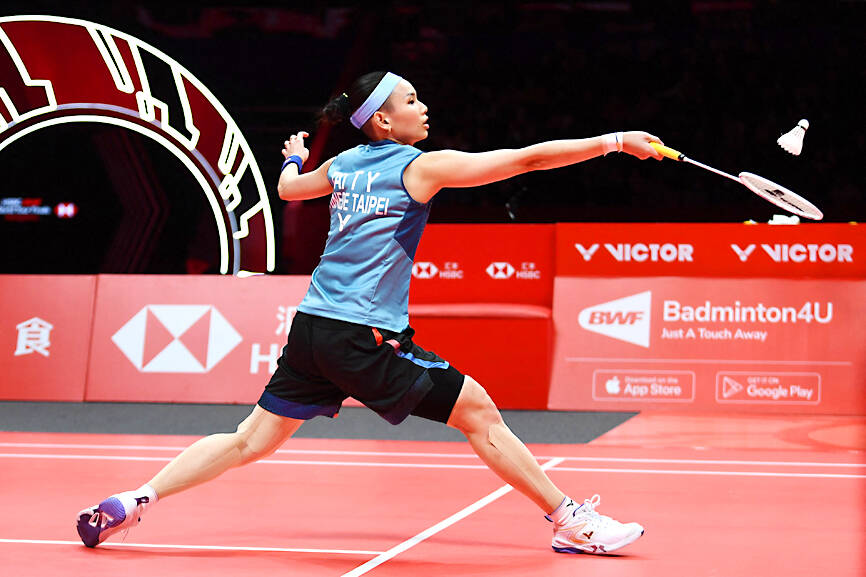
Photo: AFP
It was a close replay of their 2020 Finals match, when Tai last won the title after shaking off a first-game loss and beat Marin 14-21, 21-8, 21-19.
This time was harder. Marin continued to match Tai for nearly every point earned in the second game, until Tai went on a six-point streak to take and widen her lead to 15-11. That seemed to give her enough confidence to win the game 21-14.
In the final game, the two continued to match nearly every point, with Marin determined to win her first Finals title, or at least not give it up without a fight. The battle broke with Tai racking up six straight points to take a 19-13 lead. While the Spaniard got closer to evening the score, the Taiwanese held her ground to take the match 21-18.
On Saturday, Tai made a stunning comeback against world No. 1 An Se-young in their semi-final. The South Korean had beaten the Taiwanese in 10 of their previous 12 matches, including the day before.
In their final game, Tai avoided a seventh straight loss, rising from a nine-point deficit to win 19-21, 21-15, 22-20.
“I don’t remember the last time I made such a comeback,” Tai told the BWF Web site. “I can only remember my opponents catching up with me from a huge gap. Maybe my opponents can remember the matches where I caught up with them from a big gap.”
In April Tai announced that she would retire next year.
In yesterday’s first match, South Korea’s Kang Min-hyuk and Seo Seung-jae beat China’s Liang Weikeng and Wang Chang 21-17, 22-20 in 43 minutes to win the men’s doubles title.
In the women’s doubles, China’s Chen Qingchen and Jia Yifan dominated South Korea’s Baek Ha-na and Lee So-hee 21-16, 21-16.
In the mixed doubles final, China’s Zheng Siwei and Huang Yaqiong beat out compatriots Feng Yanzhe and Huang Dongping 21-11, 21-18.
The final match of the day, the men’s singles final, saw world No. 1 Viktor Axelsen of Denmark beat world No. 7 Shi Yuqi of China 21-11, 21-12.
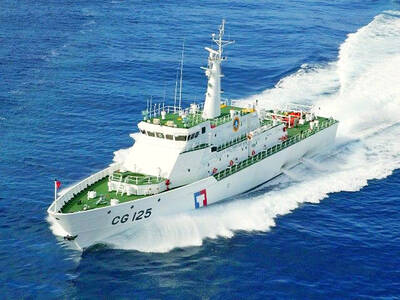
GEOPOLITICAL SIGNIFICANCE: The CGA’s nonmilitary role makes it a tool to avert diplomatic issues, an official said, while confirming the donation of a ship to Manila Coast Guard Administration (CGA) ships are scheduled to sail to the Philippines bearing the words “Taiwan Coast Guard” in a high-profile visit in October next year, the first such visit by a Taiwanese maritime law enforcement vessel to the Southeast Asian nation, the agency said yesterday. The CGA also confirmed that it had donated one of its decommissioned patrol vessels to the Philippines in a rare transfer of a retired ship to a nondiplomatic ally. The Republic of China (ROC) Navy last made such a visit in 1974, shortly before the Philippines switched diplomatic recognition to the People’s Republic of China in
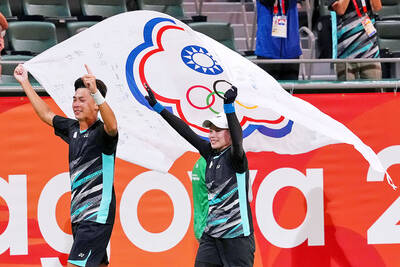
SOFT TENNIS: Yu Kai-wen and Huang Shih-yuan narrowly defeated their Japanese rivals to capture Taiwan’s first gold at the Asian Games in Nagoya Yu Kai-wen (余凱文) and Huang Shih-yuan (黃詩媛) won Taiwan’s first gold of this year’s Asian Games, defeating a Japanese duo in a nail-biter in the soft tennis mixed doubles final in Nagoya, Japan, while Johnny Sun (孫家閎) won silver in wushu and Shih Cheng-chung (石政中) won bronze in men’s kumite. Yu and Huang narrowly defeated Japan’s Toshiki Uematsu and Rena Temma 5-4 (2-4, 5-3, 4-2, 1-4, 1-4, 4-0, 1-4, 4-1, 7-5) to give Taiwan its first gold in soft tennis mixed doubles at an Asian Games since 2018. Sun secured Taiwan’s first wushu medal at this year’s game, with a combined score

CALL FOR CHANGE: They urged the UN to facilitate Taiwan’s involvement in the body, recognize its peace efforts and to work with members in preventing military conflict Representatives to the UN from five of Taiwan’s diplomatic allies sent a joint letter to UN Secretary-General Antonio Guterres on Friday, calling for the country’s inclusion in the body. Allies in the letter sent ahead of the 81st session of the UN General Assembly General Debate made three demands in support of Taiwan: inclusion, recognition and camaraderie. They implored the UN to seek an appropriate way to facilitate Taiwan’s meaningful involvement in the world governing body, saying that UN Resolution 2758, which accepted the People’s Republic of China (PRC) as a member of the UN, does not exclude Taiwan. Beijing claims that the
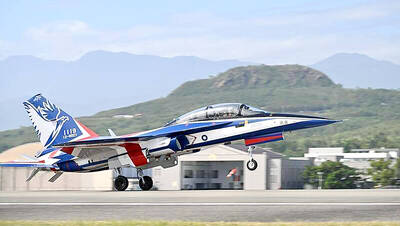
Aerospace Industrial Development Corp (AIDC, 漢翔航空工業) has finished production of the nation’s T-5 Brave Eagle (勇鷹) advanced jet trainers, with the final aircraft scheduled to be formally delivered at a ceremony on Thursday. The delivery of the trainer jets marks the end of the program, which dates back to 2017, with the first prototypes completed in 2019. Fifty-six of the 66 trainers had been delivered as of May. The Brave Eagle was developed and produced by AIDC and the National Chungshan Institute of Science and Technology. The program has provided a foundation for the development of a domestically produced next-generation primary trainer and


 RSS
RSS