


Tensions in the South China Sea have “increased rather than diminished” in the past few months, Philippine President Ferdinand Marcos Jr said, warning that a “more assertive China” posed a “real challenge” to its Asian neighbors.
In an interview with Japanese media on Saturday, Marcos underscored the need to forge strong alliances with like-minded allies, akin to the trilateral cooperation among the Philippines, Japan and the US.
His comments came as leaders from Japan and ASEAN at a special summit in Tokyo yesterday adopted a joint vision that emphasizes security and economic cooperation while respecting the rule of law, amid growing concern over China’s maritime activities in the region.
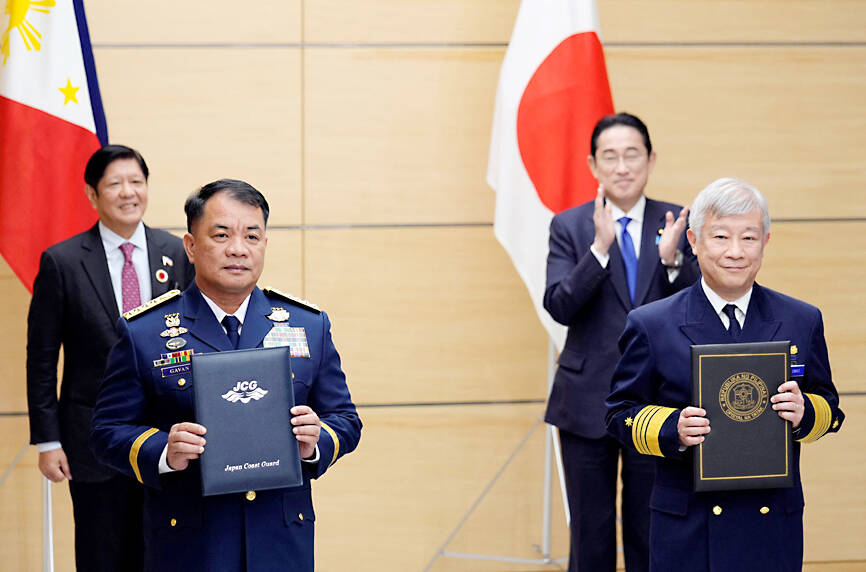
Photo: Reuters
“I’m afraid we’ll have to be able to say that tensions have increased rather than diminished for the past months or the past years,” a news release from Marcos’ office quoted the president as saying.
A week ago, Manila and Beijing traded accusations over a collision of their vessels near a disputed shoal in the South China Sea as tensions over claims in the vital waterway escalate.
In addition to the Philippines, Taiwan and ASEAN members Vietnam, Indonesia, Malaysia and Brunei claim parts of the South China Sea disputed by China, which claims almost all of the sea, a conduit for more than US$3 trillion of annual ship-borne commerce.
The Permanent Court of Arbitration in 2016 said that China’s claims had no legal basis, a ruling the US supports, but Beijing rejects.
The Philippines and Japan have started talks on a reciprocal access agreement that would allow the deployment of military forces on each other’s soil, amid growing tensions in the region. Japan also has maritime disputes with China.
“It is not sufficient actually with just Japan and the Philippines to enter into this agreement. We really must get more of these kind of arrangements in place,” Marcos said.
In Tokyo, the leaders, in a joint statement, called for strengthening their “mutually beneficial” partnership and working together for peace and stability in the Indo-Pacific region, especially in maritime security.
“We affirm the shared view to promote a rules-based Indo-Pacific region that is free and open [and] embraces key principles such as ASEAN’s unity and centrality, inclusiveness [and] transparency,” the joint statement said.
The leaders stressed “respect for sovereignty and territorial integrity, settlement of differences or disputes by peaceful means and renunciation of the threat or use of force.”
They did not specifically mention China.
Additional reporting by AP
CREDIT-GRABBER: China said its coast guard rescued the crew of a fishing vessel that caught fire, who were actually rescued by a nearby Taiwanese boat and the CGA Maritime search and rescue operations do not have borders, and China should not use a shipwreck to infringe upon Taiwanese sovereignty, the Coast Guard Administration (CGA) said yesterday. The coast guard made the statement in response to the China Coast Guard (CCG) saying it saved a Taiwanese fishing boat. The Chuan Yu No. 6 (全漁6號), a fishing vessel registered in Keelung, on Thursday caught fire and sank in waters northeast of Diaoyutai Islands (釣魚台). The vessel left Keelung’s Badouzih Fishing Harbor (八斗子漁港) at 3:35pm on Sunday last week, with seven people on board — a 62-year-old Taiwanese captain surnamed Chang (張) and six
RISKY BUSINESS: The ‘incentives’ include initiatives that get suspended for no reason, creating uncertainty and resulting in considerable losses for Taiwanese, the MAC said China’s “incentives” failed to sway sentiment in Taiwan, as willingness to work in China hit a record low of 1.6 percent, a Ministry of Labor survey showed. The Directorate-General of Budget, Accounting and Statistics (DGBAS) also reported that the number of Taiwanese workers in China has nearly halved from a peak of 430,000 in 2012 to an estimated 231,000 in 2024. That marked a new low in the proportion of Taiwanese going abroad to work. The ministry’s annual survey on “Labor Life and Employment Status” includes questions respondents’ willingness to seek employment overseas. Willingness to work in China has steadily declined from

The Legislative Yuan’s Finance Committee yesterday approved proposed amendments to the Amusement Tax Act (娛樂稅法) that would abolish taxes on films, cultural activities and competitive sporting events, retaining the fee only for dance halls and golf courses. The proposed changes would set the maximum tax rate for dance halls and golf courses at 50 and 20 percent respectively, with local governments authorized to suspend the levies. Article 2 of the act says that “amusement tax shall be levied on tickets sold or fees charged by amusement places, facilities or activities” in six categories: “Cinema; professional singing, story-telling, dancing, circus, magic show, acrobatics
INFLATION UP? The IMF said CPI would increase to 1.5 percent this year, while the DGBAS projected it would rise to 1.68 percent, with GDP per capita of US$44,181 The IMF projected Taiwan’s real GDP would grow 5.2 percent this year, up from its 2.1 percent outlook in January, despite fears of global economic disruptions sparked by the US-Iran conflict. Taiwan’s consumer price index (CPI) is projected to increase to 1.5 percent, while unemployment would be 3.4 percent, roughly in line with estimates for Asia as a whole, the international body wrote in its Global Economic Outlook Report published in the US on Monday. The figures are comparatively better than the IMF outlook for the rest of the world, which pegged real GDP growth at 3.1 percent, down from 3.3 percent


 RSS
RSS