


The Chinese People’s Liberation Army (PLA) as of October had doubled the number of ships and airplanes deployed around Taiwan compared with the previous two years, Vice Minister of National Defense Hsu Szu-chien (徐斯儉) said yesterday, a day after the opposition-controlled legislature voted against reviewing the government’s general budget for next year, including a NT$1.25 trillion (US$39.71 billion) special defense spending bill.
The legislature’s vote against the Ministry of National Defense’s spending plans was regrettable, as the budget was designed to respond to the developing Chinese military threat, Hsu said on the sidelines of a legislative meeting on the general budget.
Defense spending, be it part of a regular or special budget, is important, as it shows that the nation is willing to defend itself and fufill its responsibility to regional stability, he said.
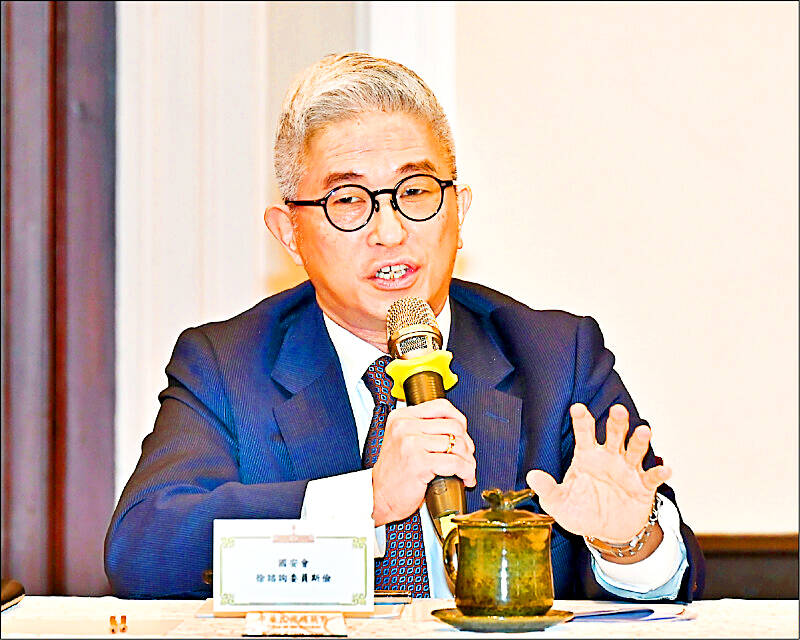
Photo: Hsieh Chun-lin, Taipei Times
Deferring the review of special budget means the government has been deprived of allotments for asymmetric warfare development and training, as well as funding for the whole-of-society defense resiliency program, he said.
Lawmakers from across the political divide should support adding the defense budget to the agenda of the Procedure Committee, he said, adding that the ministry is open to discussion and oversight regarding the bill.
Asked about a Pentagon report that stated China would achieve the capability to successfully invade Taiwan by 2027, Hsu said that the document noted that China would be able to strike all US bases on the first island chain by then.
The highlight of the report was that the PLA’s capabilities are rising to the point where it could target US forces and its allies in the Indo-Pacific region, introducing a new variable to its potential ability to defeat Taiwan, he said.
The report is a reminder of the nation’s urgent need to bolster its defenses, Hsu said.
The congressionally mandated report, which was posted on the Pentagon’s Web site on Tuesday, is the first of the second administration of US President Donald Trump.
It described a Chinese military that is increasingly sophisticated and resilient, wary of large-scale agreements with the US and learning lessons from Russia’s setbacks in Ukraine as it increases pressure on Taiwan.
Even as China and Russia deepen their strategic partnership, “almost certainly driven by a shared interest in countering the United States,” cooperation is hindered by both sides harboring a “mutual distrust” of each other, the report said.
China’s “large and growing arsenal” of nuclear, maritime, conventional long-range strike, cyber and space capabilities are able to “directly threaten America’s security,” it said.
China’s stockpile of nuclear warheads was in the low 600s through last year, a slower rate of production compared with previous years, it said, without explaining what might have caused the slowdown.
The report highlighted the PLA’s progress toward its 2027 targets — the first stage in Chinese President Xi Jinping’s (習近平) strategy for military modernization.
It describes the goals as achieving “strategic decisive victory” over Taiwan, “strategic counterbalance” against the US, and “strategic deterrence and control” against other regional countries.
“In other words, China expects to be able to fight and win a war on Taiwan by the end of 2027,” the report said, adding that the PLA is refining multiple military options to “force Taiwan unification by brute force.”
Its options range from an amphibious invasion to a maritime blockade, it said.
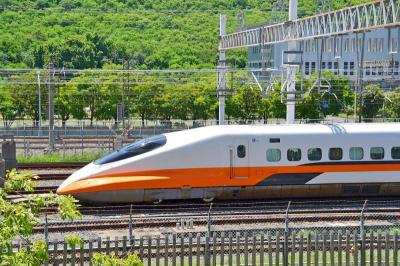
A signaling system malfunction disrupted high-speed rail (HSR) services beginning at 8am today, with trains temporarily reduced to three northbound and three southbound trains per hour as authorities conduct inspections. The malfunction occurred on a section of track in Miaoli County during pre-operation checks early this morning, forcing northbound and southbound trains to use a single track, the HSR operator said. The regular schedule has been replaced with three hourly trains offering only nonreserved seating in each direction, stopping at every station, it said, adding that business class cars would still have reserved seating. Departures from terminal stations are scheduled at the top
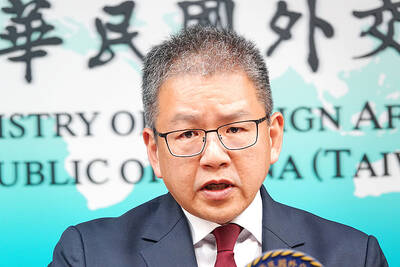
Taiwan is still in the process of assessing the possibility of recruiting workers from Eswatini, the Ministry of Foreign Affairs said yesterday, adding that its goal is to help Eswatini upgrade its vocational training centers. If there are plans to recruit workers from Eswatini, safeguarding national security, protecting public health and ensuring the employment rights of Taiwanese would be prerequisites, Department of West Asian and African Affairs Director-General Yen Chia-liang (顏嘉良) told a news conference. Key considerations would also include filling labor shortages in specific industries, and fostering bilateral professional and technical exchanges, he said. Yen was asked about the progress of labor
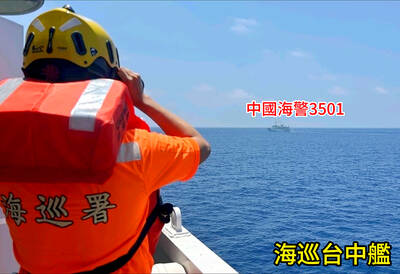
VERBOSE VESSELS: A CGA cutter and a China Coast Guard exchanged verbal barbs for more than a day in Taiwanese-controlled waters before the Chinese vessel left The Taiwanese and Chinese coast guards had a standoff near the strategically located Pratas Islands (Dongsha Islands, 東沙群島) in the north of the South China Sea, the Coast Guard Administration (CGA) said yesterday. The two sides engaged in intense radio exchanges over sovereignty claims during the 33-hour standoff. China Coast Guard vessel 3501 eventually left the restricted waters, 26.6 nautical miles (49.2km) west of the Pratas Islands, at 5pm yesterday, the CGA said. Lying approximately between southern Taiwan and Hong Kong, the Taiwan-controlled Pratas are seen by some security experts as vulnerable to Chinese attack due to their distance — more than

A US uncrewed surface vessel (USV) encountered multiple Chinese warships during an autonomous transit of the Taiwan Strait, US defense company Seasats said in a statement on Wednesday. Seasats announced that a Lightfish USV had completed the first autonomous transit of the Taiwan Strait. Over five days, the USV traversed the entire length of the Strait while constantly monitoring surface vessel traffic, the company said. The Lightfish encountered multiple Chinese warships, one of which was a Chinese People’s Liberation Army Navy (PLAN) Type 056 corvette, it said. The Chinese vessels were operating “well within Taiwan’s exclusive economic zone without transmitting their identity via the


 RSS
RSS