


China yesterday defended bounties offered for the capture of Hong Kong dissidents who live abroad.
Rewards of HK$1 million (US$128,000) have been offered for information leading to the capture of 13 opposition figures accused of contravening Hong Kong’s National Security Law.
Chinese Ministry of Foreign Affairs spokeswoman Mao Ning (毛寧) said that the arrest orders were “necessary and justified and ... in line with international law and practice.”
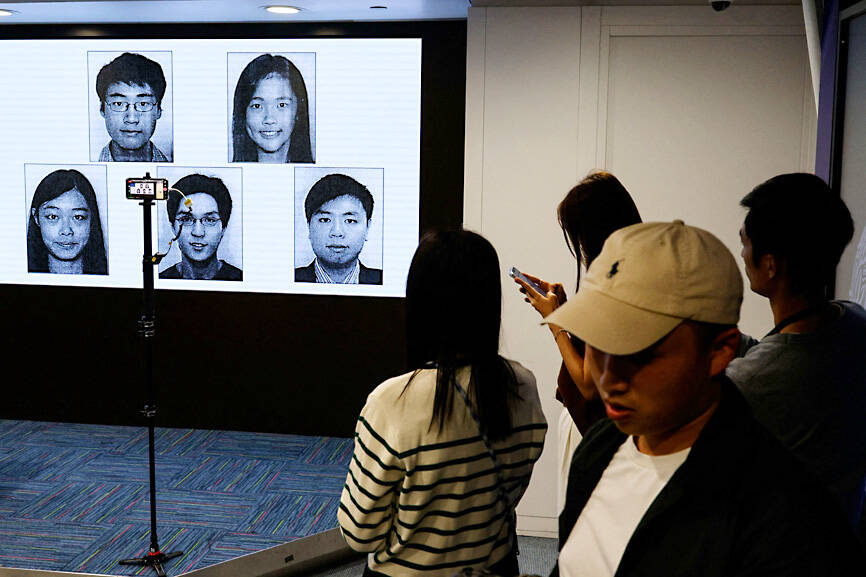
Photo: Reuters
Foreign governments’ support for those on the list was merely cover for their aim of destabilizing Hong Kong, Mao told reporters at a daily briefing.
On Thursday, Hong Kong police accused five other overseas-based rights advocates of contravening the security law and offered rewards for their arrests.
The five “endangered national security by destabilizing Hong Kong under the guise of democracy and human rights,” Mao said.
The arrest warrants were issued for Johnny Fok (霍嘉誌) and Tony Choi (蔡明達), who host a YouTube channel focusing on current affairs, and democracy advocates Simon Cheng (鄭文傑), Hui Wing-ting (許穎婷) and Joey Siu (邵嵐).
Those on the wanted list are believed to be living in self-exile mainly in Britain, the US and Australia.
In July, Hong Kong warned eight other activists who now live abroad that they would be pursued for life with bounties put on them.
The US and British governments have denounced the arrest warrants and bounties as flying in the face of human rights and democratic norms.
Cheng wrote on X that he embraced the charges.
“Being hunted by China (Hong Kong)’s secret police, under a one-million-dollar bounty, is a lifelong honor,” he wrote.
Siu wrote on X that she would not be silenced.
“This morning I, a U.S. citizen, woke up to the news that an arrest warrant & a HKD $1 million bounty have been placed on my head by the Hong Kong govt. for exercising my freedoms in my own country,” she wrote.
“More to say later but for now: I will never be silenced, I will never back down,” she wrote.

NO-LIMITS PARTNERSHIP: ‘The bottom line’ is that if the US were to have a conflict with China or Russia it would likely open up a second front with the other, a US senator said Beijing and Moscow could cooperate in a conflict over Taiwan, the top US intelligence chief told the US Senate this week. “We see China and Russia, for the first time, exercising together in relation to Taiwan and recognizing that this is a place where China definitely wants Russia to be working with them, and we see no reason why they wouldn’t,” US Director of National Intelligence Avril Haines told a US Senate Committee on Armed Services hearing on Thursday. US Senator Mike Rounds asked Haines about such a potential scenario. He also asked US Defense Intelligence Agency Director Lieutenant General Jeffrey Kruse
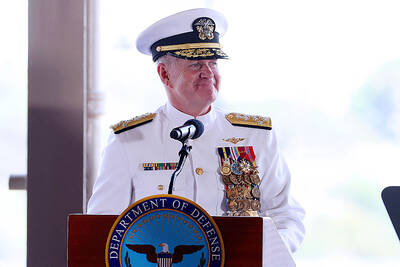
China’s intrusive and territorial claims in the Indo-Pacific region are “illegal, coercive, aggressive and deceptive,” new US Indo-Pacific Commander Admiral Samuel Paparo said on Friday, adding that he would continue working with allies and partners to keep the area free and open. Paparo made the remarks at a change-of-command ceremony at Joint Base Pearl Harbor-Hickam in Hawaii, where he took over the command from Admiral John Aquilino. “Our world faces a complex problem set in the troubling actions of the People’s Republic of China [PRC] and its rapid buildup of forces. We must be ready to answer the PRC’s increasingly intrusive and

INSPIRING: Taiwan has been a model in the Asia-Pacific region with its democratic transition, free and fair elections and open society, the vice president-elect said Taiwan can play a leadership role in the Asia-Pacific region, vice president-elect Hsiao Bi-khim (蕭美琴) told a forum in Taipei yesterday, highlighting the nation’s resilience in the face of geopolitical challenges. “Not only can Taiwan help, but Taiwan can lead ... not only can Taiwan play a leadership role, but Taiwan’s leadership is important to the world,” Hsiao told the annual forum hosted by the Center for Asia-Pacific Resilience and Innovation think tank. Hsiao thanked Taiwan’s international friends for their long-term support, citing the example of US President Joe Biden last month signing into law a bill to provide aid to Taiwan,
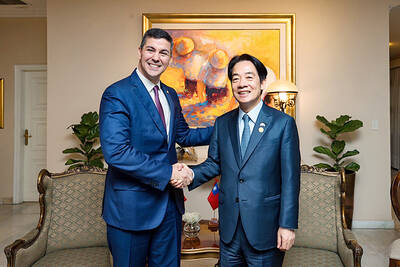
UNWAVERING: Paraguay remains steadfast in its support of Taiwan, but is facing growing pressure at home and abroad to switch recognition to Beijing, Pena said Paraguayan President Santiago Pena has pledged to continue enhancing cooperation with Taiwan, as he and Japanese Prime Minister Fumio Kishida expressed opposition to any unilateral change to the “status quo” in the Taiwan Strait using force, Japanese media reported on Saturday. Kishida yesterday completed a trip to France, Brazil and Paraguay, his first visit to South America since taking office in 2021. After the Japanese leader and Pena spoke for more than an hour on Friday, exchanging views on the situation in East Asia in the face of China’s increasing military pressure on Taiwan, they affirmed that “unilateral attempts to change the


 RSS
RSS