


President Tsai Ing-wen (蔡英文) yesterday at a ceremony to promote 26 senior military officers touted her administration’s efforts in developing indigenous weapon systems during her nearly eight years in office.
At the ceremony at the Ministry of National Defense’s Taipei headquarters — the last Tsai attended before her second four-year term ends in May next year — she said she had launched several military reforms to boost the armed forces’ readiness.
Such efforts include building warplanes and warships at home, such as Taiwan’s first indigenous defense submarine the Hai Kun (海鯤), or “Narwhal,” and bolstering the military’s combat readiness and resilience, she said.
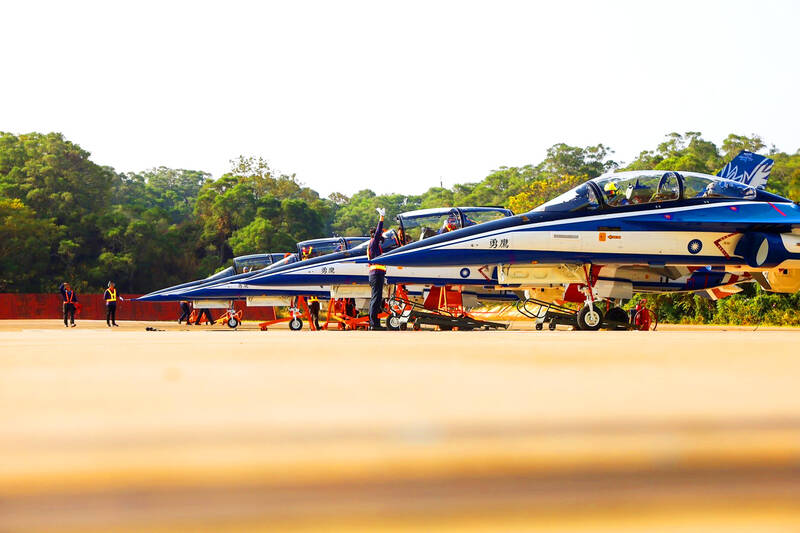
Photo: CNA
Tsai also thanked the promoted officers for their tireless efforts, and urged them to continue to exercise their leadership in their new roles.
The promotion of senior military personnel used to be carried out twice a year, but is now done at monthly events after the legislature revised the law in May last year.
However, the conferral ceremony is still held twice a year — in June and in December.
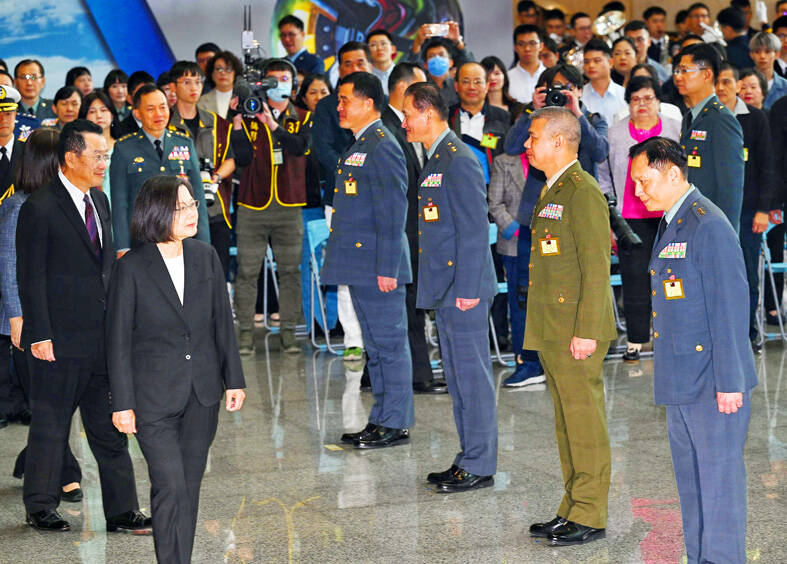
Photo: Chang Chia-ming, Taipei Times
Seven officers were yesterday promoted to the rank of two-star general — either lieutenant general or admiral — and 19 were promoted to one-star generals — either major general or vice admiral.
Among the seven new two-star generals was former military spokesman Major General Shih Shun-wen (史順文), who heads the Army Command Headquarters’ Political Warfare Department.
A graduate of Fu Hsing Kang College’s class of 1990, he previously served as a news section chief at the Army Command Headquarters and was political warfare head in Kinmen County.
Separately, Aerospace Industrial Development Corp (AIDC, 漢翔航空工業) yesterday delivered four trainer aircraft — the last four of seven scheduled for delivery this year — to the air force.
The “Brave Eagle” planes were showcased at a press event at AIDC’s manufacturing hub in Taichung and conducted a flyover there before heading to Chihang Air Base in Taitung County.
The Brave Eagle is an advanced jet trainer that is to gradually replace the military’s F-5E/F jets and AT-3 jet trainers.
The government ordered 66 of the advanced trainer aircraft from AIDC in 2017, to be delivered by 2026.
Seventeen were to be delivered by the end of this year. Two were delivered in 2021, eight were delivered last year and three had been delivered earlier this year.
There had been concerns that the last four would not be handed over in time, but the delivery was made with 19 days left to spare.
AIDC president Ma Wan-june (馬萬鈞) said it has been challenging to manufacture the planes, as the supply chain was cut off due to the COVID-19 pandemic, and it was not until Nov. 20 that they had enough key materials to assemble the planes.
AIDC workers then spent day and night manufacturing the planes before conducting ground tests, Ma said.
Meanwhile, the air force’s Project Feng Chan (鳳展) to upgrade its 141 F-16A/B jets to match F-16Vs in capability is expected to conclude on Thursday next week, military sources said yesterday.
The project — a collaboration between AIDC and Lockheed-Martin Corp of the US — was launched in 2018.
The air force separately purchased 66 Block 70 F-16Vs from the US under Project Feng Hsiang (鳳翔), the source said.
The Ministry of National Defense’s budget for next year showed that NT$140.2 billion (US$4.45 billion) has been allocated to the project, which was expected to conclude by the end of this month, the source said.
A separate project involving munitions upgrades is expected to be completed by next year, they added.
Tests on the last upgraded jet were completed on Dec. 3, the source said, adding that AIDC and Lockheed-Martin needed to complete final preparations, but no more flight tests are planned.
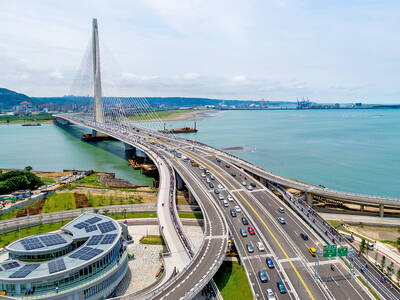
The Ministry of Transportation and Communications yesterday inaugurated the Danjiang Bridge across the Tamsui River in New Taipei City, saying that the structure would be an architectural icon and traffic artery for Taiwan. Feted as a major engineering achievement, the Danjiang Bridge is 920m long, 211m tall at the top of its pylon, and is the longest single-pylon asymmetric cable-stayed bridge in the world, the government’s Web site for the structure said. It was designed by late Iraqi-British architect Zaha Hadid. The structure, with a maximum deck of 70m, accommodates road and light rail traffic, and affords a 200m navigation channel for boats,
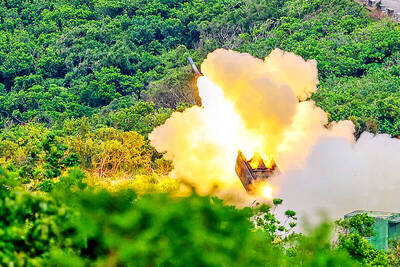
PRECISION STRIKES: The most significant reason to deploy HIMARS to outlying islands is to establish a ‘dead zone’ that the PLA would not dare enter, a source said A High Mobility Artillery Rocket System (HIMARS) would be deployed to Penghu County and Dongyin Island (東引) in Lienchiang County (Matsu) to force the Chinese military to retreat at least 100km from the coastline, a military source said yesterday. Taiwan has been procuring HIMARS and Army Tactical Missile Systems (ATACMS) from the US in batches. Once all batches have been delivered, Taiwan would possess 111 HIMARS units and 504 ATACMS, which have a range of 300km. Considering that “offense is the best defense,” the military plans to forward-deploy the systems to outlying islands such as Penghu and Dongyin so that

Taiwan Semiconductor Manufacturing Co (TSMC, 台積電), the world’s largest foundry service provider, yesterday said that global semiconductor revenue is projected to hit US$1.5 trillion in 2030, after the figure exceeds US$1 trillion this year, as artificial intelligence (AI) demand boosts consumption of token and compute power. “We are still at the beginning of the AI revolution, but we already see a significant impact across the whole semiconductor ecosystem,” TSMC deputy cochief operating officer Kevin Zhang (張曉強) said at the company’s annual technology symposium in Hsinchu City. “It is fair to say that in the past decade, smartphones and other mobile devices were
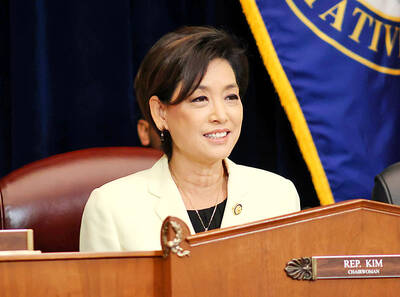
‘CLEAR MESSAGE’: The bill would set up an interagency ‘tiger team’ to review sanctions tools and other economic options to help deter any Chinese aggression toward Taiwan US Representative Young Kim has introduced a bill to deter Chinese aggression against Taiwan, calling for an interagency “tiger team” to preplan coordinated sanctions and economic measures in response to possible Chinese military or political action against Taiwan. “[Chinese President] Xi Jinping [習近平] has directed the People’s Liberation Army to be ready to invade Taiwan by 2027. China has a plan. America should have one too,” Kim said in a news release on Thursday last week. She introduced the “Deter PRC [People’s Republic of China] aggression against Taiwan act” to “ensure the US has a coordinated sanctions strategy ready should


 RSS
RSS