


Japanese Prime Minister Fumio Kishida yesterday said that his country, the Philippines and the US were cooperating to protect the freedom of the South China Sea as he committed to help enhance Manila’s security capabilities, a day after Washington and Beijing held “candid” talks on maritime issues.
“In the South China Sea, trilateral cooperation to protect the freedom of the sea is under way,” Kishida, on an official visit, said in an address before the Philippine Congress in the capital, Manila.
Kishida and Philippine President Ferdinand Marcos Jr agreed on Friday to start negotiations on a reciprocal troop access deal to enhance military cooperation as China becomes increasingly assertive in the region.
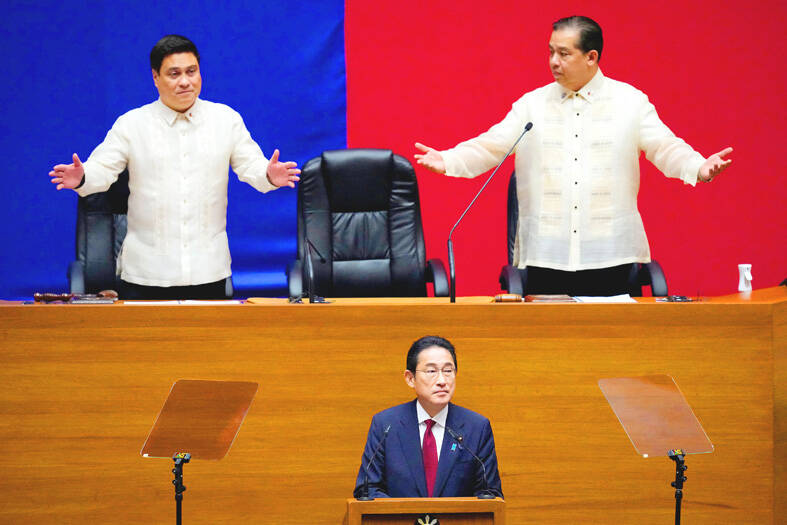
Photo: AFP
The Philippines and Japan, two of the US’ closest Asian allies, have taken a strong line against what they see as aggressive behavior by Chinese vessels amid decades-old disputes over maritime sovereignty.
Last month China and the Philippines traded accusations over a collision in the disputed waters of the South China Sea as Chinese vessels blocked Philippine boats supplying forces there.
Although Tokyo does not have any claim to the South China Sea, it has a maritime dispute with Beijing in the East China Sea.
“Japan will continue to contribute to the enhancement of the Philippines’ security capabilities, thereby contributing to regional peace and stability,” Kishida said.
Japan in March observed US-Philippine military drills, and in June the Philippine and Japanese coast guards trained together for the first time.
“Through these efforts, let us protect the maritime order, which is governed by laws and rules, not by force,” said Kishida, who in December last year unveiled Japan’s biggest military buildup as it looks to counter China’s growing military might.
Kishida said that Japan agreed to provide the Philippines with coastal surveillance radars, the first cooperation project under its Official Security Assistance program, aimed at helping boost deterrence capabilities of Tokyo’s partner countries.
The radars are to be placed in five areas along the Philippines coast, Kyodo News reported yesterday, citing an unnamed Japanese senior government official.
The report said the radars would be a fixed type and used by the Philippine Navy for coastal surveillance, but did not give further details on where the radars would be placed.
The US Department of State on Friday said that US Deputy Assistant Secretary of State in the Bureau of East Asia and Pacific Affairs Mark Lambert and Chinese Department of Boundary and Ocean Affairs Director-General Hong Liang (洪亮) discussed maritime issues in Beijing, with the US underscoring its concerns about “dangerous and unlawful” Chinese actions.
“The two sides held substantive, constructive and candid discussions on a range of maritime issues, including the situation in the South China Sea and East China Sea,” the US State Department said in a statement.
The US side reiterated the need to resume military-to-military channels, “to avoid miscommunication and miscalculation,” it said.
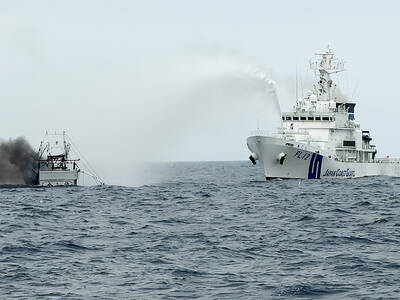
CREDIT-GRABBER: China said its coast guard rescued the crew of a fishing vessel that caught fire, who were actually rescued by a nearby Taiwanese boat and the CGA Maritime search and rescue operations do not have borders, and China should not use a shipwreck to infringe upon Taiwanese sovereignty, the Coast Guard Administration (CGA) said yesterday. The coast guard made the statement in response to the China Coast Guard (CCG) saying it saved a Taiwanese fishing boat. The Chuan Yu No. 6 (全漁6號), a fishing vessel registered in Keelung, on Thursday caught fire and sank in waters northeast of Diaoyutai Islands (釣魚台). The vessel left Keelung’s Badouzih Fishing Harbor (八斗子漁港) at 3:35pm on Sunday last week, with seven people on board — a 62-year-old Taiwanese captain surnamed Chang (張) and six

RISKY BUSINESS: The ‘incentives’ include initiatives that get suspended for no reason, creating uncertainty and resulting in considerable losses for Taiwanese, the MAC said China’s “incentives” failed to sway sentiment in Taiwan, as willingness to work in China hit a record low of 1.6 percent, a Ministry of Labor survey showed. The Directorate-General of Budget, Accounting and Statistics (DGBAS) also reported that the number of Taiwanese workers in China has nearly halved from a peak of 430,000 in 2012 to an estimated 231,000 in 2024. That marked a new low in the proportion of Taiwanese going abroad to work. The ministry’s annual survey on “Labor Life and Employment Status” includes questions respondents’ willingness to seek employment overseas. Willingness to work in China has steadily declined from

LEVERAGE: China did not ‘need to fire a shot’ to deny Taiwan airspace over Africa when it owns ‘half the continent’s debt,’ a US official said, calling it economic warfare The EU has raised concerns about overflight rights following the delay of President William Lai’s (賴清德) planned state visit to the Kingdom of Eswatini after three African nations denied overflight clearance for his charter at the last minute. Taiwanese allies Paraguay and Saint Kitts and Nevis, as well as several US lawmakers and the Inter-Parliamentary Alliance on China (IPAC) condemned China for allegedly pressuring the countries. Lai was scheduled to fly directly to Taiwan’s only African ally from yesterday to Sunday to celebrate the 40th anniversary of King Mswati III’s accession and his 58th birthday, but Seychelles, Mauritius and Madagascar suddenly revoked
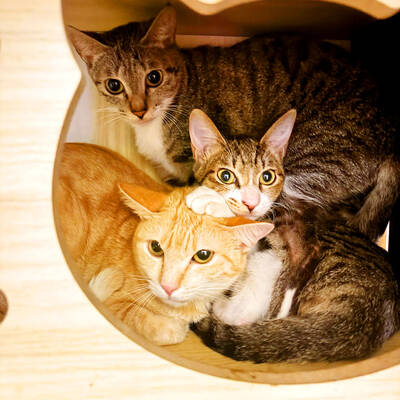
The number of pet cats in Taiwan surpassed that of pet dogs for the first time last year, reaching 1,742,033, a 32.8 percent increase from 2023, the Ministry of Agriculture said yesterday, citing a survey. By contrast, the number of pet dogs declined slightly by 1.2 percent over the same period to 1,462,528, the ministry said. Despite the shift, households with dogs still slightly outnumber those with cats by 1.2 percent. However, while the number of households with multiple dogs has remained relatively stable, households keeping more than two cats have increased, contributing to the overall rise in the feline population. The trend


 RSS
RSS