


The government is looking at providing Taiwan Semiconductor Manufacturing Co (TSMC, 台積電) with preferential rates for power and water usage, as well as a plot of land, from as early as next June, should it consider building its 1.4-nanometer fab in the Central Taiwan Science Park’s (中部科學園區) Taichung Park (台中園區), a source said yesterday.
TSMC on Oct. 17 said it had dropped its plan to build a fab for the production of next-generation chips in the Longtan (龍潭) section of Hsinchu Science Park (新竹科學園區) amid protests by residents over the government’s appropriation of privately owned land for industrial use.
The Executive Yuan recently convened a meeting to discuss the issue, with Vice Premier Cheng Wen-tsan (鄭文燦) being briefed by the National Science and Technology Council and the Ministry of Economic Affairs, the source said, speaking on condition of anonymity.
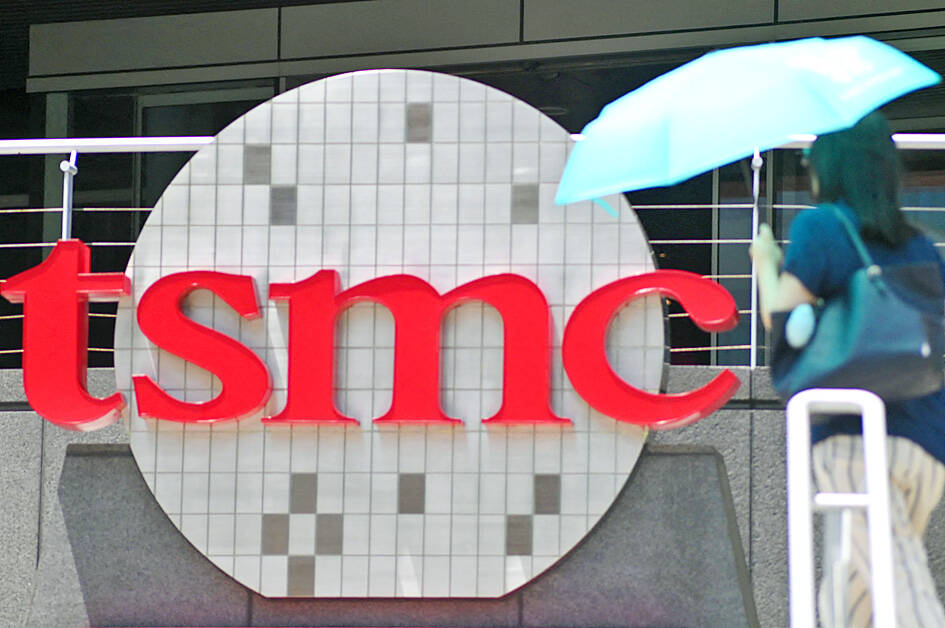
Photo: Sam Yeh, AFP
The Longtan section of the park was expected to expropriate 158.59 hectares so that semiconductor-related companies would have enough space to set up there, the source said.
Despite TSMC’s announcement that it was backing out of the Longtan plan, the section would still be dedicated to semiconductors, the source said, adding that the Executive Yuan has given the council, the Hsinchu Science Park Administration and the Taoyuan City Government the task of organizing talks with the Longtan protesters and providing them with a satisfactory solution.
If neither side can reach an amicable agreement, the Executive Yuan is considering the possibility of shrinking the area of land to be expropriated to exclude those who are the most opposed to the project, they said.
TSMC was initially eyeing the Longtan section and the Taichung Park, hoping to have fabs in both, the source said.
The discrepancy in the amount of land allotted to the two projects — TSMC had planned to use 158.59 hectares at Longtan and 90 hectares at the Taichung Park — should be manageable, the source said.
However, Taichung Mayor Lu Shiow-yen (盧秀燕) had previously said that another fab could see TSMC’s power usage increase from 15 percent to 38 percent of the municipality’s power, the source said.
Lu added that TSMC fabs would probably use up to 9 percent of the city’s water supply, they said.
If the company sets up its 1.4-nanometer fab in Taichung, it would require support from the Taichung City Government, the source said.
The city government in February passed the environmental assessment for Taichung Park’s second-phase expansion plan, and in August passed an urban planning project to accommodate it, they said.
After the National Land Management Agency receives the Taichung City Government’s revised plans, the Ministry of the Interior is planning to hold a meeting on Nov. 2 to assess the necessity of land expropriation before the report is forwarded to the Urban Planning Committee for review.
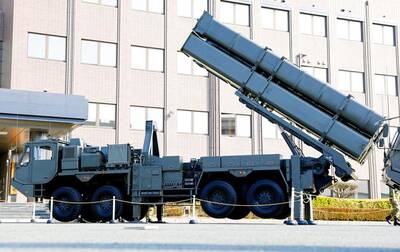
Japan has deployed long-range missiles in a southwestern region near China, the Japanese defense minister said yesterday, at a time when ties with Beijing are at their lowest in recent years. The missiles were installed in Kumamoto in the southern region of Kyushu, as Japan is attempting to shore up its military capacity as China steps up naval activity in the East China Sea. “Standoff defense capabilities enable us to counter the threat of enemy forces attempting to invade our country ... while ensuring the safety of our personnel,” Japanese Minister of Defense Shinjiro Koizumi said. “This is an extremely important initiative for
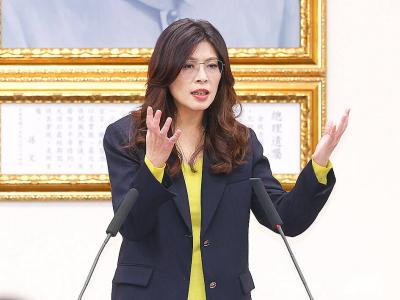
Chinese Nationalist Party (KMT) Chairwoman Cheng Li-wun (鄭麗文) today accepted an invitation from Chinese President Xi Jinping (習近平) to lead a delegation to China next month, saying she hopes to promote the peaceful development of cross-strait relations and bring stability to the Taiwan Strait. “I am grateful and happy to accept this invitation,” Cheng said in a statement from the KMT chairperson’s office. Cheng said she hopes both sides can work together to promote the peaceful development of cross-strait relations, enhance exchange and cooperation, bring stability to the Taiwan Strait and improve people’s livelihoods. At today's news conference, Cheng said any efforts to
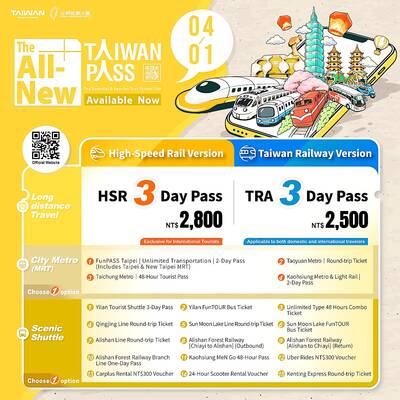
MORE POPULAR: Taiwan Pass sales increased by 59 percent during the first quarter compared with the same period last year, the Tourism Administration said The Tourism Administration yesterday said that it has streamlined the Taiwan Pass, with two versions available for purchase beginning today. The tourism agency has made the pass available to international tourists since 2024, allowing them to access the high-speed rail, Taiwan Railway Corp services, four MRT systems and four Taiwan Tourist Shuttles. Previously, five types of Taiwan Pass were available, but some tourists have said that the offerings were too complicated. The agency said only two types of Taiwan Pass would be available, starting from a three-day pass with the high-speed rail and a three-day pass with Taiwan Railway Corp. The former costs NT$2,800

The nation’s fastest supercomputer, Nano 4 (晶創26), is scheduled to be launched in the third quarter, and would be used to train large language models in finance and national defense sectors, the National Center for High-Performance Computing (NCHC) said. The supercomputer, which would operate at about 86.05 petaflops, is being tested at a new cloud computing center in the Southern Taiwan Science Park in Tainan. The exterior of the server cabinet features chip circuitry patterns overlaid with a map of Taiwan, highlighting the nation’s central position in the semiconductor industry. The center also houses Taiwania 2, Taiwania 3, Forerunner 1 and


 RSS
RSS