


US President Joe Biden and Australian Prime Minister Anthony Albanese on Wednesday toasted their shared stand on Israel, Ukraine and China, including peace and stability in the Taiwan Strait, during a lavish state visit aimed at deepening their countries’ century-old alliance.
“The alliance between Australia and the United States is an anchor to peace and prosperity,” the 80-year-old president said during a day of pomp and ceremony at the White House.
In the evening Biden treated Albanese, 60, to a gala dinner in a giant marquee erected on the South Lawn, with guests from the worlds of entertainment, business and technology. The visit underscored the importance Washington places on longtime ally Australia as a cornerstone of its strategy against an increasingly assertive Beijing in the Asia-Pacific region.
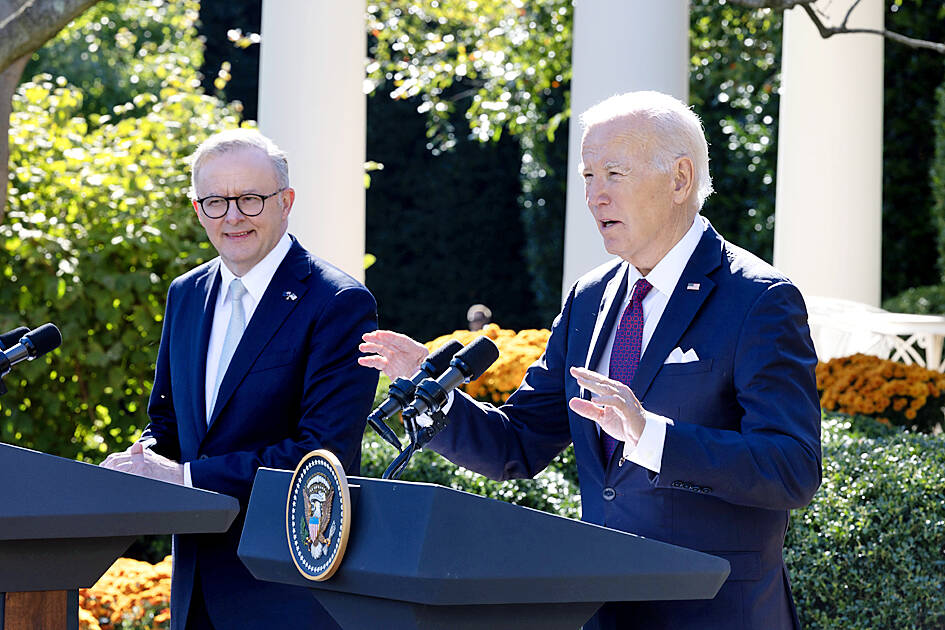
Photo: EPA
“A great deal of the history of our world will be written in the Indo-Pacific in the coming years,” Biden said. “Australia and the United States must write that story together.”
At a joint press conference with Biden earlier, Albanese said the bond between the two countries was crucial in an “uncertain world.”
“The relationship between Australia and the United States has never been more important. And it has never been stronger than it is right now,” he said.
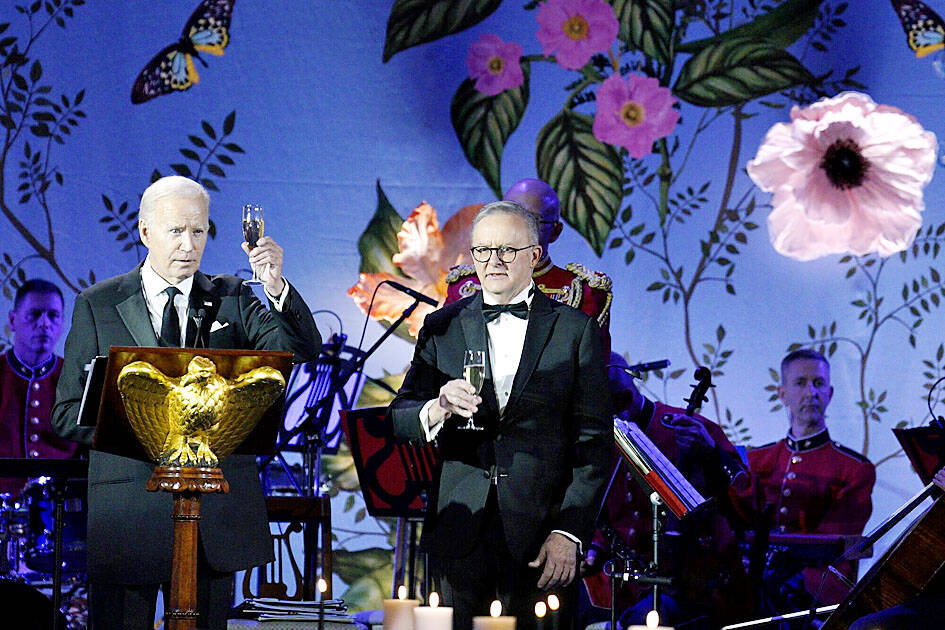
Photo: Bloomberg
During talks in the Oval Office, the leaders discussed progress on the so-called AUKUS deal between Australia, the UK and the US that would see Australia obtain nuclear-powered submarines. The trip also included announcements on technology and climate change, along with plans to boost Internet links and maritime infrastructure in Pacific island nations where China has been trying to expand its influence.
The two leaders also addressed the Israel-Hamas conflict and the war in Ukraine. Both countries are providing military aid to Kyiv and humanitarian aid for Palestinians in Gaza, while the US is supplying weapons to Israel.
Biden said both nations were “standing with Israel against Hamas terrorism” and “standing with Ukraine against [Russian President Vladimir] Putin’s tyranny.”
Albanese said “all Australians condemn the atrocities, terror and pitiless brutality of Hamas.”
China’s rise remains a long-term concern for the two allies, even as they both seek something of a reset with Beijing. Albanese is to hold talks with Chinese President Xi Jinping (習近平) in Beijing early next month, while Biden might meet Xi an APEC forum in San Francisco later the same month.
The two leaders also reaffirmed the importance of peace and stability in the Taiwan Strait and opposition to unilateral changes in the “status quo.”
“We call for the peaceful resolution of cross-strait issues through dialogue without the threat or use of force or coercion,” they said in a joint statement following their meeting.
They also emphasized the importance of open communication and practical measures to “reduce the risk of misunderstanding and miscalculation” in the Indo-Pacific region, the statement said.
Expressing concern about China’s “excessive maritime claims that are inconsistent with international law,” the two leaders resolved to work with partners to uphold maritime security.
Biden said the United States was in “competition not conflict” with China, but took a tough tone on recent collisions between Chinese and Philippine vessels in the South China Sea.
“I want to be very clear. The United States defense commitment to the Philippines is ironclad,” he told the press conference.
Additional reporting by staff writer

‘NO SECURITY RISK’: The Railway Bureau reassured the public that the technicians’ activities were limited to technical guidance and did not involve sensitive systems The Railway Bureau yesterday said it had invited eight Chinese technicians to assist with an airport MRT construction project. The bureau issued the confirmation after an Internet user said Chinese nationals had entered the construction zone of Taiwan Taoyuan International Airport’s Terminal 3 project. They asked why “individuals from an enemy state” were allowed access to such a major national infrastructure project, which raised serious concerns over Taiwan’s industrial safety, sensitive systems and information security. The bureau’s Northern Region Engineering Branch Office said subcontractor Taiwan Handle Industrial Co (台灣手把工業) of the Taoyuan airport MRT’s “Contract No. CU05 Project A14 Station Civil, MEP &

The National Chungshan Institute of Science and Technology yesterday showcased its locally developed variants of the Vision 60 robotic patrol dog, which it plans to deploy on the nation’s outlying territories in the South China Sea. The variants were produced under the Joint Lab project — created by the institute and domestic companies — and assembled with domestically produced motors, lenses and artificial intelligence (AI) systems alongside licensed tech from the US, Missile and Rocket Systems Research Division deputy director Jen Kuo-kang (任國光) told the media event at a military base in Taipei’s Dazhi (大直) area. Taiwan has built up its strengths

TIT-FOR-TAT: The US allegedly revoked the visa of a Chinese national working at Xinhua News Agency in the US in response to Beijing’s expulsion of Vivian Wang The Presidential Office yesterday condemned China for expelling a New York Times correspondent from Beijing following the newspaper’s interview with President William Lai (賴清德), saying the move highlighted Beijing’s suppression of press freedom and its threat to international news media. Taiwan has noted a series of recent incidents in which Beijing used similar tactics to “threaten and pressure international media outlets and journalists,” Presidential Office spokeswoman Karen Kuo (郭雅慧) said in a statement. “This concerns not only press freedom and freedom of expression, but also the safety of journalists, and Taiwan and relevant partners are paying close attention to the situation,” she

NOT IMMEDIATE: Taiwan has a chance to appeal the proposed 10 percent tariff before it starts, while other countries face a 12.5 percent tariff from the trade office Taiwan is among 60 economies determined by the US to have failed to impose or enforce a ban on the importation of goods produced with forced labor, according to a notice released on Tuesday by the Office of the US Trade Representative (USTR), which proposed imposing an additional 10 percent or more tariff on them. The USTR in a statement said that following an investigation, it had determined under Section 301 of the Trade Act of 1974 that the failure of the 60 economies to impose and effectively enforce a prohibition on the importation of goods produced with forced labor is


 RSS
RSS