


President Tsai Ing-wen (蔡英文) yesterday reiterated the importance of maintaining the “status quo” and called on both sides of the Taiwan Strait to seek peaceful coexistence in her Double Ten National Day speech.
Presiding over the National Day celebration as president for the last time, Tsai called for cross-strait peace and reflected on the milestones of the past seven years since she first took office in 2016.
“My administration has kept its promises and maintained the ‘status quo.’ We have adhered to the four commitments. We do not provoke, we do not act rashly and we will absolutely not bow to pressure,” Tsai said.
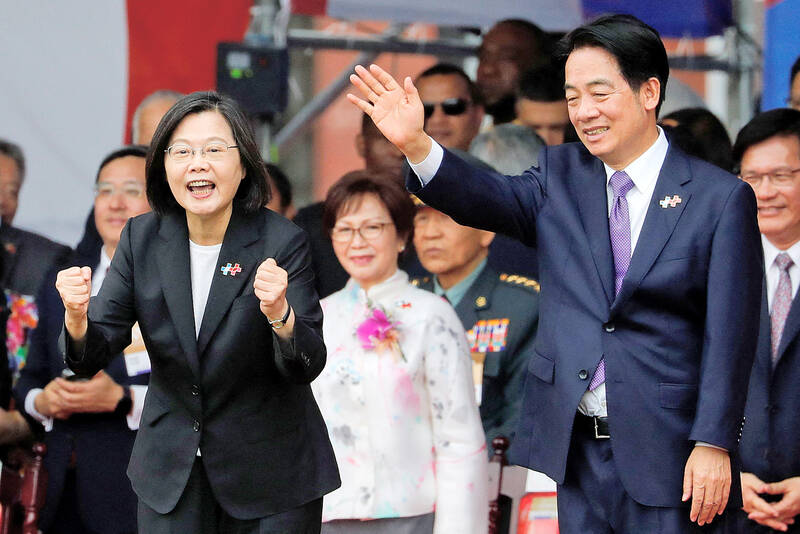
Photo: Carlos Garcia Rawlins, Reuters
Taiwan, as a force for good in the world, has been working with like-minded partners to safeguard regional peace and stability, as well as providing assistance to nations in need, she said.
Taiwan has proved itself to be a “reliable, effective and safe partner to the world” in geopolitics, democracy and supply chains, which has earned the nation unprecedented international support, she said.
“Since this is a time we can now face the world with confidence and resolve, we can also be calm and self-assured in facing China, creating conditions for peaceful coexistence and future development across the Taiwan Strait,” she said. “Peace is the only option across the Strait.”
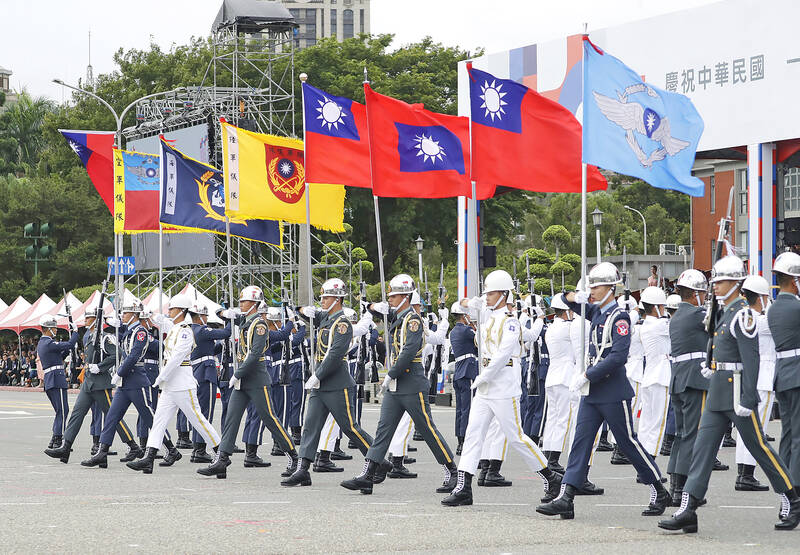
Photo: AP
“Peaceful and stable cross-strait relations” should not undermine Taiwan’s sovereignty, democracy and freedom, and should be based on a public consensus and respect for historical facts, she said.
Tsai called on political parties to unite in the face of external challenges after the presidential and legislative elections in January next year.
Seeking a mutually acceptable coexistence with Beijing “is not only the shared responsibility of Taiwan’s political parties, it is also an unavoidable historic responsibility and common mission across the Strait,” she said.
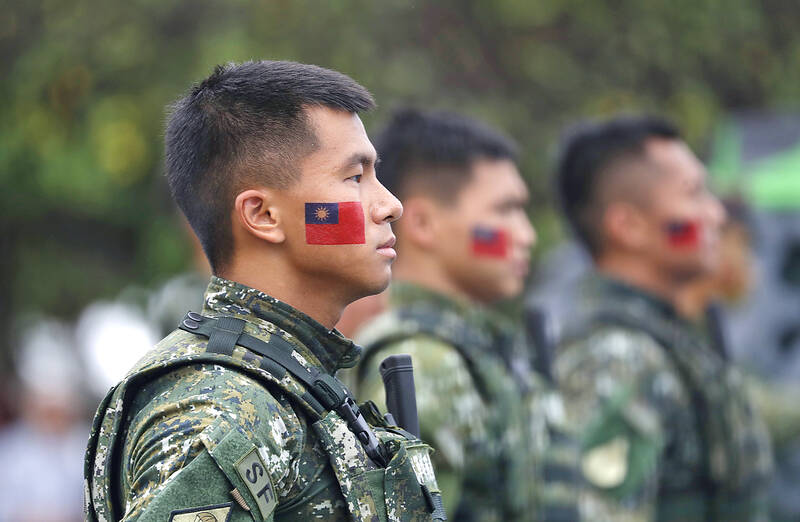
Photo: AP
On domestic issues, Tsai highlighted Taiwan’s first domestically built submarine, the Hai Kun (海鯤號), which was launched last month and is to be in service by 2025.
After 30 years of hard work, “we did it,” she said.
The submarine is a big step forward for Taiwan’s national defense self-sufficiency and asymmetric combat capabilities, Tsai said.
“We once again demonstrated our resolve to defend Taiwan,” she said.
Taiwan has increased its national strength by building an economy that is “highly resilient” and “a key force in the restructuring of global supply chains,” she said.
Not only has the GDP grown considerably, but Taiwan has also strengthened its trade relations with the US, countries included in the New Southbound Policy and Europe in the past seven years, Tsai said.
She thanked Taiwanese for overcoming challenges to legalize same-sex marriage, raise the minimum wage, increase the supply of energy from renewable sources and promote social housing, as well as introducing pension reform and labor finance reform.
As Tsai’s second and final term as president is to end on May 20 next year, she said that she is “infinitely grateful” to Taiwanese for giving her two chances to govern, adding that “our country will continue moving forward.”
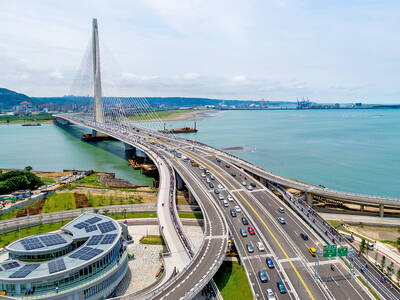
The Ministry of Transportation and Communications yesterday inaugurated the Danjiang Bridge across the Tamsui River in New Taipei City, saying that the structure would be an architectural icon and traffic artery for Taiwan. Feted as a major engineering achievement, the Danjiang Bridge is 920m long, 211m tall at the top of its pylon, and is the longest single-pylon asymmetric cable-stayed bridge in the world, the government’s Web site for the structure said. It was designed by late Iraqi-British architect Zaha Hadid. The structure, with a maximum deck of 70m, accommodates road and light rail traffic, and affords a 200m navigation channel for boats,
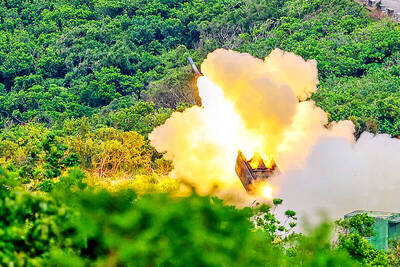
PRECISION STRIKES: The most significant reason to deploy HIMARS to outlying islands is to establish a ‘dead zone’ that the PLA would not dare enter, a source said A High Mobility Artillery Rocket System (HIMARS) would be deployed to Penghu County and Dongyin Island (東引) in Lienchiang County (Matsu) to force the Chinese military to retreat at least 100km from the coastline, a military source said yesterday. Taiwan has been procuring HIMARS and Army Tactical Missile Systems (ATACMS) from the US in batches. Once all batches have been delivered, Taiwan would possess 111 HIMARS units and 504 ATACMS, which have a range of 300km. Considering that “offense is the best defense,” the military plans to forward-deploy the systems to outlying islands such as Penghu and Dongyin so that
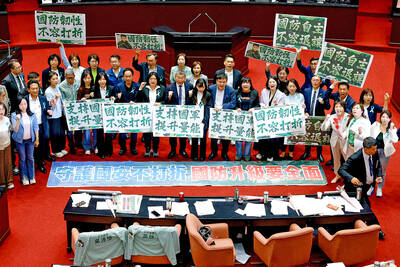
WHAT WAS ALL THAT FOR? Jaw Shaw-kong said that Cheng Li-wen had pushed for more drastic cuts and attacked him, just for the outcome to be nearly identical to his bill The legislature yesterday passed a supplementary budget bill to fund the purchase of separate packages of US military equipment, with the combined amount of spending capped at NT$780 billion (US$24.8 billion). The Chinese Nationalist Party (KMT) and Taiwan People’s Party (TPP) used their legislative majority to pass the bill, which runs until 2033 and has two main funding provisions. One was for NT$300 billion of arms sales already approved by the US for Taiwan on Dec. 17 last year, the other was for NT$480 billion for another arms package expected to be announced by Washington. The bill, which fell short of the NT$1.25
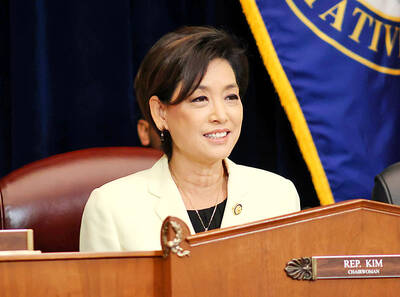
‘CLEAR MESSAGE’: The bill would set up an interagency ‘tiger team’ to review sanctions tools and other economic options to help deter any Chinese aggression toward Taiwan US Representative Young Kim has introduced a bill to deter Chinese aggression against Taiwan, calling for an interagency “tiger team” to preplan coordinated sanctions and economic measures in response to possible Chinese military or political action against Taiwan. “[Chinese President] Xi Jinping [習近平] has directed the People’s Liberation Army to be ready to invade Taiwan by 2027. China has a plan. America should have one too,” Kim said in a news release on Thursday last week. She introduced the “Deter PRC [People’s Republic of China] aggression against Taiwan act” to “ensure the US has a coordinated sanctions strategy ready should


 RSS
RSS