


Taiwanese research institutions clinched 12 prizes in this year’s R&D 100 Awards, the most of any nation in Asia and the second-most worldwide behind only the US, the Ministry of Economic Affairs said yesterday, adding that the results represented recognition of the nation’s achievements in technology research and development.
The US obtained 72 awards while the rest of the world excluding Taiwan took 16 prizes in this year’s listing.
Taiwan’s performance in the research-and-development event proved the push to boost technology via government-business cooperation is bearing fruit, Deputy Minister of Economic Affairs Lin Chuan-neng (林全能) told a news conference in Taipei.
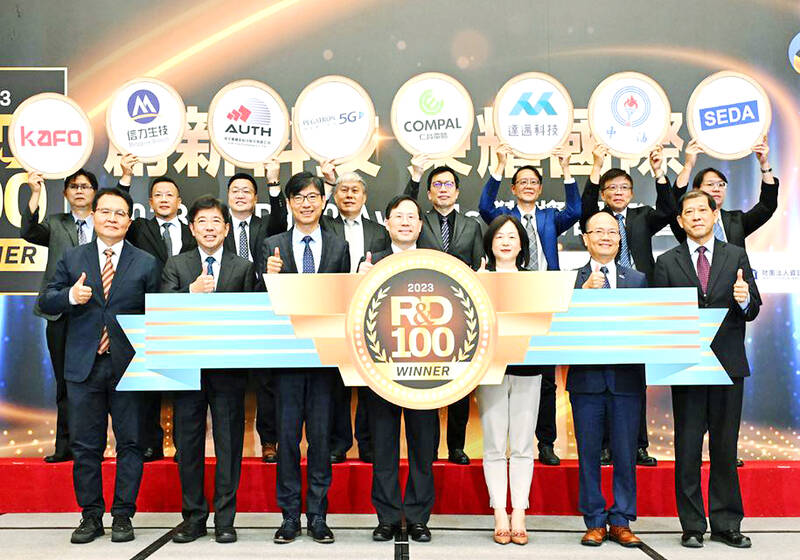
Photo: screen grab from the Ministry of Economic Affairs Web site
Taiwan has significantly fewer research-and-development institutions than the US, but won a comparable number of awards, he said, adding that the Industrial Technology Research Institute (ITRI) alone claimed eight awards, which topped the Massachusetts Institute of Technology.
The nation’s success was thanks to being able to identify the types of innovations being demanded, robust research-and-development institutions capable of achieving genuine breakthroughs and a high level of integration in public-private-sector partnerships, Lin said.
The patents created by the nation’s researchers originated from projects that the ministry conceived and implemented in cooperation with Metagone Biotech, Compal Electronics, Kao Fong Machinery and Asahi-Utou Technology, among others, he said.
This year’s awards also marked the fifth consecutive year Taiwanese innovation in biomedicine gained recognition in the awards, with three patents receiving a distinction, he said, adding that the nation’s biomedical sector has firmly established itself as a global player.
ITRI gaining eight prizes is a rare achievement and the group is proud of the work it has performed, institute president Liu Wen-hsiung (劉文雄) said.
The technologies developed and patented by the ITRI that received honors include eye drops for treating macular degeneration, targeted glaucoma drugs, surgical electrode needles and green technology for manufacturing polyimide films, he said.
They additionally included precision manufacturing software, an energy-saving private network solution, a thin-film technology for next-generation semiconductor processing and software for managing power battery rotation systems, he said.
Metal Industries Research & Development Center’s advanced electrochemical machining system, the Taiwan Textile Research Institute’s thermostatic leather, the Institute for Information Industry’s industrial cybersecurity platform and the Institute of Nuclear Energy Research’s bioplastics conversion technology for forestry waste were also awarded.
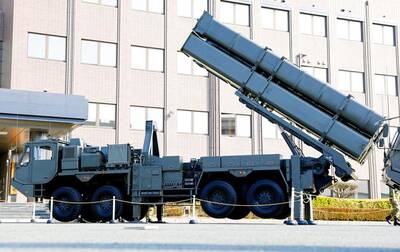
Japan has deployed long-range missiles in a southwestern region near China, the Japanese defense minister said yesterday, at a time when ties with Beijing are at their lowest in recent years. The missiles were installed in Kumamoto in the southern region of Kyushu, as Japan is attempting to shore up its military capacity as China steps up naval activity in the East China Sea. “Standoff defense capabilities enable us to counter the threat of enemy forces attempting to invade our country ... while ensuring the safety of our personnel,” Japanese Minister of Defense Shinjiro Koizumi said. “This is an extremely important initiative for

Chinese Nationalist Party (KMT) Chairwoman Cheng Li-wun (鄭麗文) today accepted an invitation from Chinese President Xi Jinping (習近平) to lead a delegation to China next month, saying she hopes to promote the peaceful development of cross-strait relations and bring stability to the Taiwan Strait. “I am grateful and happy to accept this invitation,” Cheng said in a statement from the KMT chairperson’s office. Cheng said she hopes both sides can work together to promote the peaceful development of cross-strait relations, enhance exchange and cooperation, bring stability to the Taiwan Strait and improve people’s livelihoods. At today's news conference, Cheng said any efforts to
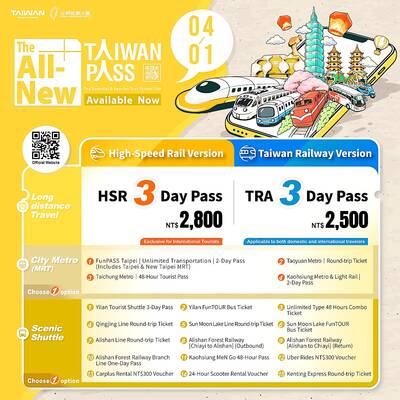
MORE POPULAR: Taiwan Pass sales increased by 59 percent during the first quarter compared with the same period last year, the Tourism Administration said The Tourism Administration yesterday said that it has streamlined the Taiwan Pass, with two versions available for purchase beginning today. The tourism agency has made the pass available to international tourists since 2024, allowing them to access the high-speed rail, Taiwan Railway Corp services, four MRT systems and four Taiwan Tourist Shuttles. Previously, five types of Taiwan Pass were available, but some tourists have said that the offerings were too complicated. The agency said only two types of Taiwan Pass would be available, starting from a three-day pass with the high-speed rail and a three-day pass with Taiwan Railway Corp. The former costs NT$2,800

The nation’s fastest supercomputer, Nano 4 (晶創26), is scheduled to be launched in the third quarter, and would be used to train large language models in finance and national defense sectors, the National Center for High-Performance Computing (NCHC) said. The supercomputer, which would operate at about 86.05 petaflops, is being tested at a new cloud computing center in the Southern Taiwan Science Park in Tainan. The exterior of the server cabinet features chip circuitry patterns overlaid with a map of Taiwan, highlighting the nation’s central position in the semiconductor industry. The center also houses Taiwania 2, Taiwania 3, Forerunner 1 and


 RSS
RSS