

Wind power has become the nation’s second-most important source of green energy after solar power, and is helping to keep the nation’s power grid online, Taiwan Power Co (台電, Taipower) said yesterday.
Total wind power generation hit a record 1.63 gigawatt-hours (GWh) on Tuesday, Taipower said.
Offshore wind power generated 1.38GWh on Friday, the first time that total output from offshore stations has exceeded 1GWh, it said.
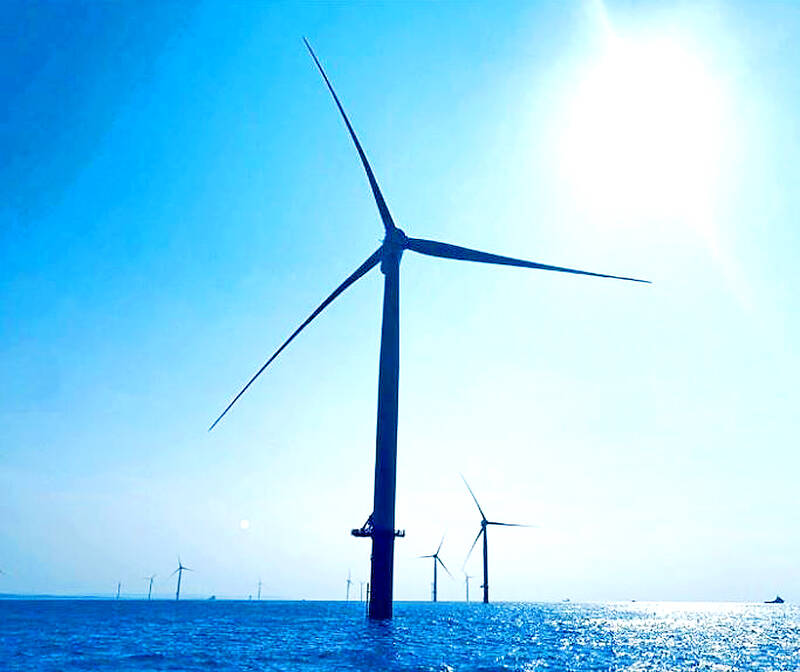
Photo: Lin Ching-hua, Taipei Times
Taiwan has excellent locations for wind farms, especially with the northeastern monsoon winds setting in during autumn, Taipower said.
As of August, power generated from wind turbines this year — especially after government and private efforts to increase the number of turbines — reached 2.89TWh, 94.1 percent more than the same period last year, the company said, adding that more turbines are becoming operational.
In July, total storage capacity for wind turbine-generated power grew to 2.25GWh, three times more than the 671MWh in July 2016, it said.
Taipower’s policy regarding power needs is to prioritize green energy usage, which the company said has helped to reduce the use of power from coal-fired plants or natural gas.
Reducing the power grid’s reliance on coal-fired generators ahead of the air pollution season would help reduce emissions, it added.
Power generators running on natural gas, which are able to increase or reduce power production quickly, can be used along with green energy to provide rapid backup power, Taipower said, adding that using more natural gas-powered generators as opposed to coal-fired generators would help to maintain a stable power grid while meeting environmental conservation goals.
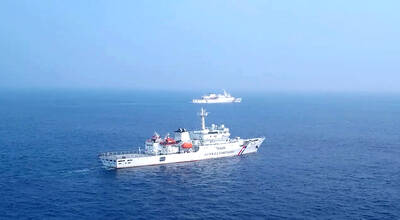
PATROL PARTNERS: The ‘Chiayi’ and the ‘Penghu’ departed for a two-day joint patrol of Palau’s exclusive economic zone, the CGA’s second diplomatic visit to the country The Coast Guard Administration (CGA) set a record for its southernmost deployment of a coast guard vessel as the vessels Chiayi and the Penghu reached Palau’s Pulo Anna Island on Saturday in a cooperative exercise between the two countries. The island, about 217 nautical miles (401km) southwest of Koror in the Palauan state of Sonsorol and 1,220 nautical miles from Taiwan’s southernmost point, Oluanpi (鵝鑾鼻), is the furthest south a CGA vessel has sailed. The two vessels are in Palau for the coast guard’s second diplomatic visit to the country. They docked at Malakal Harbor on Tuesday last week. The coast guard
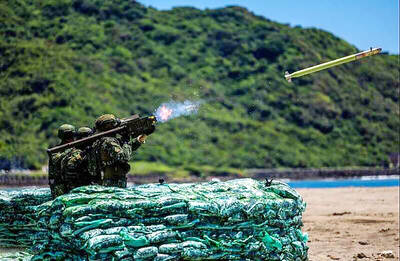
BATCH 1: The military has plans to assign the weapons to the army to defend Taiwan proper, as well as outlying islands and the navy for the Marine Corps, the official said Taiwan is to receive 500 Stinger missiles and 178 launchers from the US by the end of the year, the first batch under a planned two-stage acquisition totaling 2,621 missiles and 763 launchers, a defense official said yesterday on condition of anonymity. The portable missiles would play a vital role in the nation’s air defense capabilities, the source said. The army plans to deploy 2,235 missiles and 657 launchers to defend Taiwan proper and outlying islands, they said, citing military documents. The navy is allotted 295 missiles and 85 launchers to arm the Marine Corps and some surface vessels that lack air defense

The European Parliament on Wednesday adopted a recommendation on EU-China political relations that rejected China’s efforts to restrict Taiwan’s participation in international organizations and exchanges. The recommendation, addressed to the European Council, the European Commission and EU High Representative for Foreign Affairs and Security Policy Kaja Kallas, includes several references to EU-Taiwan relations and expresses support for closer ties, saying they would bring positive benefits and have strategic importance. Describing Taiwan as a valuable partner in trade and technology, the European Parliament said it “rejects China’s attempts to coerce international organizations, third countries and other actors into restricting Taiwan’s international participation and
‘EQUALS’: The ROC and PRC are not subordinate to each other, which is the consensus among Taiwanese, who are the only ones who can decide Taiwan’s future, MOFA said Taiwan yesterday urged China to stop its hostile rhetoric toward Taiwan as the US welcomed President William Lai’s (賴清德) commitment to Taiwan Strait stability in his Double Ten National Day speech. Lai on Saturday described Taiwan as a “city upon a hill” and said that “Taiwan cherishes peace, but we will not give up our freedom. We are open to exchanges, but will not accept subordination.” China’s Taiwan Affairs Office said Lai’s speech “disregards facts, distorts the truth, misleads the public and reveals ulterior motives.” Taiwan is part of China and Taiwan’s future “can and must be decided jointly by all the


 RSS
RSS