


Pharmacies might soon have to ask customers to limit their purchase of fever medication, as the Ministry of Health and Welfare yesterday said it is considering such a policy amid a drug shortage triggered by a massive COVID-19 outbreak in China.
Minister of Health and Welfare Hsueh Jui-yuan (薛瑞元) told the legislature’s Social Welfare and Environmental Hygiene Committee that it is paramount to ensure that Taiwan’s medical institutions have “sufficient amounts of medicines.”
Lawmaker urged Hsueh to take immediate action to tackle a severe shortage of paracetamol and other acetaminophen-based painkillers with fever-reducing properties that are widely used in Taiwan.
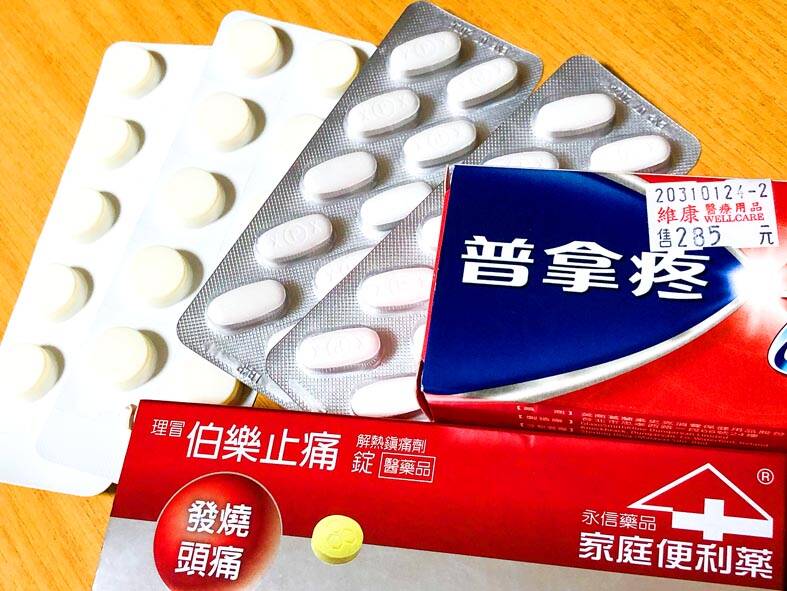
Photo: CNA
The lawmakers said they were concerned that the shortage would spill over to other fever drugs and painkillers if the government does not stop people from hoarding those drugs.
“Our No. 1 mission is to ensure that Taiwan’s medical institutions have sufficient amounts of medicines... We have asked pharmaceutical firms to first meet the demand from hospitals to ensure that they are not short of drugs for people seeking medical attention,” Hsueh said.
Hsueh said that the ministry is considering requiring pharmacies to ask their customers not to buy too many packages of the drugs at once.
However, the policy would be different from a cap on purchases, he added.
“We hope pharmacists across the country will help persuade customers not to buy too much over-the-counter antipyretics at a time,” he said. “We will closely monitor medical drug supply to determine whether stronger actions should be taken to control [the market]. Control measures will be lifted when supply becomes stable again.”
Hsueh said that the ministry still needs to discuss details with the Federation of Taiwan Pharmacists Associations, such as the recommended maximum amount for each purchase and when the measures should be implemented.
Aside from regulating purchases of acetaminophen, the ministry might also implement measures regarding other painkillers, such as ibuprofen, Hsueh said.
Food and Drug Administration Director Wu Shou-mei (吳秀梅) said that Taiwan has approximately 54 million courses of acetaminophen and 910,000 courses of ibuprofen.
The supply of chemicals could sustain local drugmakers’ production up to 10.6 months and five months respectively, Wu said.
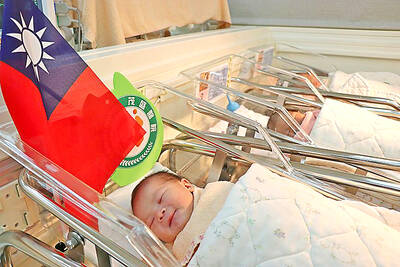
AGING: As of last month, people aged 65 or older accounted for 20.06 percent of the total population and the number of couples who got married fell by 18,685 from 2024 Taiwan has surpassed South Korea as the country least willing to have children, with an annual crude birthrate of 4.62 per 1,000 people, Ministry of the Interior data showed yesterday. The nation was previously ranked the second-lowest country in terms of total fertility rate, or the average number of children a woman has in her lifetime. However, South Korea’s fertility rate began to recover from 2023, with total fertility rate rising from 0.72 and estimated to reach 0.82 to 0.85 by last year, and the crude birthrate projected at 6.7 per 1,000 people. Japan’s crude birthrate was projected to fall below six,
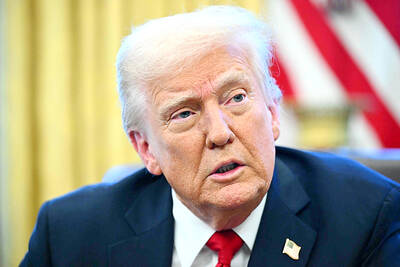
US President Donald Trump in an interview with the New York Times published on Thursday said that “it’s up to” Chinese President Xi Jinping (習近平) what China does on Taiwan, but that he would be “very unhappy” with a change in the “status quo.” “He [Xi] considers it to be a part of China, and that’s up to him what he’s going to be doing, but I’ve expressed to him that I would be very unhappy if he did that, and I don’t think he’ll do that. I hope he doesn’t do that,” Trump said. Trump made the comments in the context
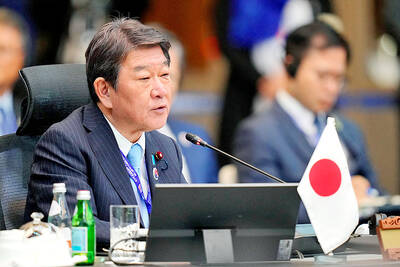
SELF-DEFENSE: Tokyo has accelerated its spending goal and its defense minister said the nation needs to discuss whether it should develop nuclear-powered submarines China is ramping up objections to what it sees as Japan’s desire to acquire nuclear weapons, despite Tokyo’s longstanding renunciation of such arms, deepening another fissure in the two neighbors’ increasingly tense ties. In what appears to be a concerted effort, China’s foreign and defense ministries issued statements on Thursday condemning alleged remilitarism efforts by Tokyo. The remarks came as two of the country’s top think tanks jointly issued a 29-page report framing actions by “right-wing forces” in Japan as posing a “serious threat” to world peace. While that report did not define “right-wing forces,” the Chinese Ministry of Foreign Affairs was

PREPAREDNESS: Given the difficulty of importing ammunition during wartime, the Ministry of National Defense said it would prioritize ‘coproduction’ partnerships A newly formed unit of the Marine Corps tasked with land-based security operations has recently replaced its aging, domestically produced rifles with more advanced, US-made M4A1 rifles, a source said yesterday. The unnamed source familiar with the matter said the First Security Battalion of the Marine Corps’ Air Defense and Base Guard Group has replaced its older T65K2 rifles, which have been in service since the late 1980s, with the newly received M4A1s. The source did not say exactly when the upgrade took place or how many M4A1s were issued to the battalion. The confirmation came after Chinese-language media reported


 RSS
RSS