


US Secretary of State Antony Blinken said that a crisis over Taiwan would lead to “a global economic crisis,” while US Assistant Secretary of State for East Asian and Pacific Affairs Daniel Kritenbrink underlined the importance of cross-strait peace and stability.
Blinken made the remarks in an interview with The Atlantic magazine at The Atlantic Festival on Thursday.
China has been attempting to change the “status quo” across the Taiwan Strait since 2016, which has been met by strong opposition from countries around the world, Blinken said.
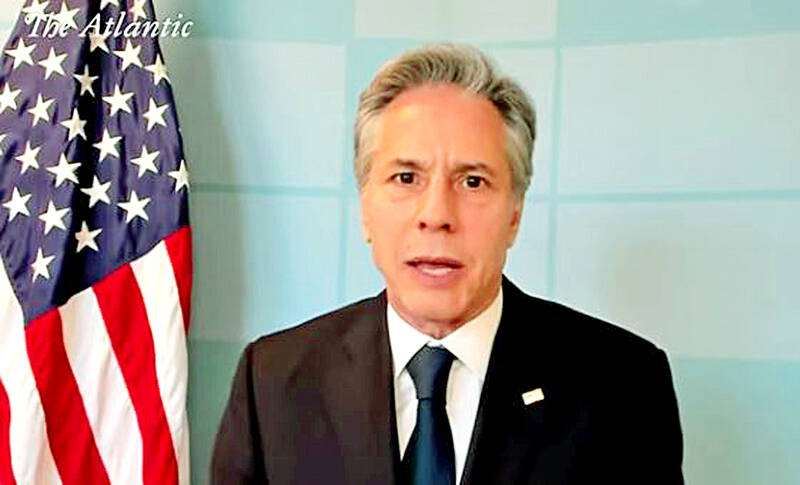
Photo: screen grab from The Atlantic’s Web site
“The stakes not just for Taiwan, but quite literally for the entire world are extraordinarily high” considering the amount of traffic that travels through the Taiwan Strait every day and the semiconductors manufactured in Taiwan, he said.
“Were there to be a crisis over Taiwan precipitated by Chinese actions, you would have a global economic crisis,” he added.
Blinken said that the message the world is sending to China should be clear: “Everyone wants peace and stability. Everyone wants the status quo to be preserved.”
On Wednesday, Kritenbrink met with Chinese Vice Minister of Foreign Affairs Sun Weidong (孫衛東) in Washington to discuss regional issues “as part of ongoing efforts to maintain open lines of communication,” the US Department of State said in a press release.
Kritenbrink stressed “the importance of a free and open, connected, prosperous, resilient and secure Indo-Pacific region and upholding the rules-based international order,” the statement said.
He also “reaffirmed the importance of maintaining peace and stability across the Taiwan Strait,” it added.
In a press release the Chinese Ministry of Foreign Affairs issued yesterday, it said Sun “emphasized that the ‘one China’ principle is the cornerstone of peace and stability across the Taiwan Strait.”
Beijing views positive China-US interactions in the Asia-Pacific region as serving the common interests of both sides and agrees to maintain communication with the US on Asia-Pacific affairs, the ministry cited Sun as saying.
High-level interactions between the US and China have been held frequently in the past few months, with Blinken, US Secretary of the Treasury Janet Yellen and US Secretary of Commerce Gina Raimondo visiting China in June, July and last month respectively.
Blinken on Monday met with Chinese Vice President Han Zheng (韓正) on the sidelines of the UN General Assembly in New York.
Earlier this month, US National Security Adviser Jake Sullivan met with Chinese Minister of Foreign Affairs Wang Yi (王毅) in Malta.
The Wall Street Journal on Thursday reported that Washington and Beijing are paving the way for Chinese President Xi Jinping (習近平) to visit US President Joe Biden.
In other developments, the New York and Chicago branches of the Taipei Economic and Cultural Office (TECO) blasted Beijing’s claim that Taiwan is part of China.
The New York office issued a press release rebutting Chinese Ambassador to the UN Zhang Jun’s (張軍) statement to reporters on Tuesday that UN Secretary-
General Antonio Guterres reaffirmed the international body’s adherence to Resolution 2758 and the “one China principle.”
The resolution recognizes the People’s Republic of China (PRC) as the “only lawful representative of China,” but does not mention Taiwan and does not state that “Taiwan is part of the PRC,” nor does it authorize the PRC to represent Taiwanese in the UN system, the New York office said.
China’s attempt to impose the so-called “one-China principle” on other countries and international organizations will only “fuel the resentment and disgust of the Taiwanese people and the international community,” it said.
In a letter published in the Star Tribune on Wednesday, TECO Chicago Director-General Dennis Yen-feng Lei (類延峰) said the Chinese consul general in Chicago, Zhao Jian (趙建), “falsely claimed Taiwan as ‘an inalienable part of China.’”
Lei called on Beijing to respect the “status quo” — ie, neither Taiwan nor China is subordinate to the other — and “refrain from coercing the world into accepting its spurious ‘one China principle.’”

‘NO SECURITY RISK’: The Railway Bureau reassured the public that the technicians’ activities were limited to technical guidance and did not involve sensitive systems The Railway Bureau yesterday said it had invited eight Chinese technicians to assist with an airport MRT construction project. The bureau issued the confirmation after an Internet user said Chinese nationals had entered the construction zone of Taiwan Taoyuan International Airport’s Terminal 3 project. They asked why “individuals from an enemy state” were allowed access to such a major national infrastructure project, which raised serious concerns over Taiwan’s industrial safety, sensitive systems and information security. The bureau’s Northern Region Engineering Branch Office said subcontractor Taiwan Handle Industrial Co (台灣手把工業) of the Taoyuan airport MRT’s “Contract No. CU05 Project A14 Station Civil, MEP &

The National Chungshan Institute of Science and Technology yesterday showcased its locally developed variants of the Vision 60 robotic patrol dog, which it plans to deploy on the nation’s outlying territories in the South China Sea. The variants were produced under the Joint Lab project — created by the institute and domestic companies — and assembled with domestically produced motors, lenses and artificial intelligence (AI) systems alongside licensed tech from the US, Missile and Rocket Systems Research Division deputy director Jen Kuo-kang (任國光) told the media event at a military base in Taipei’s Dazhi (大直) area. Taiwan has built up its strengths

NOT IMMEDIATE: Taiwan has a chance to appeal the proposed 10 percent tariff before it starts, while other countries face a 12.5 percent tariff from the trade office Taiwan is among 60 economies determined by the US to have failed to impose or enforce a ban on the importation of goods produced with forced labor, according to a notice released on Tuesday by the Office of the US Trade Representative (USTR), which proposed imposing an additional 10 percent or more tariff on them. The USTR in a statement said that following an investigation, it had determined under Section 301 of the Trade Act of 1974 that the failure of the 60 economies to impose and effectively enforce a prohibition on the importation of goods produced with forced labor is

RIGHT DIRECTION: Taiwan’s efforts to prevent forced labor include a proposal to ‘fully prohibit’ employers from withholding workers’ documents, an official said Taiwan is to establish a mechanism to restrict imports of goods linked to forced labor, the Executive Yuan said yesterday, after the US proposed imposing additional tariffs on Taiwanese goods over labor concerns. “The Ministry of Labor and the Ministry of Economic Affairs are to establish an interministerial review procedure,” Executive Yuan spokesperson Michelle Lee (李慧芝) said at a news briefing in Taipei. “The government is to use the Foreign Trade Act [貿易法] as the legal basis to restrict imports of goods produced with forced labor” and bring its supply chain governance more in line with international standards on human rights, resilience


 RSS
RSS