


Iranian authorities yesterday prevented the family of Mahsa Amini from holding a ceremony to commemorate the first anniversary of her death, confining her father to his home after briefly detaining him, rights groups said.
Amini, a 22-year-old Iranian Kurd, died a few days after her arrest by religious police for allegedly contravening the strict dress code for women in force since shortly after the 1979 Islamic Revolution.
Her family says she died from a blow to the head, but that was disputed by Iranian authorities.
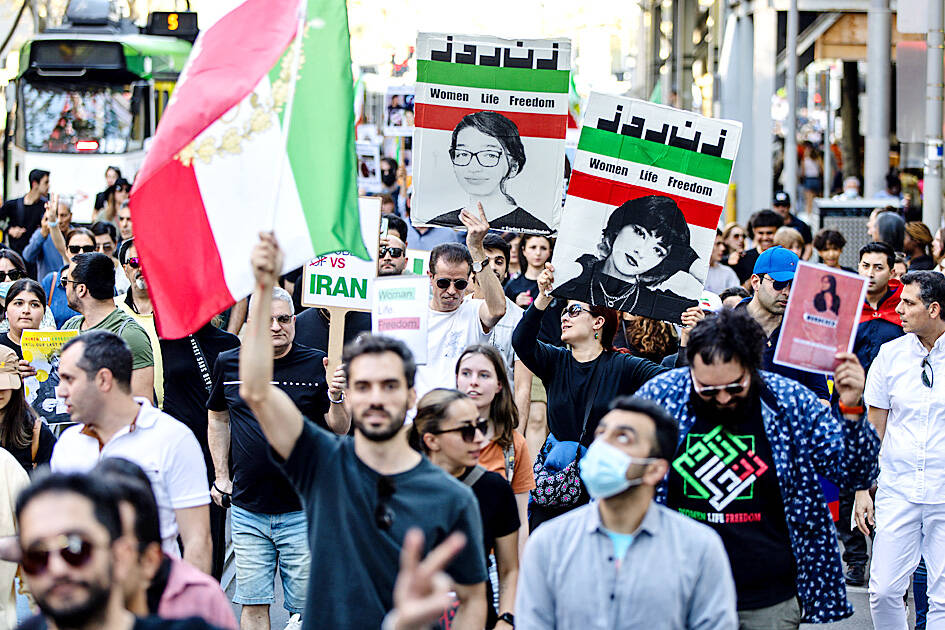
Photo: EPA-EFE
Mahsa Amimi’s father, Amjad Amini, was detained while exiting the family home in the western town of Saqez and then released after being warned not to hold a memorial service at her grave, the Kurdistan Human Rights Network, 1500tasvir monitor and Norway-based Iran Human Rights (IHR) said.
He was not being allowed to leave the family home, with members of the security forces stationed outside, the groups said in separate statements.
“Amjad Amini is under house arrest... Security forces are preventing him from visiting his daughter’s grave,” IHR said.
The official Islamic Republic News Agency described the reports of the arrest as “false,” saying they were aimed at “inciting the population to protest.”
Amjad Amini was already last week summoned by intelligence officials after his announcement that he planned to hold a memorial ceremony. One of Mahsa Amini’s uncles, Safa Aeli, was detained in Saqez on Sept. 5 and remains in custody.
Some reports suggested security forces had blocked access to Mahsa Amini’s grave.
The protests lost momentum after several months in the face of a crackdown that saw security forces kill 551 protesters, according to IHR, and arrest more than 22,000, according to Amnesty International.
Iranian authorities say dozens of security personnel were also killed in what they describe as “riots” incited by foreign governments and hostile media.
Seven men have been executed after being convicted in protest-related cases.
Campaigners say the authorities have renewed their crackdown in the run-up to the anniversary, putting pressure on relatives of those killed in the protests in a bid to stop them from speaking out.
New York-based Human Rights Watch said family members of at least 36 people killed or executed in the crackdown had been interrogated, arrested, prosecuted or sentenced to prison over the past month.
“Iranian authorities are trying to impose a chokehold on dissent to prevent public commemoration of Mahsa Jina Amini’s death in custody, which has become the symbol of the government’s systematic oppression of women, injustice and impunity,” said Tara Sepehri Far, senior Iran researcher at Human Rights Watch.
Kurdish-focused group Hengaw said that people in western Iran were expressing discontent through a general strike, with shops shut down in a dozen towns and cities, including Saqez.
Persian-language channels based outside Iran, including Iran International, broadcast footage of residents shouting “Death to the dictator” and the main protest slogan of “woman, life, freedom” from apartment blocks in Tehran and its satellite city of Karaj overnight.
Taiwan Semiconductor Manufacturing Co (TSMC, 台積電), the world’s largest foundry service provider, yesterday said that global semiconductor revenue is projected to hit US$1.5 trillion in 2030, after the figure exceeds US$1 trillion this year, as artificial intelligence (AI) demand boosts consumption of token and compute power. “We are still at the beginning of the AI revolution, but we already see a significant impact across the whole semiconductor ecosystem,” TSMC deputy cochief operating officer Kevin Zhang (張曉強) said at the company’s annual technology symposium in Hsinchu City. “It is fair to say that in the past decade, smartphones and other mobile devices were
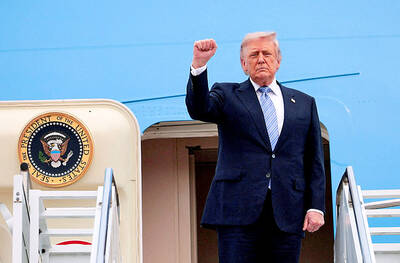
US-CHINA SUMMIT: MOFA welcomed US reassurance of no change in its Taiwan policy; Trump said he did not comment when Xi talked of opposing independence US President Donald Trump yesterday said he has not made a decision on whether to move forward with a major arms package for Taiwan after hearing concerns about it from Chinese President Xi Jinping (習近平). Trump’s comments on Taiwan came as he flew back to Washington after wrapping up critical talks in which both leaders said important progress was made in stabilizing US-China relations even as deep differences persist between the world’s two biggest powers on Iran and Taiwan. “I will make a determination,” Trump said, adding: “I’ll be making decisions. But, you know, I think the last thing we need right
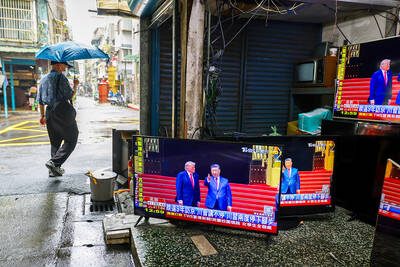
TAIWAN ISSUE: US treasury secretary Scott Bessent said on the first day of meetings that ‘it wouldn’t be a US-China summit without the Taiwan issue coming up’ There were no surprises on the first day of the summit between US President Donald Trump and Chinese President Xi Jinping (習近平), the Mainland Affairs Council (MAC) said yesterday, as the government reiterated that cross-strait stability is crucial to the Asia-Pacific region, as well as the world. As the two presidents met for a highly anticipated summit yesterday, Chinese state media reported that Xi warned Trump that missteps regarding Taiwan could push their two countries into “conflict.” Trump arrived in China with accolades for his host, calling Xi a “great leader” and “friend,” and extending an invitation to visit the White House
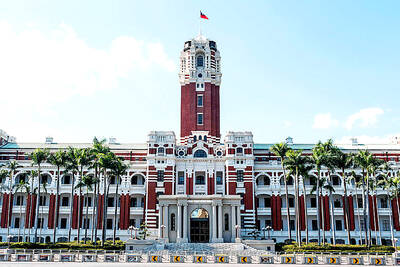
SECURITY: Taipei presses the US for arms supplies, saying the arms sales are not only a reflection of the US security commitment to Taiwan but also serve as a mutual deterrent against regional threats Taiwan is committed to preserving the cross-strait “status quo” and contributing to regional peace and stability, the Presidential Office said yesterday. “It is an undeniable fact that the Republic of China is a sovereign and independent democratic nation,” Presidential Office spokeswoman Karen Kuo (郭雅慧) reiterated, adding that Beijing has no right to claim sovereignty over Taiwan. The statements came after US President Donald Trump warned against Taiwanese independence. Trump wrapped up a state visit to Beijing on Friday, during which Chinese President Xi Jinping (習近平) had pressed him not to support Taiwan. Taiwan depends heavily on US security backing to deter China from carrying


 RSS
RSS