


The Tourism Bureau was officially redesignated the Tourism Administration yesterday, with Director-General Chou Yung-hui (周永暉) vowing to collect regular feedback and expand the international tourist market.
Speaking at a ceremony to unveil the plaque for the agency, Chou said that it would enhance collaboration with the tourism industry, be responsive to the sector’s needs, accelerate recovery of tourism and convene experts to help with strategy.
The team would include Lion Travel Services Co (雄獅旅行社) chairman Jason Wang (王文傑) and Formosa International Hotels Corp (晶華國際酒店集團) chairman Steven Pan, he said.

Photo: Liao Chen-huei, Taipei Times
The agency would also boost its collaboration with the Ministry of Culture, the Ministry of Agriculture, the Ministry of Education, the Hakka Affairs Council and the Council of Indigenous Peoples, Chou said.
Academic cooperation with the tourism industry is to be enhanced under the Tourism Administration’s guidance, especially to solve a labor shortage, he said.
Middle-aged and elderly people rejoining the workforce and university students should be targeted for recruitment, as they can attract tourists across age groups and improve the quality of service, Chou said.
Taiwan needs to double down on efforts to restore the nation’s exchange of tourists with Japan, South Korea, Vietnam and the Philippines, he said.
Tourism service centers and other facilities should be developed in connection with pleasure cruises to South Korea’s Busan, and prospective destinations in Indonesia and India, Chou said.
Taiwan would also welcome the resumption of cross-strait travel, he said.
Additionally, the Tourism Administration is to launch a joint effort with the Taiwan Visitors’ Association to draw big-spending tourists from the EU and UK, he said.
Vice Premier Cheng Wen-tsan (鄭文燦) said he hopes Taiwan and China can restart tours simultaneously, adding that the number of visitors should be capped at 2,000 for now.
The Executive Yuan would do what it can to address the lack of workers in the tourism industry by convening ministries, Cheng said
Minister of Transportation and Communications Wang Kwo-tsai (王國材) said that Taiwan would welcome Chinese visitors and his ministry has made preparations to receive tourists from across the Taiwan Strait.
Separately, the Central Weather Bureau was also officially redesignated as the Central Weather Administration (CWA).
The weather agency said in a news release that its mission is to obtain and make use of new technologies enabling it to have a positive impact on the public, help society and serve national interests.
It would continue to provide crucial weather data and would strive to play a larger role in scientific research into climate change, it said, adding that a joint project with the National Science and Technology Council is being prepared.
Wang Kwo-tsai was cited as saying that while the reorganization did not increase the weather agency’s personnel, the transportation ministry intends to support it in the acquisition of supercomputers and new weather stations.

CREDIT-GRABBER: China said its coast guard rescued the crew of a fishing vessel that caught fire, who were actually rescued by a nearby Taiwanese boat and the CGA Maritime search and rescue operations do not have borders, and China should not use a shipwreck to infringe upon Taiwanese sovereignty, the Coast Guard Administration (CGA) said yesterday. The coast guard made the statement in response to the China Coast Guard (CCG) saying it saved a Taiwanese fishing boat. The Chuan Yu No. 6 (全漁6號), a fishing vessel registered in Keelung, on Thursday caught fire and sank in waters northeast of Diaoyutai Islands (釣魚台). The vessel left Keelung’s Badouzih Fishing Harbor (八斗子漁港) at 3:35pm on Sunday last week, with seven people on board — a 62-year-old Taiwanese captain surnamed Chang (張) and six
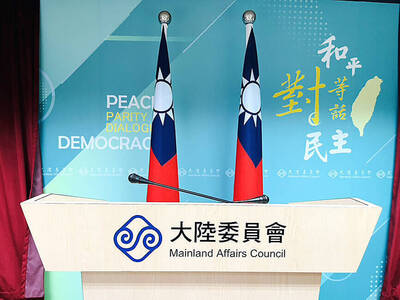
RISKY BUSINESS: The ‘incentives’ include initiatives that get suspended for no reason, creating uncertainty and resulting in considerable losses for Taiwanese, the MAC said China’s “incentives” failed to sway sentiment in Taiwan, as willingness to work in China hit a record low of 1.6 percent, a Ministry of Labor survey showed. The Directorate-General of Budget, Accounting and Statistics (DGBAS) also reported that the number of Taiwanese workers in China has nearly halved from a peak of 430,000 in 2012 to an estimated 231,000 in 2024. That marked a new low in the proportion of Taiwanese going abroad to work. The ministry’s annual survey on “Labor Life and Employment Status” includes questions respondents’ willingness to seek employment overseas. Willingness to work in China has steadily declined from

The Legislative Yuan’s Finance Committee yesterday approved proposed amendments to the Amusement Tax Act (娛樂稅法) that would abolish taxes on films, cultural activities and competitive sporting events, retaining the fee only for dance halls and golf courses. The proposed changes would set the maximum tax rate for dance halls and golf courses at 50 and 20 percent respectively, with local governments authorized to suspend the levies. Article 2 of the act says that “amusement tax shall be levied on tickets sold or fees charged by amusement places, facilities or activities” in six categories: “Cinema; professional singing, story-telling, dancing, circus, magic show, acrobatics

INFLATION UP? The IMF said CPI would increase to 1.5 percent this year, while the DGBAS projected it would rise to 1.68 percent, with GDP per capita of US$44,181 The IMF projected Taiwan’s real GDP would grow 5.2 percent this year, up from its 2.1 percent outlook in January, despite fears of global economic disruptions sparked by the US-Iran conflict. Taiwan’s consumer price index (CPI) is projected to increase to 1.5 percent, while unemployment would be 3.4 percent, roughly in line with estimates for Asia as a whole, the international body wrote in its Global Economic Outlook Report published in the US on Monday. The figures are comparatively better than the IMF outlook for the rest of the world, which pegged real GDP growth at 3.1 percent, down from 3.3 percent


 RSS
RSS