


Australia, Japan and the US are to conduct a joint naval exercise in a show of support for the Philippines’ stand against China’s territorial claims in the South China Sea, Kyodo News reported on Friday.
The announcement of the drills comes amid regional tensions after Manila said a China Coast Guard ship had fired a water cannon at Philippine supply boats in the waters off the Second Thomas Shoal (Renai Shoal, 仁愛暗沙) in the Spratly archipelagolo (Nansha Islands, 南沙群島) earlier this month, the report said, citing unnamed sources.
Taiwan also claims the islands.
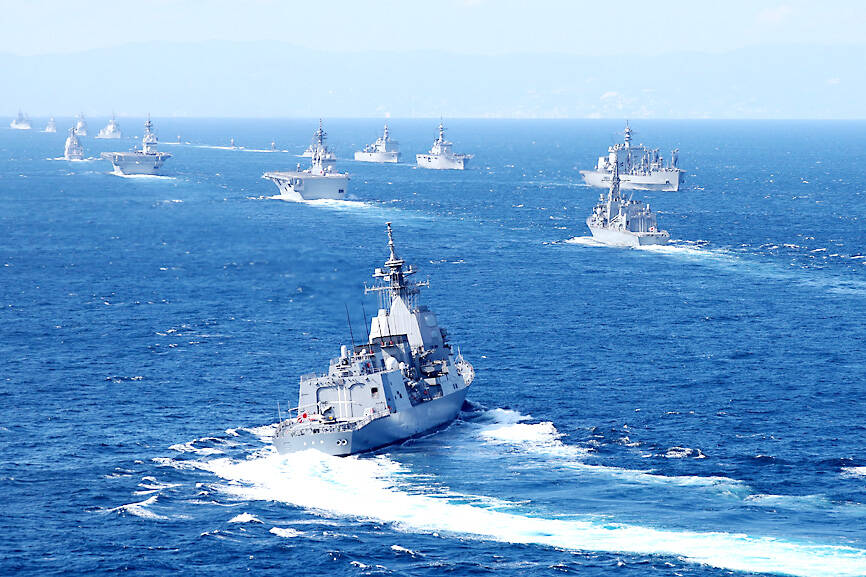
Photo: AFP
The Japan Maritime Self-Defense Force is expected to send its largest destroyer, the JS Izumo, which is slated to be refitted to become an aircraft carrier next year or the year after, Kyodo said.
The US Navy and the Australian Royal Navy would deploy the USS America and HMAS Canberra respectively, the sources were cited as saying.
The joint exercise aims to display the US’ and its allies’ commitment to upholding freedom of navigation and would feature aircraft takeoff and landing exercises from the decks of the three ships, they said.
The Philippine forces declined to take part in the exercise, as their ships cannot handle the other navies’ large warplanes, they said.
The commanders of the four navies might issue a joint statement from Manila to send a “strong message,” the sources said.
In the past few years, the Philippines has increasingly looked to the US-led security coalition for assistance in defending its waters against Beijing’s increasing assertiveness in the region, Kyodo said.
In June, Australia, Japan, the Philippines and the US held their first summit involving top defense officials in Singapore to declare their intent to bolster quadrilateral security cooperation and maintain a free and open Indo-Pacific.
A month later, China Coast Guard vessels began to interfere with Philippine supply boats operating in the vicinity of the Second Thomas Shoal — a move that was broadly construed to be a test of the US and its regional allies’ resolve.
LEVERAGE: China did not ‘need to fire a shot’ to deny Taiwan airspace over Africa when it owns ‘half the continent’s debt,’ a US official said, calling it economic warfare The EU has raised concerns about overflight rights following the delay of President William Lai’s (賴清德) planned state visit to the Kingdom of Eswatini after three African nations denied overflight clearance for his charter at the last minute. Taiwanese allies Paraguay and Saint Kitts and Nevis, as well as several US lawmakers and the Inter-Parliamentary Alliance on China (IPAC) condemned China for allegedly pressuring the countries. Lai was scheduled to fly directly to Taiwan’s only African ally from yesterday to Sunday to celebrate the 40th anniversary of King Mswati III’s accession and his 58th birthday, but Seychelles, Mauritius and Madagascar suddenly revoked
PROVOCATIVE: Chinese Deputy Ambassador to the UN Sun Lei accused Japan of sending military vessels to deliberately provoke tensions in the Taiwan Strait China denounced remarks by Japan and the EU about the South China Sea at a UN Security Council meeting on Monday, and accused Tokyo of provocative behavior in the Taiwan Strait and planning military expansion. Ayano Kunimitsu, a Japanese vice foreign minister, told the Council meeting on maritime security that Tokyo was seriously concerned about the situation in the East China and South China seas, and reiterated Japan’s opposition to any attempt to change the “status quo” by force, and obstruction of freedom of navigation and overflight. Stavros Lambrinidis, head of the EU delegation to the UN, also highlighted South China Sea
The final batch of 28 M1A2T Abrams tanks purchased from the US arrived at Taipei Port last night and were transported to the Armor Training Command in Hsinchu County’s Hukou Township (湖口), completing the military’s multi-year procurement of 108 of the tanks. Starting at 12:10am today, reporters observed more than a dozen civilian flatbed trailers departing from Taipei Port, each carrying an M1A2T tank covered with black waterproof tarps. Escorted by military vehicles, the convoy traveled via the West Coast Expressway to the Armor Training Command, with police implementing traffic control. The army operates about 1,000 tanks, including CM-11 Brave Tiger
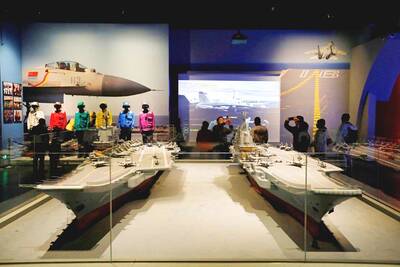
China on Wednesday teased in a video an aircraft carrier that could be its fourth, and the first using nuclear power, while making an allusion to Taiwan and vowing to further build up its islands, as it looks to boost maritime power, secure resources and bolster territorial claims. The video, issued on the eve of the 77th founding anniversary of the Chinese People’s Liberation Army Navy, featured fictional officers with names that are homophones of three commissioned aircraft carriers, the Liaoning (遼寧), Shandong (山東) and Fujian (福建). Titled Into the Deep, it showed a 19-year-old named “Hejian” (何劍) joining the group, sparking


 RSS
RSS