


President Tsai Ing-wen (蔡英文) yesterday expressed her condolences to those affected by the wildfires in Hawaii that have so far killed 55 people, and destroyed thousands of structures and homes.
In addition to expressing her concerns, the president has instructed the Ministry of Foreign Affairs to convey the government’s willingness to provide any necessary assistance to the US, Presidential Office spokesperson Lin Yu-chan (林聿禪) quoted Tsai as saying in a statement.
The president hopes for a quick recovery and a return to normal life in Hawaii, Lin said.
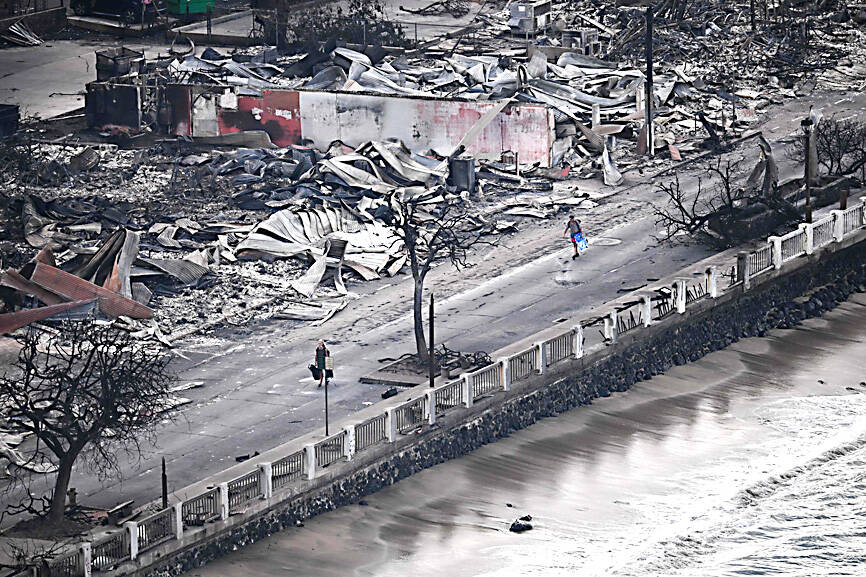
Photo: AFP
Tsai has also requested that the nation’s representative office in Hawaii monitor and support Taiwanese nationals caught up in the disaster that left a historic Hawaiian town in charred ruins.
Wildfires on the west coast of Hawaii’s Maui island — fueled by high winds from a nearby hurricane — broke out on Tuesday and rapidly engulfed the seaside town of Lahaina.
The flames moved so quickly that many were caught off guard, trapped in the streets or jumping into the ocean in a desperate bid to escape.
“It really looks like somebody came along and just bombed the whole town. It’s completely devastated,” said Canadian Brandon Wilson, who had traveled to Hawaii with his wife to celebrate their 25th anniversary, but was at the airport trying to get them a flight out.
“It was really hard to see,” he said, teary-eyed. “You feel so bad for people. They lost their homes, their lives, their livelihoods.”
The fires follow other extreme weather events in North America this summer, with record-breaking wildfires still burning across Canada and a major heat wave baking the US southwest.
“What we’ve seen today has been catastrophic ... likely the largest natural disaster in Hawaii state history,” Hawaii Governor Josh Green said.
“In 1960 we had 61 fatalities when a large wave came through Big Island,” he said earlier in the day, referring to a tragedy that struck a year after Hawaii became the 50th US state. “This time, it’s very likely that our death totals will significantly exceed that.”
Maui County officials said just after 9pm on Thursday that fatalities stood at 55 and firefighters were still battling the blaze in the town that served as the Hawaiian kingdom’s capital in the early 19th century.
Pictures taken by an Agence France-Presse photographer who flew over Lahaina showed it had been reduced to blackened, smoking ruins.
The burned skeletons of trees still stand, rising above the ashes of the buildings to which they once offered shelter.
Green said 80 percent of the town was gone.
“Buildings that we’ve all enjoyed and celebrated together for decades, for generations, are completely destroyed,” he said.
Thousands have been left homeless and Green said a massive operation was swinging into action to find accommodation.
“We are going to need to house thousands of people,” he told a news conference. “That will mean reaching out to all of our hotels and those in the community to ask people to rent extra rooms at their property.”
US President Joe Biden on Thursday declared the fires a “major disaster” and unblocked federal aid for relief efforts, with rebuilding expected to take years.
US Coast Guard Commander Aja Kirksey told CNN that about 100 people were believed to have jumped into the water in a desperate effort to flee the flames as they tore through Lahaina.
Kirksey said helicopter pilots struggled to see because of dense smoke, but that a coast guard vessel had been able to rescue more than 50 people from the water.
“It was a really rapidly developing scene and pretty harrowing for the victims that had to jump into the water,” she said.
For resident Kekoa Lansford, the horror was far from over.
“We still get dead bodies in the water floating and on the seawall,” Lansford told CBS. “We have been pulling people out... We’re trying to save people’s lives and I feel like we are not getting the help we need.”
“With lives lost and properties decimated, we are grieving with each other during this inconsolable time,” Maui Mayor Richard Bissen said. “In the days ahead, we will be stronger as a ... community as we rebuild with resilience and aloha.”
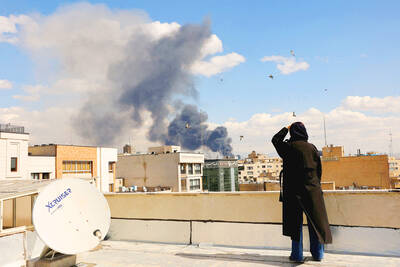
CHAOS: Iranians took to the streets playing celebratory music after reports of Khamenei’s death on Saturday, while mourners also gathered in Tehran yesterday Iranian Supreme Leader Ayatollah Ali Khamenei was killed in a major attack on Iran launched by Israel and the US, throwing the future of the Islamic republic into doubt and raising the risk of regional instability. Iranian state television and the state-run IRNA news agency announced the 86-year-old’s death early yesterday. US President Donald Trump said it gave Iranians their “greatest chance” to “take back” their country. The announcements came after a joint US and Israeli aerial bombardment that targeted Iranian military and governmental sites. Trump said the “heavy and pinpoint bombing” would continue through the week or as long
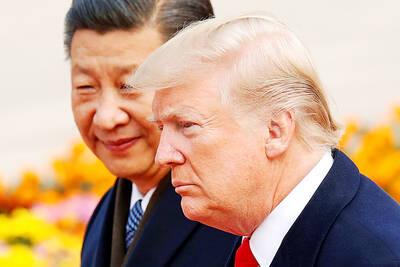
TRUST: The KMT said it respected the US’ timing and considerations, and hoped it would continue to honor its commitments to helping Taiwan bolster its defenses and deterrence US President Donald Trump is delaying a multibillion-dollar arms sale to Taiwan to ensure his visit to Beijing is successful, a New York Times report said. The weapons sales package has stalled in the US Department of State, the report said, citing US officials it did not identify. The White House has told agencies not to push forward ahead of Trump’s meeting with Chinese President Xi Jinping (習近平), it said. The two last month held a phone call to discuss trade and geopolitical flashpoints ahead of the summit. Xi raised the Taiwan issue and urged the US to handle arms sales to

An Emirates flight from Dubai arrived at Taiwan Taoyuan International Airport yesterday afternoon, the first service of the airline since the US and Israel launched strikes against Iran on Saturday. Flight EK366 took off from the United Arab Emirates (UAE) at 3:51am yesterday and landed at 4:02pm before taxiing to the airport’s D6 gate at Terminal 2 at 4:08pm, data from the airport and FlightAware, a global flight tracking site, showed. Of the 501 passengers on the flight, 275 were Taiwanese, including 96 group tour travelers, the data showed. Tourism Administration Deputy Director-General Huang He-ting (黃荷婷) greeted Taiwanese passengers at the airport and
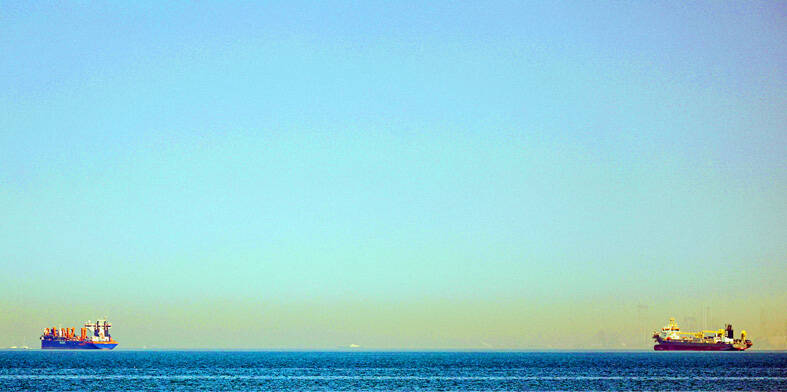
State-run CPC Corp, Taiwan (CPC, 台灣中油) yesterday said that it had confirmed on Saturday night with its liquefied natural gas (LNG) and crude oil suppliers that shipments are proceeding as scheduled and that domestic supplies remain unaffected. The CPC yesterday announced the gasoline and diesel prices will rise by NT$0.2 and NT$0.4 per liter, respectively, starting Monday, citing Middle East tensions and blizzards in the eastern United States. CPC also iterated it has been reducing the proportion of crude oil imports from the Middle East and diversifying its supply sources in the past few years in response to geopolitical risks, expanding


 RSS
RSS