


A diabolo instructor, Lu Chi-hsien (魯紀賢), and four retired military personnel were yesterday detained after a court hearing on suspicion of forming a spy network for China.
The Taipei District Prosecutors’ Office, along with the Ministry of Justice Investigation Bureau (MJIB) and New Taipei City police, on Wednesday conducted 25 searches, including six at military units, questioned seven suspects and interviewed 11 witnesses.
The five are suspected of “contacting, enticing and recruiting” military personnel from April last year to obtain military intelligence in contravention of the National Security Act (國家安全法), Taipei Deputy Head Prosecutor Tsai Wei-yi (蔡偉逸) said.
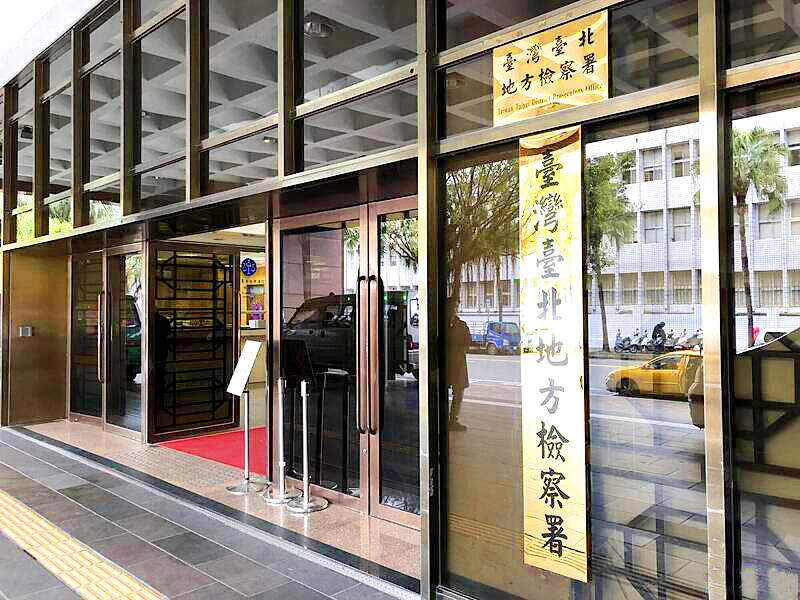
Photo: Chien Li-chung, Taipei Times
Investigations showed that after retiring from the army, Lu was recruited by Chinese intelligence officers, who offered him money to use his connection and friends still in active service to obtain classified materials and recruit others to form a spy network, Tsai said, adding that his unusual activities drew the attention of the MJIB’s National Security Operation Division.
This case shows that Chinese espionage has found a new way of infiltrating Taiwan and recruiting new members, with Lu focusing on pawnshops, money lenders and loan-shark operations near army bases, where he could find soldiers or officers who needed money or were having problems paying debts, Tsai said.
With the help of old friends and other officers, Lu was able to hook up with potential targets, offering them money to pay off debts or loans, he said.
Lu was able to entice more than 10 lower-ranked military personnel into working for the espionage ring, instructing them to gather classified documents at their service units or any confidential information they could access and handing them over to Lu, who then passed it on to his Chinese handlers, Tsai said.
After a bail hearing, Lu and four other retired military personnel — two men surnamed Lee (李) and Chang (常), and two women surnamed Lin (林) — were listed as suspects and denied bail.
Another suspect, Kuo Po-ting (郭伯廷), was released on NT$200,000 bail, with media reports identifying him as the younger brother of singer and actress Kuo Shu-yao (郭書瑤).
With the revelation of another spy ring operating in Taiwan drawing criticism, the Ministry of National Defense yesterday released a statement saying that “military personnel have helped the investigation with their tip-offs, and we are currently cooperating with national security agencies in the probe.”
It added that it cannot comment on an ongoing investigation.
Taipei prosecutors said that Lu, a well-known diabolo instructor, had served on the board of the Republic of China Diabolo Federation.
However, Lu used his position at the federation to engage in several fraud schemes, including deceiving investors and companies that Taiwan was to host the “2021 Diabolo World Cup,” and collecting NT$13.18 million (US$424,108) in funds, they said.
Convicted on four charges of fraud, Lu was in March sentenced to five years and four months in prison.
However, he did not show up on the day he was to start his term and was placed on the wanted list until his arrest on Wednesday, they said.
Additional reporting by Chien Li-chung and Kayleigh Madjar

‘NO SECURITY RISK’: The Railway Bureau reassured the public that the technicians’ activities were limited to technical guidance and did not involve sensitive systems The Railway Bureau yesterday said it had invited eight Chinese technicians to assist with an airport MRT construction project. The bureau issued the confirmation after an Internet user said Chinese nationals had entered the construction zone of Taiwan Taoyuan International Airport’s Terminal 3 project. They asked why “individuals from an enemy state” were allowed access to such a major national infrastructure project, which raised serious concerns over Taiwan’s industrial safety, sensitive systems and information security. The bureau’s Northern Region Engineering Branch Office said subcontractor Taiwan Handle Industrial Co (台灣手把工業) of the Taoyuan airport MRT’s “Contract No. CU05 Project A14 Station Civil, MEP &

The National Chungshan Institute of Science and Technology yesterday showcased its locally developed variants of the Vision 60 robotic patrol dog, which it plans to deploy on the nation’s outlying territories in the South China Sea. The variants were produced under the Joint Lab project — created by the institute and domestic companies — and assembled with domestically produced motors, lenses and artificial intelligence (AI) systems alongside licensed tech from the US, Missile and Rocket Systems Research Division deputy director Jen Kuo-kang (任國光) told the media event at a military base in Taipei’s Dazhi (大直) area. Taiwan has built up its strengths

NOT IMMEDIATE: Taiwan has a chance to appeal the proposed 10 percent tariff before it starts, while other countries face a 12.5 percent tariff from the trade office Taiwan is among 60 economies determined by the US to have failed to impose or enforce a ban on the importation of goods produced with forced labor, according to a notice released on Tuesday by the Office of the US Trade Representative (USTR), which proposed imposing an additional 10 percent or more tariff on them. The USTR in a statement said that following an investigation, it had determined under Section 301 of the Trade Act of 1974 that the failure of the 60 economies to impose and effectively enforce a prohibition on the importation of goods produced with forced labor is
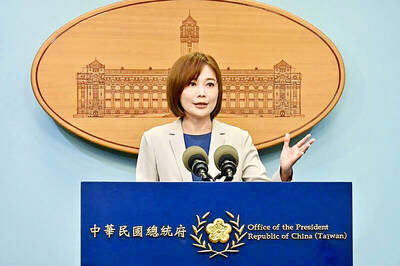
TIT-FOR-TAT: The US allegedly revoked the visa of a Chinese national working at Xinhua News Agency in the US in response to Beijing’s expulsion of Vivian Wang The Presidential Office yesterday condemned China for expelling a New York Times correspondent from Beijing following the newspaper’s interview with President William Lai (賴清德), saying the move highlighted Beijing’s suppression of press freedom and its threat to international news media. Taiwan has noted a series of recent incidents in which Beijing used similar tactics to “threaten and pressure international media outlets and journalists,” Presidential Office spokeswoman Karen Kuo (郭雅慧) said in a statement. “This concerns not only press freedom and freedom of expression, but also the safety of journalists, and Taiwan and relevant partners are paying close attention to the situation,” she


 RSS
RSS