


Taiwan is a crucial partner to the US in the semiconductor industry, US academics said in an article published on Monday in US magazine Foreign Affairs.
Hoover Institution fellows Larry Diamond and Jim Ellis, and Orville Schell, the Arthur Ross director of the Center on US-China Relations at the Asia Society in New York, discussed in the article how to strengthen the semiconductor supply chain without endangering Taiwan.
The US needs reliable international partners to enhance its chances of prevailing in the economic, technological and strategic competition with China, the authors said.
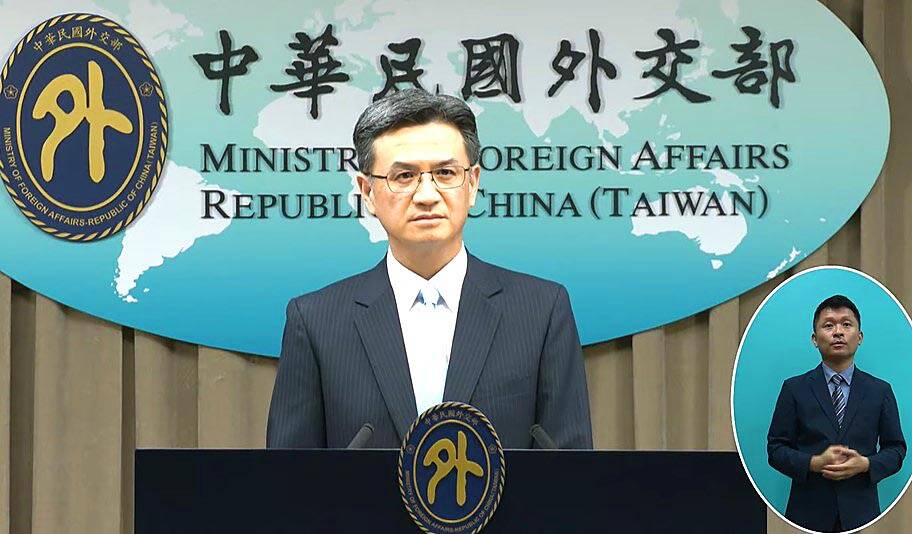
Photo: screen grab from a Ministry of Foreign Affairs Webcast
“No partner is more important in this effort than Taiwan,” with whom the US can work to reconfigure and strengthen its semiconductor supply chain, they wrote.
The US needs to forge a cooperative strategy to pursue two objectives simultaneously without undermining each other — safeguarding the security of global supply chains for semiconductors and ensuring Taiwan’s security, they wrote.
The US and Taiwan can both benefit from the bilateral partnership on this front, as the US needs investment from Taiwan to expand semiconductor manufacturing on its soil while Taiwan needs the security assistance of the US to protect both its semiconductor industry and its democracy, they wrote.
A treaty precluding double taxation and a free-trade agreement would further help to enhance economic and technological ties between the US and Taiwan, they added.
The authors also reiterated the importance for the US to deliver effective weaponry to Taiwan, “especially the kind of mobile weaponry that can help turn Taiwan into a ‘porcupine’ that the People’s Liberation Army would be unable to swallow.”
In related news, the Ministry of Foreign Affairs yesterday reaffirmed the nation’s close economic and trade relations with the US after former US president Donald Trump accused Taiwan of taking chip business away from the US.
In an interview on Fox News that was aired on Sunday, Trump was asked if the US should help defend Taiwan if it means going to war with China.
“If I answered that question, it’ll put me in a very bad negotiating position,” Trump said. “Taiwan [is] smart, brilliant, they took our business away. We should have stopped them. We should have taxed them. We should have tariffed them.”
In Taipei, ministry spokesman Jeff Liu (劉永健) told a news conference yesterday that “Taiwan cooperates and exchanges closely with the US, and the economic, trade and industrial structures of the two sides are complementary and mutually beneficial.”
Asked by reporters at the Legislative Yuan about the issue yesterday, Premier Chen Chien-jen (陳建仁) said that Taiwan has good relations with the US executive branch, as well as the two major parties in the US Congress.
Additional reporting by CNA

National Taiwan University (NTU) yesterday said it disqualified a person from an entrance examination for using AI smart glasses to cheat, along with two others for making untruthful statements in their curriculum vitae. The three applicants were given null scores, Taiwan’s highest-ranked university said, calling on prospective students to be honest in the admissions process. NTU registrar Lee Hung-sen (李宏森) said that the cheating applicant wore a hat and thick-rimmed glasses to the second written exam for medical school, claiming that they felt cold. Suspicions were aroused when the applicant stared oddly at the test for long stretches while steadily bringing the paper
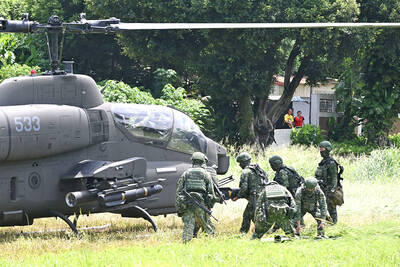
MILITARY ISSUES: A partisan divide between the Cabinet and the legislature ‘raised questions about Taiwan’s ability to adequately fund its defense,’ the report said Taiwan’s defense budget, military personnel numbers and resilience are challenges to its ability to meet national defense goals, the US Naval Institute said in a report published on Tuesday. In response to the perception of a growing military threat posed by China, Taiwan has embarked on an effort to enhance the capabilities needed to deter an attempt by Beijing to annex the nation by force, the institute said in the US Congressional Research Service report, titled Taiwan: Defense and Military Issues, which was filed on Thursday last week. Taiwan’s defense budget increased by about 7.5 percent from 2024 to last year, it
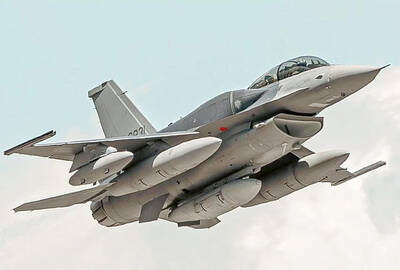
66 FIGHTER JETS: The aircraft is likely undergoing preparations for its transfer to Taiwan — a significant step forward in the nation’s modernization program, a lawmaker said The first of Taiwan’s order of F-16V Block 70 aircraft has been sighted in Texas ahead of delivery, Democratic Progressive Party (DPP) Legislator Wang Ting-yu (王定宇) said. Taiwan’s first F-16V Block 70 two-seat aircraft, tail number 6831, was seen flying from Lockheed Martin’s production facility in Greenville, South Carolina, to Naval Air Station Joint Reserve Base Fort Worth in Texas, Wang wrote on Facebook yesterday. The plane is likely undergoing preparations for its transfer to Taiwan, marking a significant step forward in the Republic of China Air Force’s modernization program, Wang said, citing military analysts. The F-16V Block 70 is a new-build version
NOT JUST NUMBERS: What matters to intelligence work is crucial, reliable information, so even a few credible leads can be highly valuable to national security, a legislator said The National Security Bureau (NSB) yesterday said it has finished the establishment of an information-reporting channel for Chinese nationals, the aim of which is to broaden intelligence gathering on China’s political, military, economic and social developments. Chinese nationals can submit information on the Web page, https://report.nsb.gov.tw, the NSB said in a statement. The move aims to expand the bureau’s diverse intelligence sources and is pursuant to the National Intelligence Services Act (國家情報工作法), it said, adding that it referenced practices adopted by intelligence agencies in the US, the UK and Israel. An increasing number of people are approaching Taiwanese agencies to provide information, as


 RSS
RSS