


Members of a major trans-Pacific trade pact yesterday said they were gathering information on Taiwan, China and other countries interested in joining the agreement to see whether they were able to meet the pact’s “high standards.”
The comments followed the Comprehensive and Progressive Agreement for Trans-Pacific Partnership (CPTPP) meeting in Auckland where the UK formally signed the treaty to become a member, and a decision to review and update the agreement was also made.
Along with Taiwan and China, Costa Rica, Ecuador, Ukraine and Uruguay have also applied to join the pact. A decision on which country can join and when would be made collectively.
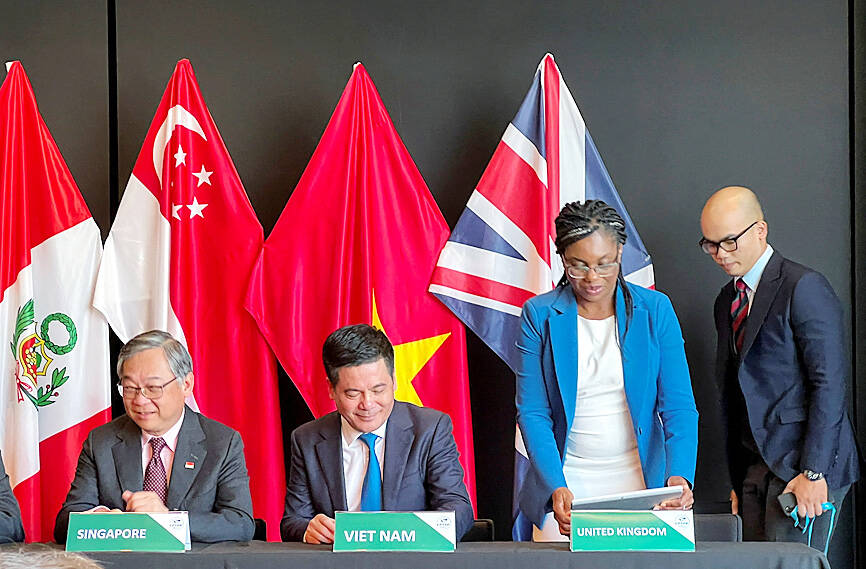
Photo: Reuters
“The membership is currently undertaking an information-gathering process on whether aspirant economies can meet the CPTPP’s high standards, taking into account their experience on their trade commitments,” the members said in a joint statement.
The CPTPP is a landmark trade pact agreed in 2018 between 11 countries including Australia, Brunei, Canada, Chile, Japan, Malaysia, Mexico, New Zealand, Peru, Singapore and Vietnam.
The UK became the 12th member of the pact, which cuts trade barriers, as it looks to deepen ties in the Pacific after its exit from the EU in 2020.
“We continue to discuss how to move forward collectively on accession processes in a way that reflects all our interests and maintains the high standards,” the CPTPP statement said.
China’s application to join the pact is next in line if they are dealt with in the order they were received, but the country faces a number of hurdles to be included.
The CPTPP requires countries to eliminate or significantly reduce tariffs, make strong commitments to opening services and investment markets and has rules around competition, intellectual property rights and protections for foreign companies.
New Zealand Minister for Trade and Export Growth Damien O’Connor, who chaired the CPTPP meeting, told a news conference that there was no timeframe for when any decisions on future membership would be made.
“It’s a complex area,” O’Connor said of membership applications, adding no single country’s application was discussed on Sunday.
China has opposed Taiwan’s application, which is to be reviewed after Beijing’s.
Earlier in the day, the UK signed the treaty to accede into the pact, although it still needs to be ratified by the country’s government.
British Secretary of State for Business and Trade Kemi Badenoch said at the signing that her country was delighted to become the first new member of the CPTPP.
“This is a modern and ambitious agreement and our membership in this exciting, brilliant and forward-looking bloc is proof that the UK’s doors are open for business,” Badenoch said.

PROVOCATIVE: Chinese Deputy Ambassador to the UN Sun Lei accused Japan of sending military vessels to deliberately provoke tensions in the Taiwan Strait China denounced remarks by Japan and the EU about the South China Sea at a UN Security Council meeting on Monday, and accused Tokyo of provocative behavior in the Taiwan Strait and planning military expansion. Ayano Kunimitsu, a Japanese vice foreign minister, told the Council meeting on maritime security that Tokyo was seriously concerned about the situation in the East China and South China seas, and reiterated Japan’s opposition to any attempt to change the “status quo” by force, and obstruction of freedom of navigation and overflight. Stavros Lambrinidis, head of the EU delegation to the UN, also highlighted South China Sea
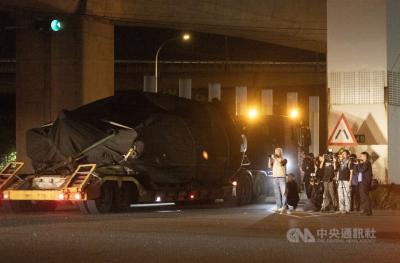
The final batch of 28 M1A2T Abrams tanks purchased from the US arrived at Taipei Port last night and were transported to the Armor Training Command in Hsinchu County’s Hukou Township (湖口), completing the military’s multi-year procurement of 108 of the tanks. Starting at 12:10am today, reporters observed more than a dozen civilian flatbed trailers departing from Taipei Port, each carrying an M1A2T tank covered with black waterproof tarps. Escorted by military vehicles, the convoy traveled via the West Coast Expressway to the Armor Training Command, with police implementing traffic control. The army operates about 1,000 tanks, including CM-11 Brave Tiger
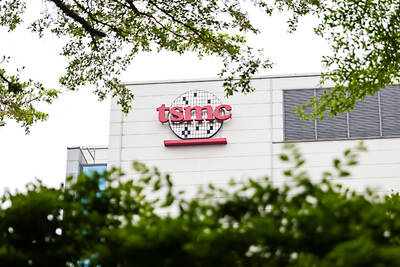
Taiwan Semiconductor Manufacturing Co (TSMC, 台積電), the world’s largest contract chipmaker, said it expects its 2-nanometer (2nm) chip capacity to grow at a compound annual rate of 70 percent from this year to 2028. The projection comes as five fabs begin volume production of 2-nanometer chips this year — two in Hsinchu and three in Kaohsiung — TSMC senior vice president and deputy cochief operating officer Cliff Hou (侯永清) said at the company’s annual technology symposium in Silicon Valley, California, last week. Output in the first year of 2-nanometer production, which began in the fourth quarter of last year, is expected to
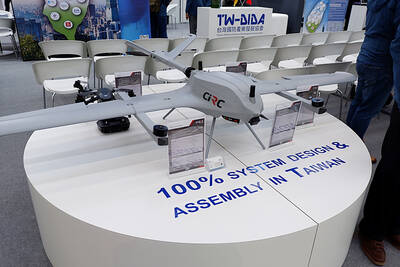
Taiwan’s drone exports surged past US$100 million in the first quarter, exceeding last year’s full-year total, with the Czech Republic emerging as the largest buyer, the Ministry of Economic Affairs said. Exports of complete drones reached US$115.85 million in the period, about 1.2 times the total recorded for all of last year, the ministry said in a report. Exports to the Czech Republic accounted for about US$100 million, far outpacing other markets. Poland, last year’s top destination, recorded about US$11.75 million in the first quarter. Taiwan’s drone exports have expanded rapidly in the past few years, with last year’s total


 RSS
RSS