


North Korea said it scrambled warplanes to ward off a US spy plane in its exclusive economic zone and raised the possibility of “shocking” consequences if the incursions persist.
Kim Yo-jong, the sister of North Korean leader Kim Jong-un, said in a statement early yesterday carried by Pyongyang’s Korean Central News Agency that the US aircraft “retreated” when the North Korean air force sent up a sortie of planes.
“The intrusion into the DPRK’s 200 nautical mile [370km] economic water zone by the reconnaissance asset of the hostile country ... is clearly a grave encroachment upon the sovereignty and security of the DPRK,” Kim Yo-jong said, referring to North Korea by the acronym of its formal name.
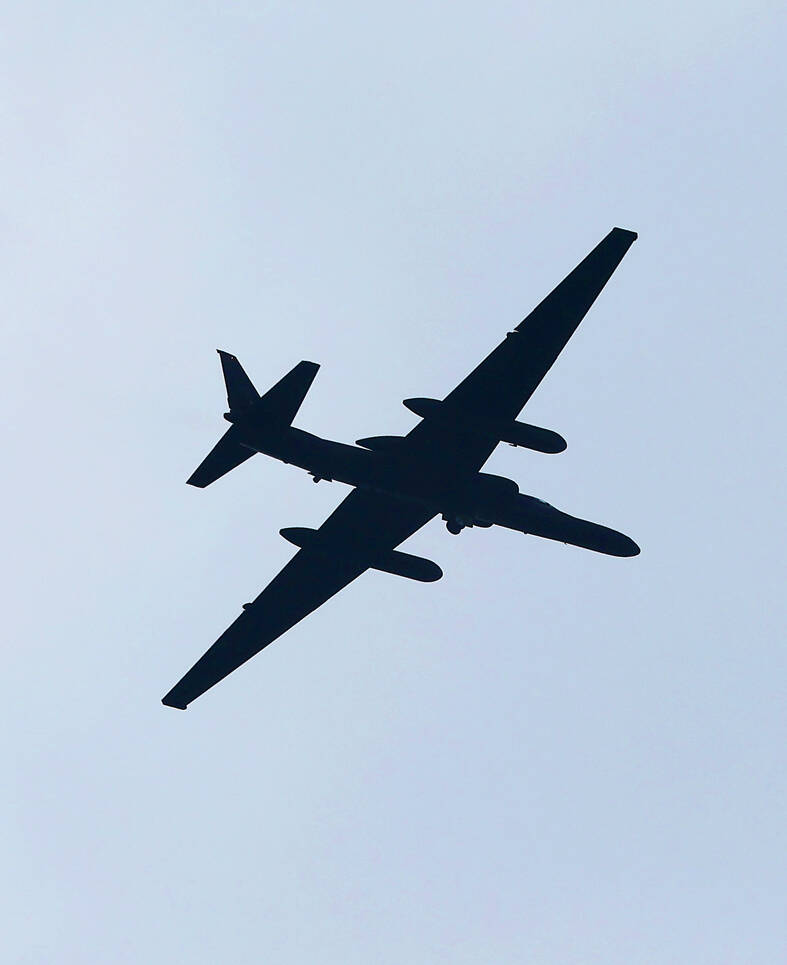
Photo: EPA-EFE
Her comments came hours after Pyongyang claimed US drones and spy planes flew for eight straight days along its coasts, with aircraft repeatedly violating its airspace.
South Korea’s military disputed those accusations, saying the aerial reconnaissance aircraft did not breach North Korean airspace.
It said Pyongyang has willfully stirred tensions by launching threats over “normal flight activities” over international waters.
It urged the North to immediately cease such actions
A spokesman at the Joint Chiefs of Staff added that South Korean and US personnel are maintaining a readiness posture.
Kim Yo-jong also criticized South Korea for defending the US activities.
“As regards the provocation by the US forces, the military of the ‘ROK’ again impudently took the lead in denying the encroachment on the DPRK’s sovereignty, while shamelessly asserting that it was a ‘normal flight,’” she said, referring to South Korea by its formal name.
The latest flare-up in tensions on the peninsula came as NATO leaders yesterday gathered in Lithuania for their annual summit. The leaders of Japan, South Korea, Australia and New Zealand are also attending to bolster awareness of security threats in the Asia-Pacific region.
The North may launch surface-to-air missiles in protest if tensions remain high ahead of the July 27 anniversary of the armistice that ended the Korean War 70 years ago, said Lim Eul-chul, a professor at Kyungnam University’s Institute for Far Eastern Studies in Seoul.
“Pyongyang is facing a sense of security crisis,” Lim said.
Speaking at a forum in Seoul on Monday, John Weidner, chief of staff at the US Forces Korea, reaffirmed Washington’s commitment to enhancing the “regular visibility” of powerful military assets in South Korea, referring to the “upcoming visit” of a US nuclear ballistic missile submarine, Yonhap reported.
“The US will enhance regular visibility of strategic assets to the Korean Peninsula as evidenced by the upcoming visit of a US nuclear ballistic missile submarine to the ROK,” Weidner said.

‘NO SECURITY RISK’: The Railway Bureau reassured the public that the technicians’ activities were limited to technical guidance and did not involve sensitive systems The Railway Bureau yesterday said it had invited eight Chinese technicians to assist with an airport MRT construction project. The bureau issued the confirmation after an Internet user said Chinese nationals had entered the construction zone of Taiwan Taoyuan International Airport’s Terminal 3 project. They asked why “individuals from an enemy state” were allowed access to such a major national infrastructure project, which raised serious concerns over Taiwan’s industrial safety, sensitive systems and information security. The bureau’s Northern Region Engineering Branch Office said subcontractor Taiwan Handle Industrial Co (台灣手把工業) of the Taoyuan airport MRT’s “Contract No. CU05 Project A14 Station Civil, MEP &

The National Chungshan Institute of Science and Technology yesterday showcased its locally developed variants of the Vision 60 robotic patrol dog, which it plans to deploy on the nation’s outlying territories in the South China Sea. The variants were produced under the Joint Lab project — created by the institute and domestic companies — and assembled with domestically produced motors, lenses and artificial intelligence (AI) systems alongside licensed tech from the US, Missile and Rocket Systems Research Division deputy director Jen Kuo-kang (任國光) told the media event at a military base in Taipei’s Dazhi (大直) area. Taiwan has built up its strengths
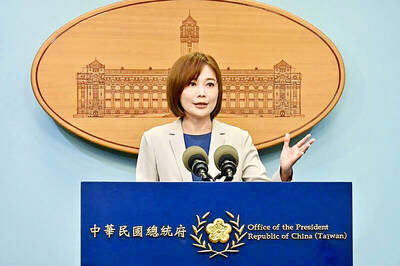
TIT-FOR-TAT: The US allegedly revoked the visa of a Chinese national working at Xinhua News Agency in the US in response to Beijing’s expulsion of Vivian Wang The Presidential Office yesterday condemned China for expelling a New York Times correspondent from Beijing following the newspaper’s interview with President William Lai (賴清德), saying the move highlighted Beijing’s suppression of press freedom and its threat to international news media. Taiwan has noted a series of recent incidents in which Beijing used similar tactics to “threaten and pressure international media outlets and journalists,” Presidential Office spokeswoman Karen Kuo (郭雅慧) said in a statement. “This concerns not only press freedom and freedom of expression, but also the safety of journalists, and Taiwan and relevant partners are paying close attention to the situation,” she

NOT IMMEDIATE: Taiwan has a chance to appeal the proposed 10 percent tariff before it starts, while other countries face a 12.5 percent tariff from the trade office Taiwan is among 60 economies determined by the US to have failed to impose or enforce a ban on the importation of goods produced with forced labor, according to a notice released on Tuesday by the Office of the US Trade Representative (USTR), which proposed imposing an additional 10 percent or more tariff on them. The USTR in a statement said that following an investigation, it had determined under Section 301 of the Trade Act of 1974 that the failure of the 60 economies to impose and effectively enforce a prohibition on the importation of goods produced with forced labor is


 RSS
RSS