


Philippine police backed by commandos on Tuesday staged a massive raid and said they rescued more than 2,700 workers from Taiwan and more than a dozen other countries who were allegedly swindled into working for fraudulent online gaming sites and other cybercrime groups.
The number of people rescued from seven buildings in Las Pinas city in metropolitan Manila and the scale of the nighttime police raid were the largest so far this year, indicating how the Philippines has become a key base of operations for cybercrime syndicates.
Cybercrime scams have become a major issue in Asia, with reports of people from the region and beyond being lured into taking jobs in countries such as Myanmar and Cambodia.
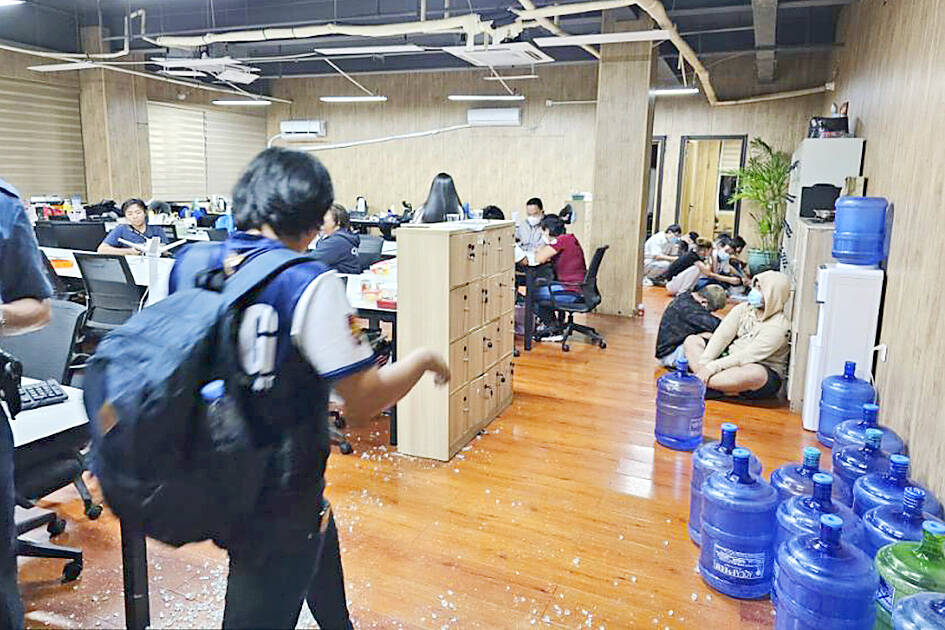
Photo: AP
However, many of these workers find themselves trapped in virtual slavery and forced to participate in scams targeting people over the Internet.
ASEAN leaders last month agreed in a summit in Indonesia to tighten border controls and law enforcement, and broaden public education to fight criminal syndicates that traffic workers to other nations, where they are made to participate in online fraud.
Brigadier General Sydney Hernia, who heads the national Philippine police’s anti-cybercrime unit, said that officers with warrants raided and searched the buildings at about midnight in Las Pinas and rescued 1,534 Filipinos and 1,190 people from at least 17 other countries, including Taiwan.
The biggest groups were Chinese workers, with 604 reported rescued, 183 Vietnamese, 137 Indonesians, 134 Malaysians and 81 Thais. There were also people from Myanmar, Pakistan, Yemen, Somalia, Sudan and Nigeria.
It was not immediately clear how many suspected leaders of the syndicate were arrested.
Some of the workers told investigators that when they tried to quit they were forced to pay a hefty amount for unclear reasons or they feared they would be sold to other syndicates, police said, adding that workers were also forced to pay fines for perceived infractions at work.
Workers were lured with high salary offers and ideal working conditions in Facebook advertisements, but later found out the promises were a ruse, officials said.

PROVOCATIVE: Chinese Deputy Ambassador to the UN Sun Lei accused Japan of sending military vessels to deliberately provoke tensions in the Taiwan Strait China denounced remarks by Japan and the EU about the South China Sea at a UN Security Council meeting on Monday, and accused Tokyo of provocative behavior in the Taiwan Strait and planning military expansion. Ayano Kunimitsu, a Japanese vice foreign minister, told the Council meeting on maritime security that Tokyo was seriously concerned about the situation in the East China and South China seas, and reiterated Japan’s opposition to any attempt to change the “status quo” by force, and obstruction of freedom of navigation and overflight. Stavros Lambrinidis, head of the EU delegation to the UN, also highlighted South China Sea

The final batch of 28 M1A2T Abrams tanks purchased from the US arrived at Taipei Port last night and were transported to the Armor Training Command in Hsinchu County’s Hukou Township (湖口), completing the military’s multi-year procurement of 108 of the tanks. Starting at 12:10am today, reporters observed more than a dozen civilian flatbed trailers departing from Taipei Port, each carrying an M1A2T tank covered with black waterproof tarps. Escorted by military vehicles, the convoy traveled via the West Coast Expressway to the Armor Training Command, with police implementing traffic control. The army operates about 1,000 tanks, including CM-11 Brave Tiger

Taiwan Semiconductor Manufacturing Co (TSMC, 台積電), the world’s largest contract chipmaker, said it expects its 2-nanometer (2nm) chip capacity to grow at a compound annual rate of 70 percent from this year to 2028. The projection comes as five fabs begin volume production of 2-nanometer chips this year — two in Hsinchu and three in Kaohsiung — TSMC senior vice president and deputy cochief operating officer Cliff Hou (侯永清) said at the company’s annual technology symposium in Silicon Valley, California, last week. Output in the first year of 2-nanometer production, which began in the fourth quarter of last year, is expected to

Taiwan’s drone exports surged past US$100 million in the first quarter, exceeding last year’s full-year total, with the Czech Republic emerging as the largest buyer, the Ministry of Economic Affairs said. Exports of complete drones reached US$115.85 million in the period, about 1.2 times the total recorded for all of last year, the ministry said in a report. Exports to the Czech Republic accounted for about US$100 million, far outpacing other markets. Poland, last year’s top destination, recorded about US$11.75 million in the first quarter. Taiwan’s drone exports have expanded rapidly in the past few years, with last year’s total


 RSS
RSS