


Thailand’s two main opposition parties yesterday agreed to form a ruling coalition after they trounced in a weekend election military-backed rivals that have controlled government for nearly a decade.
The Move Forward party and opposition heavyweight Pheu Thai dominated Sunday’s ballot in a rout of army-backed parties, but could face challenges in mustering enough support to be voted in as prime minister, with parliamentary rules drafted by the military after a 2014 coup skewed in favor of its allies.
Their alliance would need to ensure its efforts to form a new government would not be stymied by a junta-appointed senate, which gets to vote on a prime minister in a bicameral sitting of the 750-member legislature, and has a record of favoring conservative parties led by generals.

Photo: EPA-EFE
Pita Limjaroenrat, Move Forward’s 42-year-old leader, proposed an alliance of six parties that would command 309 seats. That would be short of the 376 seats needed to ensure he is elected as prime minister.
Asked about the senate, he said all sides must respect the election outcome and there was no use going against it.
“I am not worried, but I am not careless,” he told a news conference.
“It will be quite a hefty price to pay if someone is thinking about debunking the election result or forming a minority government,” he said.
Pheu Thai, controlled by the billionaire Shinawatra family, said it agreed with Pita’s proposal and wished him luck in efforts to become prime minister.
The party had won most seats in every election this century, including twice in landslides, but met its match against Move Forward as it came close to a sweep of the capital, Bangkok, and made gains in rivals’ strongholds.
“Pheu Thai has no plan to form any other government,” party leader Chonlanan Srikaew told a news conference.
Although the results appear to be a hammer blow for the military and its allies, with parliamentary rules on their side and some influential power-brokers behind them, they could determine the shape of a new government.
Move Forward was galvanized by a wave of excitement among the youth over its liberal agenda and promises of bold changes, including breaking up monopolies and reforming a law on insulting the monarchy.
Pita yesterday did a victory lap in Bangkok where thousands of supporters had gathered — some in the streets, others on rooftops — dressed in Move Forward’s signature orange color and chanting “Prime Minister Pita.”
Pita has said Move Forward would press ahead with its plan to amend strict lese majeste laws against insulting the monarchy, which critics say have been used to stifle free speech.
Thailand’s palace does not comment on the law or its use.
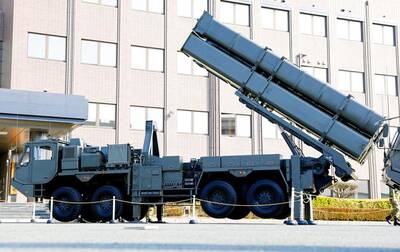
Japan has deployed long-range missiles in a southwestern region near China, the Japanese defense minister said yesterday, at a time when ties with Beijing are at their lowest in recent years. The missiles were installed in Kumamoto in the southern region of Kyushu, as Japan is attempting to shore up its military capacity as China steps up naval activity in the East China Sea. “Standoff defense capabilities enable us to counter the threat of enemy forces attempting to invade our country ... while ensuring the safety of our personnel,” Japanese Minister of Defense Shinjiro Koizumi said. “This is an extremely important initiative for

Chinese Nationalist Party (KMT) Chairwoman Cheng Li-wun (鄭麗文) today accepted an invitation from Chinese President Xi Jinping (習近平) to lead a delegation to China next month, saying she hopes to promote the peaceful development of cross-strait relations and bring stability to the Taiwan Strait. “I am grateful and happy to accept this invitation,” Cheng said in a statement from the KMT chairperson’s office. Cheng said she hopes both sides can work together to promote the peaceful development of cross-strait relations, enhance exchange and cooperation, bring stability to the Taiwan Strait and improve people’s livelihoods. At today's news conference, Cheng said any efforts to

MORE POPULAR: Taiwan Pass sales increased by 59 percent during the first quarter compared with the same period last year, the Tourism Administration said The Tourism Administration yesterday said that it has streamlined the Taiwan Pass, with two versions available for purchase beginning today. The tourism agency has made the pass available to international tourists since 2024, allowing them to access the high-speed rail, Taiwan Railway Corp services, four MRT systems and four Taiwan Tourist Shuttles. Previously, five types of Taiwan Pass were available, but some tourists have said that the offerings were too complicated. The agency said only two types of Taiwan Pass would be available, starting from a three-day pass with the high-speed rail and a three-day pass with Taiwan Railway Corp. The former costs NT$2,800

The nation’s fastest supercomputer, Nano 4 (晶創26), is scheduled to be launched in the third quarter, and would be used to train large language models in finance and national defense sectors, the National Center for High-Performance Computing (NCHC) said. The supercomputer, which would operate at about 86.05 petaflops, is being tested at a new cloud computing center in the Southern Taiwan Science Park in Tainan. The exterior of the server cabinet features chip circuitry patterns overlaid with a map of Taiwan, highlighting the nation’s central position in the semiconductor industry. The center also houses Taiwania 2, Taiwania 3, Forerunner 1 and


 RSS
RSS