


A strong, shallow earthquake hit central Japan on Friday afternoon, killing at least one person and injuring 22, but no tsunami warning was issued.
The magnitude 6.2 quake struck Ishikawa Prefecture at 2:42pm on the west coast of Japan’s main island of Honshu, the US Geological Survey said.
The Japan Meteorological Agency measured the quake at magnitude 6.5 and at a depth of about 12km, 300km northwest of Tokyo.
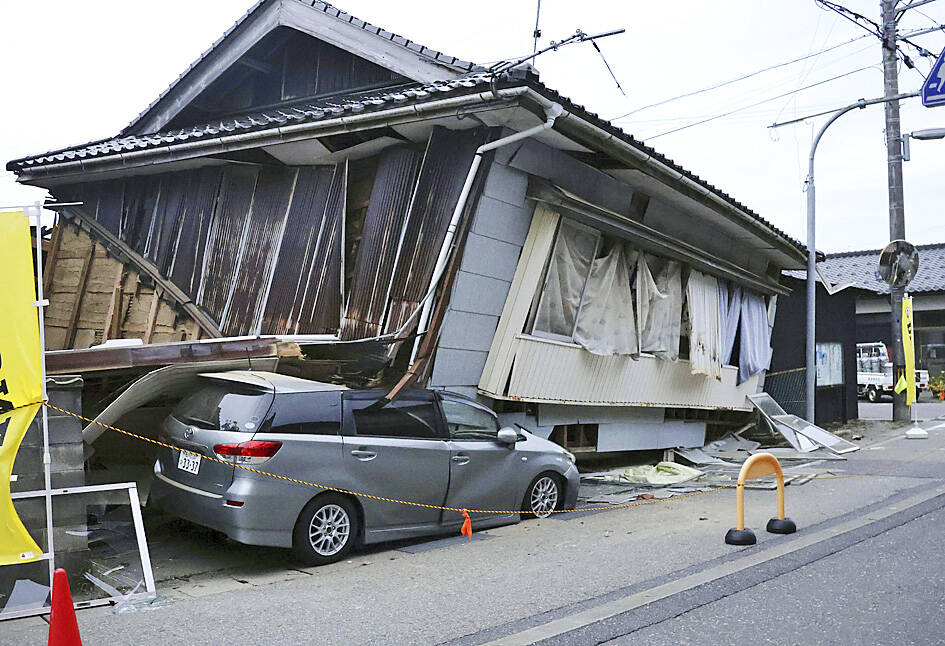
Photo: AP
One person was reported dead in Suzu city at the northern tip of Noto Peninsula in Ishikawa Prefecture, a city official said.
The Japan Times last night reported three collapsed houses and 22 injuries in the area.
Six homes were damaged and rain could trigger mudslides, causing further damage, the official said.
He did not say how the person died, but the Japanese Fire and Disaster Management Agency reported that a person was found without vital signs after falling from a ladder.
Two people were rescued from damaged buildings, the Japan Meteorological Agency said.
It said another person was injured when a cabinet fell on them, and two people were rescued from damaged buildings.
Japanese Chief Cabinet Secretary Hirokazu Matsuno told reporters that no abnormalities had been detected at the two nuclear power plants in the affected area.
A video broadcast by NHK public television showed a section of a hill that had crumbled and fallen on a house. It also broadcast a video that showed a room shaking for nearly half a minute.
Kenji Satake, a professor at the University of Tokyo Earthquake Research Institute, told NHK that aftershocks would likely continue for a week.
East Japan Railway Co said the super-express Shinkansen connecting Tokyo and Kanazawa in Ishikawa Prefecture was temporarily suspended for safety checks, but had resumed normal operations with delays.
Additional reporting by AFP
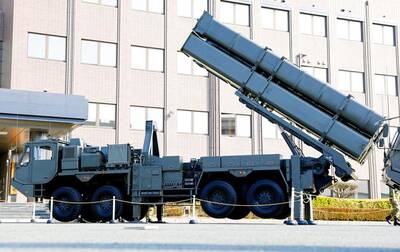
Japan has deployed long-range missiles in a southwestern region near China, the Japanese defense minister said yesterday, at a time when ties with Beijing are at their lowest in recent years. The missiles were installed in Kumamoto in the southern region of Kyushu, as Japan is attempting to shore up its military capacity as China steps up naval activity in the East China Sea. “Standoff defense capabilities enable us to counter the threat of enemy forces attempting to invade our country ... while ensuring the safety of our personnel,” Japanese Minister of Defense Shinjiro Koizumi said. “This is an extremely important initiative for
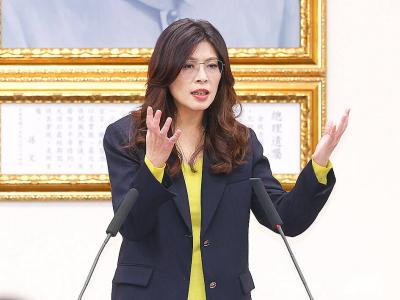
Chinese Nationalist Party (KMT) Chairwoman Cheng Li-wun (鄭麗文) today accepted an invitation from Chinese President Xi Jinping (習近平) to lead a delegation to China next month, saying she hopes to promote the peaceful development of cross-strait relations and bring stability to the Taiwan Strait. “I am grateful and happy to accept this invitation,” Cheng said in a statement from the KMT chairperson’s office. Cheng said she hopes both sides can work together to promote the peaceful development of cross-strait relations, enhance exchange and cooperation, bring stability to the Taiwan Strait and improve people’s livelihoods. At today's news conference, Cheng said any efforts to
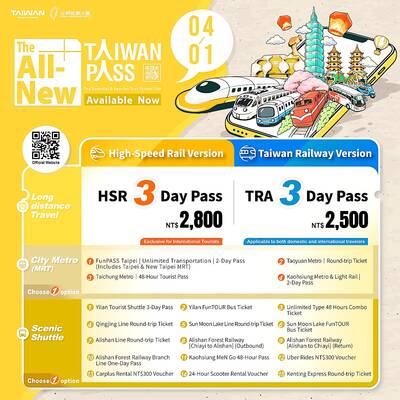
MORE POPULAR: Taiwan Pass sales increased by 59 percent during the first quarter compared with the same period last year, the Tourism Administration said The Tourism Administration yesterday said that it has streamlined the Taiwan Pass, with two versions available for purchase beginning today. The tourism agency has made the pass available to international tourists since 2024, allowing them to access the high-speed rail, Taiwan Railway Corp services, four MRT systems and four Taiwan Tourist Shuttles. Previously, five types of Taiwan Pass were available, but some tourists have said that the offerings were too complicated. The agency said only two types of Taiwan Pass would be available, starting from a three-day pass with the high-speed rail and a three-day pass with Taiwan Railway Corp. The former costs NT$2,800

The nation’s fastest supercomputer, Nano 4 (晶創26), is scheduled to be launched in the third quarter, and would be used to train large language models in finance and national defense sectors, the National Center for High-Performance Computing (NCHC) said. The supercomputer, which would operate at about 86.05 petaflops, is being tested at a new cloud computing center in the Southern Taiwan Science Park in Tainan. The exterior of the server cabinet features chip circuitry patterns overlaid with a map of Taiwan, highlighting the nation’s central position in the semiconductor industry. The center also houses Taiwania 2, Taiwania 3, Forerunner 1 and


 RSS
RSS