


The US Army Special Operations Command (USASOC) for the first time simulated the defense of Taiwan against an invasion by China, the Military.com Web site reported on Sunday.
The report, titled “Defending a Mock Invasion of Taiwan Signals Shift for Army Special Operations After Years of Counterinsurgency,” said that during its annual combat exercise last week, the USASOC landed Chinook helicopters on a concrete structure representing Taiwan, at the Range 68 training site in Fort Bragg, North Carolina.
“The exercise combined some of the hallmark tactics and weapons that were used during the global war on terror with other tools, reflecting a seismic shift for the command as it prepares for potential conflict against major military rivals,” it wrote.
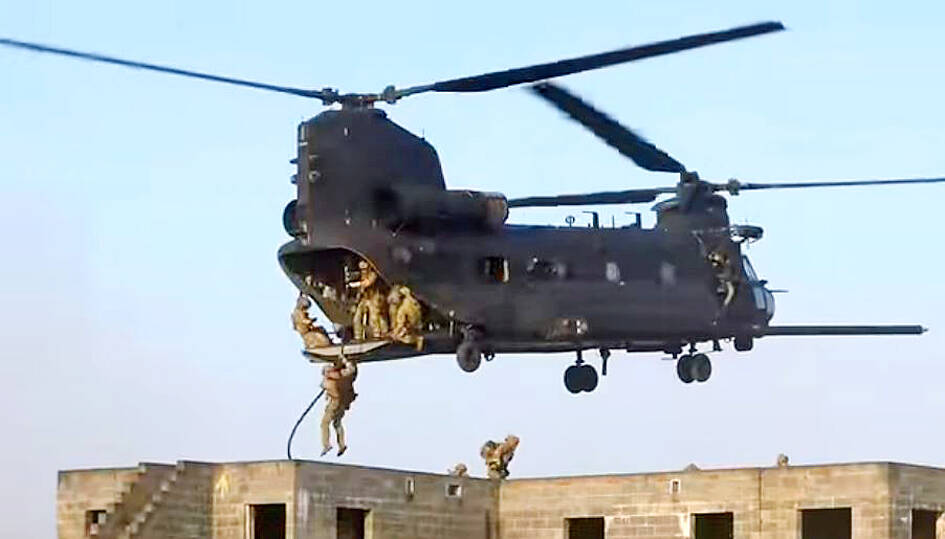
Photo: US Army Special Operations Command’s Facebook page
USASOC Commander Lieutenant General Jonathan Braga said the command aims to “prevent World War III.”
An officer speaking to the public ahead of the exercise specifically named the Chinese People’s Liberation Army (PLA) as the target of the exercise, saying: “I’m going to receive a brief from my boss giving us a task to conduct an operation to counter the PLA on the island of Taiwan.”
USASOC’s shift in focus was also demonstrated in its foreign-language program, which no longer teaches Pashto and Dari — the official languages of Afghanistan — but instead teaches Ukrainian and Japanese.
During the exercise, soldiers also demonstrated intermediate to advanced command of Mandarin or Russian, the report said.
The exercise included the firing of Carl Gustaf recoilless rifles, sabotaging of tunnels and use of AeroVironment Switchblade drones.
The operatives also practiced capture evasion, recognizing and responding to information warfare, and responding to “gray zone” tactics employed by China and Russia, the report said.
“Staying competitive without escalating to a crisis or direct conflict is a nuanced game of shadows in the gray zone — one that requires a balance that USASOC is trying to maintain,” the report cited Braga as saying.
Civilians also took part in the exercise, playing the role of Taiwanese civilians, who the command would train in the event of a real conflict.
Soldiers led the civilians in simulated attacks on the enemy, the report said.
Some US soldiers who trained Ukrainian civilians also participated in the exercise, it said.
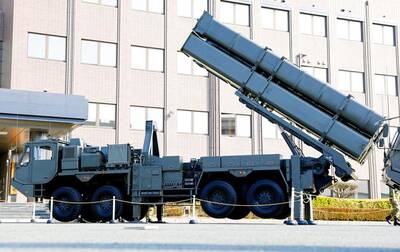
Japan has deployed long-range missiles in a southwestern region near China, the Japanese defense minister said yesterday, at a time when ties with Beijing are at their lowest in recent years. The missiles were installed in Kumamoto in the southern region of Kyushu, as Japan is attempting to shore up its military capacity as China steps up naval activity in the East China Sea. “Standoff defense capabilities enable us to counter the threat of enemy forces attempting to invade our country ... while ensuring the safety of our personnel,” Japanese Minister of Defense Shinjiro Koizumi said. “This is an extremely important initiative for

Chinese Nationalist Party (KMT) Chairwoman Cheng Li-wun (鄭麗文) today accepted an invitation from Chinese President Xi Jinping (習近平) to lead a delegation to China next month, saying she hopes to promote the peaceful development of cross-strait relations and bring stability to the Taiwan Strait. “I am grateful and happy to accept this invitation,” Cheng said in a statement from the KMT chairperson’s office. Cheng said she hopes both sides can work together to promote the peaceful development of cross-strait relations, enhance exchange and cooperation, bring stability to the Taiwan Strait and improve people’s livelihoods. At today's news conference, Cheng said any efforts to
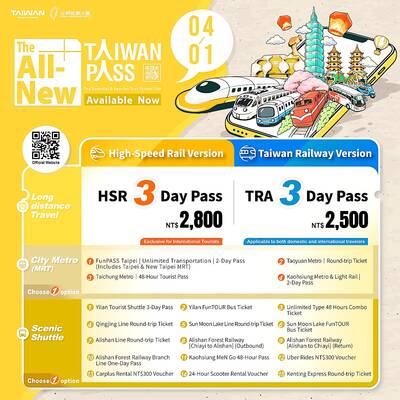
MORE POPULAR: Taiwan Pass sales increased by 59 percent during the first quarter compared with the same period last year, the Tourism Administration said The Tourism Administration yesterday said that it has streamlined the Taiwan Pass, with two versions available for purchase beginning today. The tourism agency has made the pass available to international tourists since 2024, allowing them to access the high-speed rail, Taiwan Railway Corp services, four MRT systems and four Taiwan Tourist Shuttles. Previously, five types of Taiwan Pass were available, but some tourists have said that the offerings were too complicated. The agency said only two types of Taiwan Pass would be available, starting from a three-day pass with the high-speed rail and a three-day pass with Taiwan Railway Corp. The former costs NT$2,800

The nation’s fastest supercomputer, Nano 4 (晶創26), is scheduled to be launched in the third quarter, and would be used to train large language models in finance and national defense sectors, the National Center for High-Performance Computing (NCHC) said. The supercomputer, which would operate at about 86.05 petaflops, is being tested at a new cloud computing center in the Southern Taiwan Science Park in Tainan. The exterior of the server cabinet features chip circuitry patterns overlaid with a map of Taiwan, highlighting the nation’s central position in the semiconductor industry. The center also houses Taiwania 2, Taiwania 3, Forerunner 1 and


 RSS
RSS