

The Philippines is in talks to possibly include Australia and Japan in planned joint South China Sea patrols with the US, a senior diplomat said on Monday, in another sign of concern over Beijing’s activities in the strategic waters.
“Meetings have already been set and probably we may have the Japanese and the Australians join in,” Philippine Ambassador to the US Jose Manuel Romualdez said.
“They would like to join in for joint patrols to make sure that there’s the code of conduct and there’s freedom of navigation,” he said, adding that it was still “an idea under discussion.”
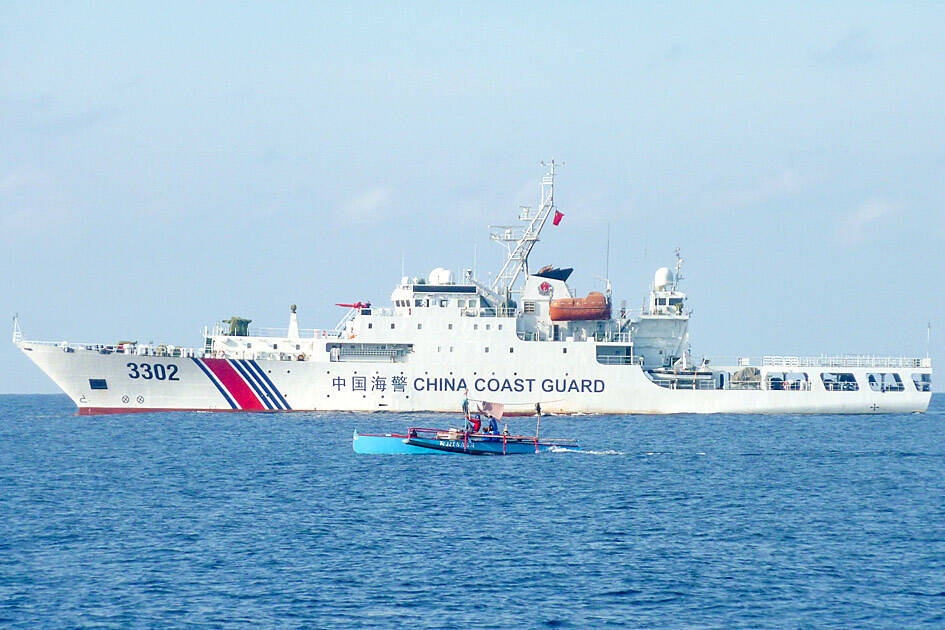
Photo: AFP
If the plan materializes, it would be the first time the Philippines has joined multilateral maritime patrols in the South China Sea, a move that would likely anger Beijing, which claims most of the sea as its territory.
The patrol talks and renewed engagement with the US underscore how much Philippine President Ferdinand Marcos Jr has realigned his nation with its historic ally, moving away from former Philippine president Rodrigo Duterte’s hostile approach to Washington, while still pursuing close economic engagement with regional powerhouse China.
Australia and the US have separately been discussing joint patrols with the Philippines, amid concerns about China’s assertiveness in the South China Sea, through which about US$3.4 trillion of commerce passes each year.
The US, Japan and Australia have been conducting trilateral naval exercises, and joint patrols with those nations would be “good for the Philippines and for the entire area,” Romualdez said.
“We want to have freedom of navigation,” he said.
The patrols “could be initially country-to-country” and expanded eventually “because these are our allies, like-minded countries,” he added.
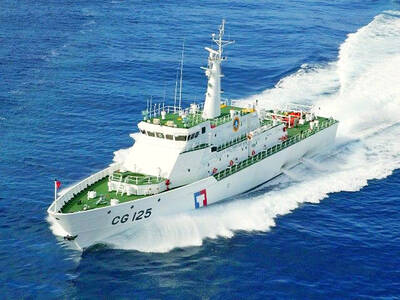
GEOPOLITICAL SIGNIFICANCE: The CGA’s nonmilitary role makes it a tool to avert diplomatic issues, an official said, while confirming the donation of a ship to Manila Coast Guard Administration (CGA) ships are scheduled to sail to the Philippines bearing the words “Taiwan Coast Guard” in a high-profile visit in October next year, the first such visit by a Taiwanese maritime law enforcement vessel to the Southeast Asian nation, the agency said yesterday. The CGA also confirmed that it had donated one of its decommissioned patrol vessels to the Philippines in a rare transfer of a retired ship to a nondiplomatic ally. The Republic of China (ROC) Navy last made such a visit in 1974, shortly before the Philippines switched diplomatic recognition to the People’s Republic of China in

‘GLOBAL WARNING’: The infiltration is not just a local problem, as Beijing has been deploying the same tactics worldwide against Western democracies, a report said Between 50,000 and 100,000 Chinese spies are operating in Taiwan, far more than the National Security Bureau’s previous estimate of 5,000, German journalist and author Jurgen Kremb said on Monday. Kremb presented his research, titled “The War of Spies: How China’s Intelligence Services Are Infiltrating Taiwan — and What Europe Must Learn from It,” at a joint event held by the Taiwan offices of the Friedrich Naumann Foundation and the European Values Center for Security Policy. The report was published in June in the Ministry of Justice Investigation Bureau’s Prospect & Exploration Monthly (展望與探索月刊). By spies, he said he was referring to informants,

PRICE STABILIZATION: The Ministry of Economic Affairs has urged the legislature to support the Cabinet’s supplementary budget for state-owned energy companies State-owned oil supplier CPC Corp, Taiwan (CPC, 台灣中油) on Saturday announced that it would raise domestic gasoline prices by NT$0.7 (US$0.02) per liter and diesel prices by NT$0.6 per liter this week after international crude oil prices rose above US$100 per barrel last week. Formosa Petrochemical Corp (台塑石化) yesterday said that it matched CPC’s price adjustments for this week. The decisions end a six-week period during which CPC and Formosa kept fuel prices in Taiwan unchanged. Retail gasoline prices this week would rise to NT$31.2, NT$32.7 and NT$34.7 per liter for 92, 95 and 98-octane unleaded gasoline respectively at CPC
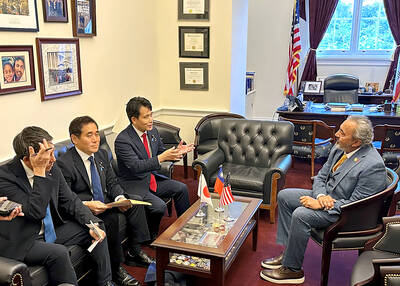
WASHINGTON MEETING: Japan’s Hirofumi Takinami said participants rejected the idea that the US should limit its defensive perimeter to the Second Island Chain US and Japanese lawmakers agree that the US must defend the First Island Chain, including Taiwan, and should not fall back to the Second Island Chain, while “a Taiwan contingency is a Japan contingency and therefore a US-Japan alliance contingency,” media reported after a meeting between officials of the two nations in Washington on Tuesday. A delegation of Japanese lawmakers from the Liberal Democratic Party met with US Senator Thom Tillis, co-chair of the Senate Taiwan Caucus, and US Representative Ami Bera, co-chair of the US Congressional Taiwan caucus, to discuss issues concerning East Asia and the Taiwan Strait. The Japanese and


 RSS
RSS