


President Tsai Ing-wen (蔡英文) and Paraguayan President Mario Abdo Benitez yesterday highlighted their governments’ accomplishments in women’s empowerment at a forum in Taipei about Taiwan’s cooperation with its Latin American and Caribbean (LAC) diplomatic allies.
During her opening address at the Empower Women Empower LAC Forum, at which representatives from nine allies of Taiwan shared how their countries had cooperated with Taipei to empower women to develop economic resilience in the post-COVID-19 era, Tsai said that Taiwan has pushed for gender equality for decades.
Taiwanese women play an important role in politics and business, with female lawmakers making up more than 40 percent of the legislature, while 37 percent of owners of small and medium-sized businesses were women as of last year, Tsai said.
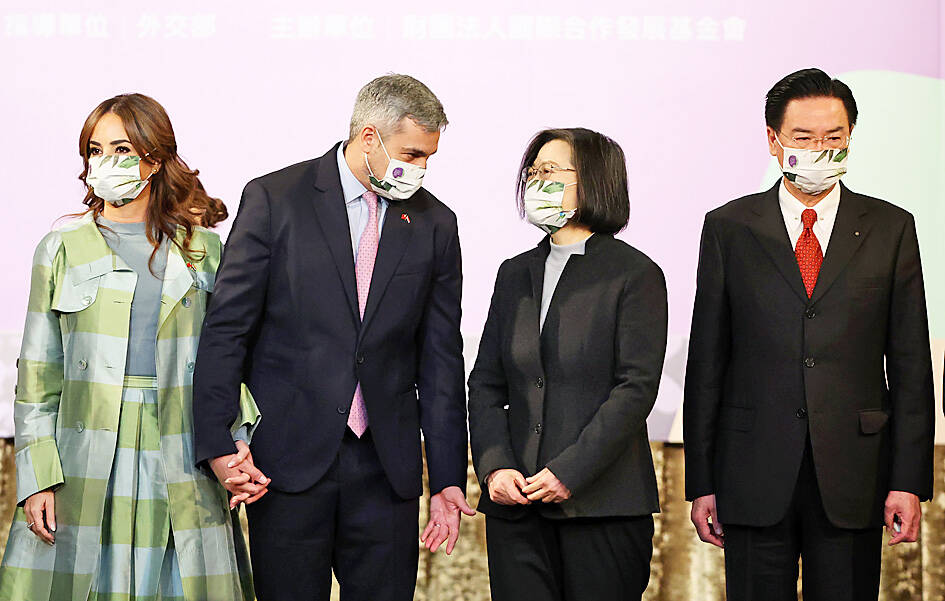
Photo: CNA
Taiwan has also been working with its diplomatic allies in Latin America and the Caribbean on women’s empowerment, she said, referring to the Ministry of Foreign Affairs-funded International Cooperation and Development Fund (TaiwanICDF).
As part of the TaiwanICDF’s first regional development project, which focuses on women’s empowerment, women in Latin America and the Caribbean have been given vocational training to enhance their employment and entrepreneurial skills, and business mentoring to help them establish firms, she said.
The two-year project has successfully promoted gender equality and women’s empowerment by developing their skills, supporting women to build their own businesses, and providing them with a strong sense of achievement, confidence and courage to transform their lives, she said.
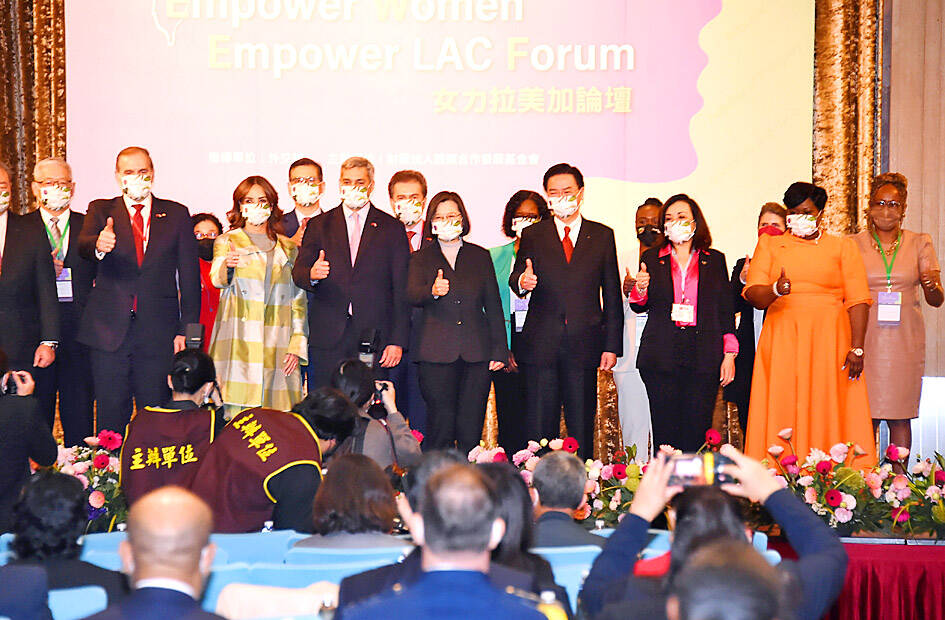
Photo: CNA
Abdo, who is visiting Taiwan on a five-day state trip, said that women’s empowerment has not been easy for his country to develop, as women have faced disadvantages, including domestic violence, throughout Latin America.
That is why his government has been working with Taiwan to build a system of state-funded programs to help women access resources to enjoy better health and equal rights, he said.
“We are very grateful for your country in helping us to implement many programs to help our women,” Abdo said.
With funding from Taiwan, Paraguay has provided safer environments for female workers and established more than 100 vocational training centers across the country that train to women to make them more employable, he said.
More than 100 female entrepreneurs trained at the centers have gone on to win international awards, he said.
Yen Ming-hong (顏銘宏), director of TaiwanICDF’s Technical Cooperation Department, said that the regional project, which began in 2020, helps train a large number of women in participating countries to learn how to start their own businesses and provide them with start-up funding after they finish an entrepreneurial training program.
With TaiwanICDF as guarantor, the women are also able to apply for loans more easily if they want to expand their business operations, Yen told reporters.
One of the entrepreneurs who has benefited from the TaiwanICDF project is Cristha Fuentes, a Guatemalan who owns a brand named after herself that fuses traditional handmade footwear with contemporary design.
Fuentes told reporters on the sideline of the one-day forum that she founded the brand — which sells mostly shoes and handmade leather accessories — when she was only 19.
Before joining the TaiwanICDF program, she knew nothing about business management or finance, she said.
The mentorship she received from the program was a “life-changing experience,” as it helped her as a designer and a businesswoman to be more confident about her decisions and goals, she said.
The project also helped her understand which of her products were more profitable, which she focused on to increase revenue at Cristha Fuentes while continuing to retain her favorite shoe designs, she said.
She won a TaiwanICDF grant, which she plans to use to expand production capacity and hire more sellers, Fuentes added.
US-CHINA SUMMIT: MOFA welcomed US reassurance of no change in its Taiwan policy; Trump said he did not comment when Xi talked of opposing independence US President Donald Trump yesterday said he has not made a decision on whether to move forward with a major arms package for Taiwan after hearing concerns about it from Chinese President Xi Jinping (習近平). Trump’s comments on Taiwan came as he flew back to Washington after wrapping up critical talks in which both leaders said important progress was made in stabilizing US-China relations even as deep differences persist between the world’s two biggest powers on Iran and Taiwan. “I will make a determination,” Trump said, adding: “I’ll be making decisions. But, you know, I think the last thing we need right
SECURITY: Taipei presses the US for arms supplies, saying the arms sales are not only a reflection of the US security commitment to Taiwan but also serve as a mutual deterrent against regional threats Taiwan is committed to preserving the cross-strait “status quo” and contributing to regional peace and stability, the Presidential Office said yesterday. “It is an undeniable fact that the Republic of China is a sovereign and independent democratic nation,” Presidential Office spokeswoman Karen Kuo (郭雅慧) reiterated, adding that Beijing has no right to claim sovereignty over Taiwan. The statements came after US President Donald Trump warned against Taiwanese independence. Trump wrapped up a state visit to Beijing on Friday, during which Chinese President Xi Jinping (習近平) had pressed him not to support Taiwan. Taiwan depends heavily on US security backing to deter China from carrying
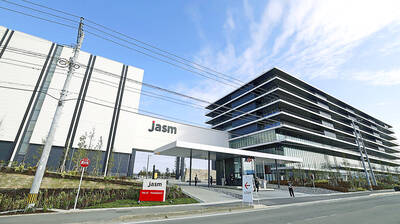
The subsidiary of Taiwan Semiconductor Manufacturing Co (TSMC, 台積電) in Kumamoto, Japan, turned a profit in the first quarter of this year, marking the first time the first fab of the unit has become profitable since mass production started at the end of 2024. According to the contract chipmaker’s financial statement released on Friday, Japan Advanced Semiconductor Manufacturing Inc (JASM), a joint venture running the fab in Kumamoto, posted NT$951 million (US$30.19 million) in profit in the January-to-March period, compared with a loss of NT$1.39 billion in the previous quarter, and a loss of NT$3.25 billion in the first quarter of
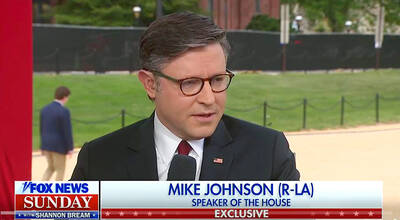
RESOLUTE BACKING: Two Republican senators are planning to introduce legislation that would impose immediate sanctions on China if it attempts to invade Taiwan US House of Representatives Speaker Mike Johnson on Sunday reaffirmed US congressional support for Taiwan, saying the US and “all freedom-loving people” have a stake in preventing China from seizing Taiwan by force. Johnson made the remarks in an interview with Fox News Sunday on US President Donald Trump’s summit with Chinese President Xi Jinping (習近平) last week. In an interview that aired on Friday on Fox News, just as Trump wrapped up a high-stakes visit to China, he said he has yet to green-light a new US$14 billion arms package to Taiwan and that it “depends on China.” “It’s a very good


 RSS
RSS