


A four-star US Air Force general has warned of a conflict with China as early as 2025 — most likely over Taiwan — and urged his commanders to push their units to achieve maximum operational battle readiness this year.
In an internal memorandum that first emerged on social media on Friday, and was later confirmed as genuine by the Pentagon, Air Mobility Command Commander General Mike Minihan said that the main goal should be to deter “and, if required, defeat” China.
“I hope I am wrong. My gut tells me we will fight in 2025,” Minihan said.
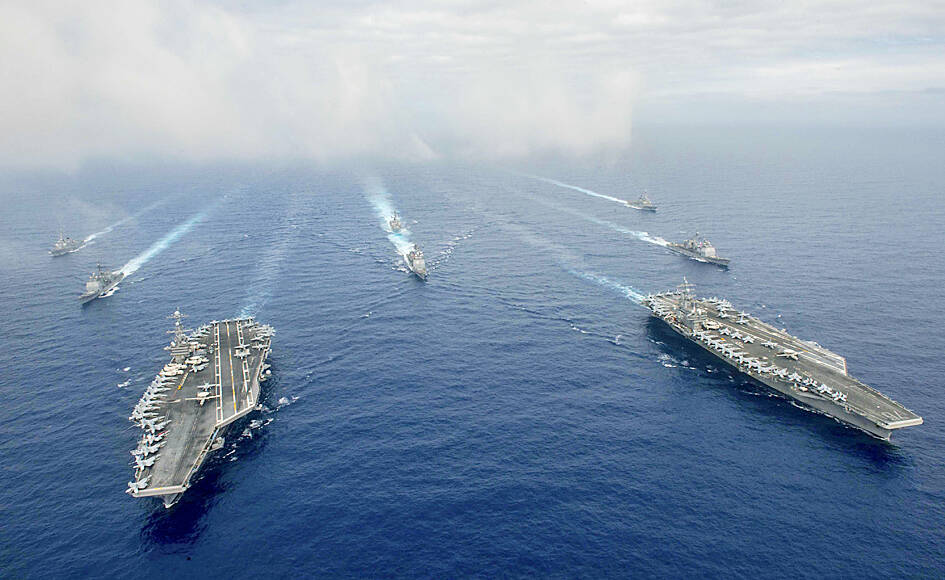
Photo: Jake Greenberg / US Navy / Handout via Reuters
Minihan said that Taiwan’s presidential election next year would offer Chinese President Xi Jinping (習近平) an excuse for military aggression, while the US would be distracted by its own contest for the White House.
“Xi’s team, reason and opportunity are all aligned for 2025,” he added.
The memorandum also calls on all US mobile command personnel to go to the firing range, “fire a clip” into a target and “aim for the head.”
A Pentagon spokesperson responded to an e-mail query about the memo saying that “yes, it’s factual that he sent that out.”
Senior US officials have said in the past few months that China appears to be speeding up its timeframe to annex Taiwan.
China staged major military exercises around Taiwan in August last year, seen as a trial run for an invasion after a defiant visit of solidarity to Taipei by then-US House of Representatives speaker Nancy Pelosi.
The US switched recognition from Taipei to Beijing in 1979, but sells weapons to Taiwan for self-defense.
A growing number of US lawmakers have called for ramping up assistance, including sending direct military aid to Taiwan, saying that Russia’s invasion of Ukraine underscores the need for early preparation.
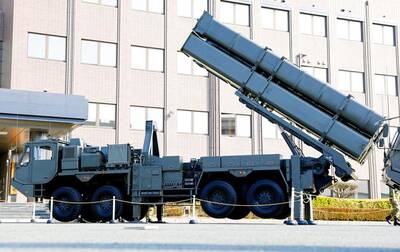
Japan has deployed long-range missiles in a southwestern region near China, the Japanese defense minister said yesterday, at a time when ties with Beijing are at their lowest in recent years. The missiles were installed in Kumamoto in the southern region of Kyushu, as Japan is attempting to shore up its military capacity as China steps up naval activity in the East China Sea. “Standoff defense capabilities enable us to counter the threat of enemy forces attempting to invade our country ... while ensuring the safety of our personnel,” Japanese Minister of Defense Shinjiro Koizumi said. “This is an extremely important initiative for

MORE POPULAR: Taiwan Pass sales increased by 59 percent during the first quarter compared with the same period last year, the Tourism Administration said The Tourism Administration yesterday said that it has streamlined the Taiwan Pass, with two versions available for purchase beginning today. The tourism agency has made the pass available to international tourists since 2024, allowing them to access the high-speed rail, Taiwan Railway Corp services, four MRT systems and four Taiwan Tourist Shuttles. Previously, five types of Taiwan Pass were available, but some tourists have said that the offerings were too complicated. The agency said only two types of Taiwan Pass would be available, starting from a three-day pass with the high-speed rail and a three-day pass with Taiwan Railway Corp. The former costs NT$2,800

COUNTERING HOSTILITY: The draft bill would require the US to increase diplomatic pressure on China and would impose sanctions on those who sabotage undersea cable networks US lawmakers on Thursday introduced a bipartisan bill to bolster the resilience of Taiwan’s submarine cables to counter China’s hostile activities. The proposal, titled the critical undersea infrastructure resilience initiative act, was cosponsored by Republican representatives Mike Lawler and Greg Stanton, and Democratic Representative Dave Min. US Senators John Curtis and Jacky Rosen also introduced a companion bill in the US Senate, which has passed markup at the chamber’s Committee on Foreign Relations. The House’s version of the bill would prioritize the deployment of sensors to detect disruptions or potential sabotage in real-time and enhance early warning capabilities through global intelligence sharing frameworks,

NEW LOW: The council in 2024 based predictions on a pessimistic estimate for the nation’s total fertility rate of 0.84, but last year that rate was 0.69, 17 percent lower An expected National Development Council (NDC) report expects the nation’s population to drop below 12 million by 2065, with the old-age dependency ratio to top 100 percent sooner than 2070, sources said yesterday. The council is slated to release its latest population projections in August, using an ultra-low fertility model, the sources said. The previous report projected that Taiwan’s population would fall to 14.37 million by 2070, but based on a new estimate of the total fertility rate (TFR) — the average number of children born to a woman over her lifetime — the population is expected to reach 12 million by


 RSS
RSS