


The Tourism Bureau has rolled out several initiatives to boost a post-COVID-19 recovery in the domestic travel sector, including themed itineraries, subsidies to travel agencies and a NT$5 million (US$164,647) subsidy program for seniors.
The bureau early this month brought back a program to offer charter-flight subsidies to travel agencies that bring international tourists to Hualien and Taitung counties.
Under the program, travel operators that charter flights carrying 50 or more tourists from other countries and land in Hualien or Taitung are entitled to subsidies, with flights from Japan eligible to receive a NT$385,000 subsidy, while those from South Korea can get NT$335,000, the bureau said.
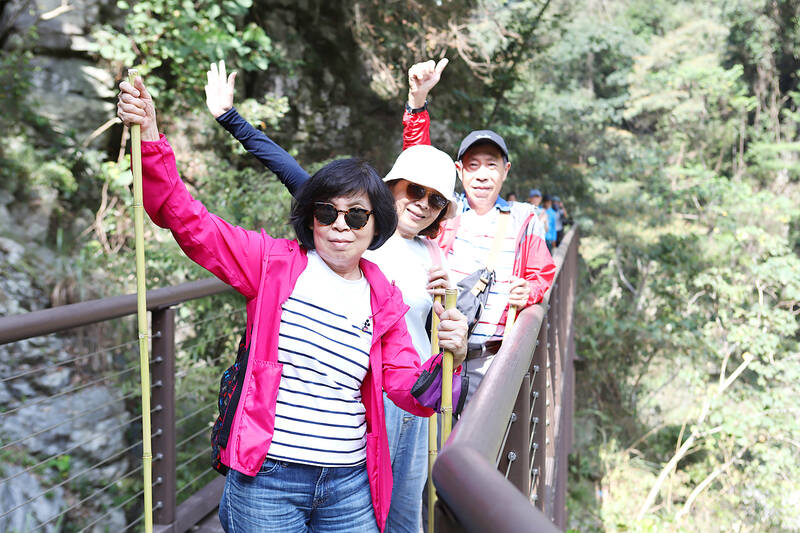
Photo courtesy of Lion Travel via CNA
Charter flights from China, Hong Kong, Macau and other countries or areas can each receive subsidies of NT$285,000, it said.
Moreover, travel operators that charter flights with a load factor of more than 50 percent are eligible for additional subsidies, it said.
Meanwhile, to tap into the potential of the estimated NT$100 billion over-55s domestic travel market, the bureau in August last year launched its “Golden Years” program.
The program comprises eight itineraries catering to the demographic based on three major themes: the environment, culture, and lifestyles of health and sustainability, the bureau said.
The eight itineraries include whale and dolphin watching in Hualien County, a ride on the Breezy Blue excursion train between Taitung and Pingtung County’s Fangliao Township (枋寮) and a ride on the Alishan Forestry Railway’s heritage trains in Chiayi County.
In 2021, domestic travel by Taiwanese tourists aged 55 or older totaled NT$40 billion, Tourism Bureau Deputy Director-General Trust Lin (林信任) said.
Foreign seniors were also an important source of tourists, accounting for 15 percent of inbound travelers, bringing an estimated NT$60 billion each year to Taiwan, Lin said.
The bureau also launched a NT$5 million government-run travel subsidy plan for domestic travelers aged 65 or older in July last year after a hiatus of more than two years due to the COVID-19 pandemic.
Under the subsidy program, Taiwanese aged 65 or older taking part in travel agency-organized tour groups of more than six people are entitled to a daily subsidy of NT$500 per person, provided the trip includes at least one night at a hotel and at least half of the participants are 65 or older.
However, the total subsidy to cover transportation and accommodation is capped at NT$15,000 per tour group, the bureau said.
In related developments, to welcome foreign visitors following Taiwan lifting its COVID-19 pandemic border controls in October last year, the tea-themed CHO Stay Capsule Hotel at Taoyuan International Airport Terminal 2 has reopened.
The hotel said that its award-winning design was inspired by the layout of tea plantations and aims to give guests a taste of Taiwan’s tea culture.
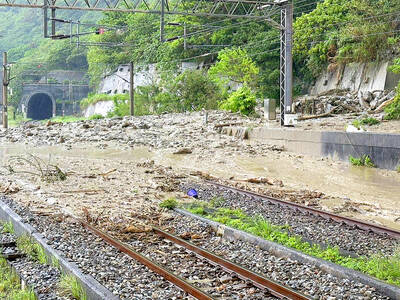
ROLLER-COASTER RIDE: More than five earthquakes ranging from magnitude 4.4 to 5.5 on the Richter scale shook eastern Taiwan in rapid succession yesterday afternoon Back-to-back weather fronts are forecast to hit Taiwan this week, resulting in rain across the nation in the coming days, the Central Weather Administration said yesterday, as it also warned residents in mountainous regions to be wary of landslides and rockfalls. As the first front approached, sporadic rainfall began in central and northern parts of Taiwan yesterday, the agency said, adding that rain is forecast to intensify in those regions today, while brief showers would also affect other parts of the nation. A second weather system is forecast to arrive on Thursday, bringing additional rain to the whole nation until Sunday, it
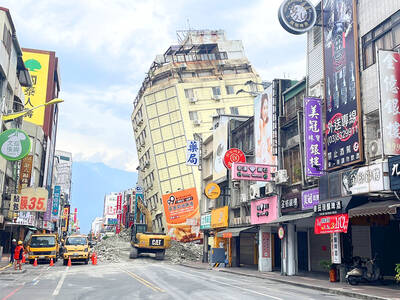
LANDSLIDES POSSIBLE: The agency advised the public to avoid visiting mountainous regions due to more expected aftershocks and rainfall from a series of weather fronts A series of earthquakes over the past few days were likely aftershocks of the April 3 earthquake in Hualien County, with further aftershocks to be expected for up to a year, the Central Weather Administration (CWA) said yesterday. Based on the nation’s experience after the quake on Sept. 21, 1999, more aftershocks are possible over the next six months to a year, the agency said. A total of 103 earthquakes of magnitude 4 on the local magnitude scale or higher hit Hualien County from 5:08pm on Monday to 10:27am yesterday, with 27 of them exceeding magnitude 5. They included two, of magnitude

CONDITIONAL: The PRC imposes secret requirements that the funding it provides cannot be spent in states with diplomatic relations with Taiwan, Emma Reilly said China has been bribing UN officials to obtain “special benefits” and to block funding from countries that have diplomatic ties with Taiwan, a former UN employee told the British House of Commons on Tuesday. At a House of Commons Foreign Affairs Committee hearing into “international relations within the multilateral system,” former Office of the UN High Commissioner for Human Rights (OHCHR) employee Emma Reilly said in a written statement that “Beijing paid bribes to the two successive Presidents of the [UN] General Assembly” during the two-year negotiation of the Sustainable Development Goals. Another way China exercises influence within the UN Secretariat is

Taiwan’s first drag queen to compete on the internationally acclaimed RuPaul’s Drag Race, Nymphia Wind (妮妃雅), was on Friday crowned the “Next Drag Superstar.” Dressed in a sparkling banana dress, Nymphia Wind swept onto the stage for the final, and stole the show. “Taiwan this is for you,” she said right after show host RuPaul announced her as the winner. “To those who feel like they don’t belong, just remember to live fearlessly and to live their truth,” she said on stage. One of the frontrunners for the past 15 episodes, the 28-year-old breezed through to the final after weeks of showcasing her unique


 RSS
RSS