


Ousted Burmese state councilor Aung San Suu Kyi was sentenced to another seven years in jail as her long series of trials ended yesterday, with the Nobel laureate now facing more than three decades behind bars.
A prisoner of the military since a coup last year, Aung San Suu Kyi, 77, has been convicted on every charge leveled against her, ranging from corruption to illegally possessing walkie-talkies and flouting COVID-19 restrictions.
She was yesterday sentenced to an additional seven years in prison, on five counts of corruption related to hiring, maintaining and purchasing a helicopter for a Burmese government official, a case in which she allegedly caused “a loss to the state.”
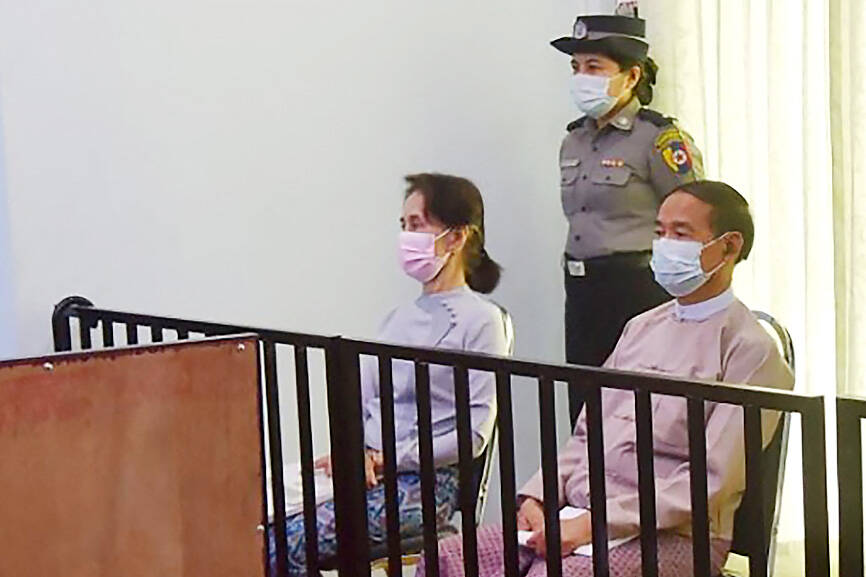
Photo: AFP MYANMAR`S MINISTRY OF INFORMATION
Aung San Suu Kyi — sentenced to a total of 33 years following 18 months of court proceedings that rights groups called as a sham — appeared in good health, a legal source familiar with the case said.
“All her cases were finished and there are no more charges against her,” said the source, who requested anonymity as they were not authorized to speak to the media.
Journalists have been barred from the hearings, and Aung San Suu Kyi’s lawyers have been blocked from speaking to the media.
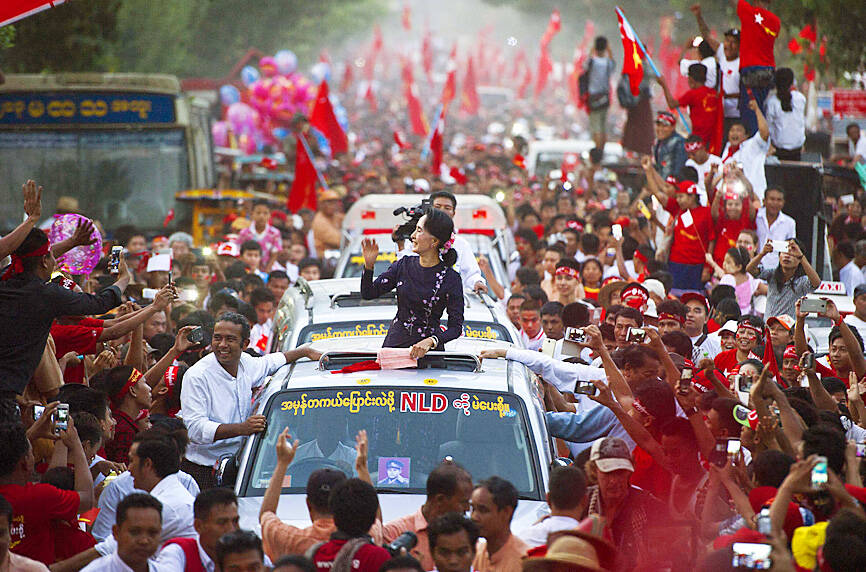
Photo: AFP
The road leading to the prison holding Aung San Suu Kyi in the military-built capital, Naypyidaw, was clear of traffic ahead of the verdict, an Agence France-Presse correspondent said.
Former Burmese president Win Myint, who was accused alongside Aung San Suu Kyi in the most recent trial, also received a seven-year sentence, the source said.
Since her trial began, Aung San Suu Kyi has been seen only once — in grainy state media photographs from a bare courtroom — and has been reliant on lawyers to relay messages to the world.
Many in Myanmar’s democracy struggle, which Aung San Suu Kyi has dominated for decades, have abandoned her core principle of nonviolence, with the opposition Burmese People’s Defense Forces clashing regularly with the military across the country.
Last week, the UN Security Council called on the junta to release Aung San Suu Kyi in its first resolution on the situation in Myanmar since the coup.
The corruption charges were “ridiculous,” said Htwe Htwe Thein, an associate professor at Curtin University in Australia.
“Nothing in Aung San Suu Kyi’s leadership, governance or lifestyle indicates the smallest hint of corruption,” she said.
“The question now will be what to do with Aung San Suu Kyi,” International Crisis Group senior Myanmar adviser Richard Horsey said. “Whether to allow her to serve out her sentence under some form of house arrest, or grant foreign envoys limited access to her. But the regime is unlikely to be in any rush to make such decisions.”
The military alleged widespread voter fraud during elections in November 2020 that were won resoundingly by Aung San Suu Kyi’s National League for Democracy (NLD), although international observers said the polls were largely free and fair.
The junta has since canceled the result and said it uncovered wide-spread voter fraud.
Aung San Suu Kyi’s convictions “aim to both permanently sideline her, as well as undermine and ultimately negate her NLD party’s landslide victory,” Human Rights Watch deputy Asia director Phil Robertson said.
Myanmar has been in turmoil since the coup, ending the its brief experiment with democracy and sparking huge protests. The junta has responded with a crackdown that rights groups say includes razing villages, mass extrajudicial killings and airstrikes on civilians.

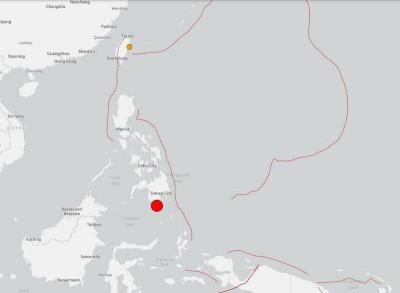
A magnitude 7.8 earthquake struck off the southern coast of Mindanao in the Philippines at 7:38am today, prompting the US Tsunami Warning System to issue an alert for neighboring countries, including Taiwan. The system issued a purple alert indicating a "tsunami threat." The potential threat zone includes Taiwan, the Philippines, Papua New Guinea, Yap and Palau. Philippine authorities were assessing the damage from the quake, with the office of civil defense seeking to verifying initial reports that 15 people had been killed and 129 injured in the region, mostly from falling debris. Arlene Hollero, disaster chief of Maasim town in the Philippines' Sarangani Province,

RESILIENCE: Taiwan plays a key role in semiconductors, energy, information infrastructure and advanced manufacturing, AIT Director Raymond Greene said Taiwan’s continued investment in deterrence and resilience remains vital, especially in uncrewed systems and other emerging technologies, American Institute in Taiwan (AIT) Director Raymond Greene said yesterday. Greene made the remarks at the annual National Strategic Summit on Supply Chain Resilience held by the Research Institute for Democracy, Society and Emerging Technology (DSET), a government-backed think tank. As Taiwan last year became the US’ fourth-largest trading partner and supply chain security is becoming more important, cooperation in emerging technologies continues to deepen between the two countries, he said. The US is committed to accelerating innovation, building key infrastructure, strengthening cooperation

‘GRAY ZONE’ PRESSURE: Beijing’s activities are intended to create the deceitful impression that China has jurisdiction over the area around Taiwan, the CGA said Taiwan’s rights over its territorial waters and exclusive economic zone must not be violated by any country, the Mainland Affairs Council said yesterday, adding that it will not accept any unprovoked actions. The council issued the remarks in response to the China Coast Guard conducting maritime enforcement drills near eastern Taiwan and claiming to fully exercise China’s maritime administrative law enforcement authority. The Coast Guard Administration (CGA) has been closely monitoring the situation and is taking concrete steps to defend the nation’s sovereignty and secure its waters, the council said. China has no sovereign rights over the waters off eastern

The National Chungshan Institute of Science and Technology yesterday showcased its locally developed variants of the Vision 60 robotic patrol dog, which it plans to deploy on the nation’s outlying territories in the South China Sea. The variants were produced under the Joint Lab project — created by the institute and domestic companies — and assembled with domestically produced motors, lenses and artificial intelligence (AI) systems alongside licensed tech from the US, Missile and Rocket Systems Research Division deputy director Jen Kuo-kang (任國光) told the media event at a military base in Taipei’s Dazhi (大直) area. Taiwan has built up its strengths


 RSS
RSS