


Nations early yesterday approved a historic deal to reverse decades of environmental destruction threatening the world’s species and ecosystems at a marathon UN biodiversity summit in Montreal.
The chair of the COP15 nature summit, Chinese Minister of Ecology and Environment Huang Runqiu (黃潤秋), declared the deal adopted at a late-night plenary session and struck his gavel, sparking loud applause from assembled delegates.
In doing so he overruled an objection from the Democratic Republic of the Congo, which had refused to back the text, demanding greater funding for developing nations as part of the accord.
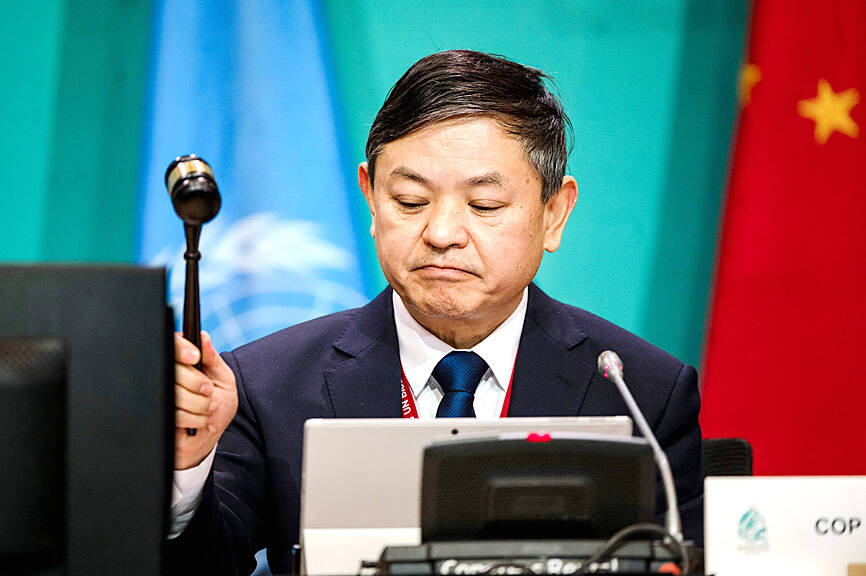
Photo: AFP
After four years of fraught negotiations, more than 190 other states rallied behind the Chinese-brokered accord aimed at saving lands, oceans and species from pollution, degradation and the climate crisis.
The deal pledges to secure 30 percent of the planet as a protected zone by 2030 and to stump up US$30 billion in yearly conservation aid for the developing world.
Environmentalists have compared the accord to the landmark plan to limit global warming to 1.5°C under the Paris agreement, though some earlier warned that it did not go far enough.
Brian O’Donnell of the Campaign for Nature called it “the largest land and ocean conservation commitment in history.”
“The international community has come together for a landmark global biodiversity agreement that provides some hope that the crisis facing nature is starting to get the attention it deserves,” O’Donnell said. “Moose, sea turtles, parrots, rhinos, rare ferns and ancient trees, butterflies, rays, and dolphins are among the million species that will see a significantly improved outlook for their survival and abundance if this agreement is implemented effectively.”
The text calls on wealthy nations to increase financial aid to the developing world to US$20 billion a year by 2025, rising to US$30 billion a year by 2030, while ensuring 30 percent of land and sea areas are effectively conserved and managed by the end of this decade.
It pledges to safeguard the rights of indigenous peoples as stewards of their lands, a key demand of campaigners, but it pulled punches in other areas — for example, only encouraging businesses to report their biodiversity impacts rather than mandating them to do so.
The 23 targets also include cutting environmentally destructive farming subsidies, reducing the risk from pesticides and tackling invasive species.
China chaired the conference, but it was held in Canada because of Beijing’s strict COVID-19 regulations.

Japan has deployed long-range missiles in a southwestern region near China, the Japanese defense minister said yesterday, at a time when ties with Beijing are at their lowest in recent years. The missiles were installed in Kumamoto in the southern region of Kyushu, as Japan is attempting to shore up its military capacity as China steps up naval activity in the East China Sea. “Standoff defense capabilities enable us to counter the threat of enemy forces attempting to invade our country ... while ensuring the safety of our personnel,” Japanese Minister of Defense Shinjiro Koizumi said. “This is an extremely important initiative for

Chinese Nationalist Party (KMT) Chairwoman Cheng Li-wun (鄭麗文) today accepted an invitation from Chinese President Xi Jinping (習近平) to lead a delegation to China next month, saying she hopes to promote the peaceful development of cross-strait relations and bring stability to the Taiwan Strait. “I am grateful and happy to accept this invitation,” Cheng said in a statement from the KMT chairperson’s office. Cheng said she hopes both sides can work together to promote the peaceful development of cross-strait relations, enhance exchange and cooperation, bring stability to the Taiwan Strait and improve people’s livelihoods. At today's news conference, Cheng said any efforts to

MORE POPULAR: Taiwan Pass sales increased by 59 percent during the first quarter compared with the same period last year, the Tourism Administration said The Tourism Administration yesterday said that it has streamlined the Taiwan Pass, with two versions available for purchase beginning today. The tourism agency has made the pass available to international tourists since 2024, allowing them to access the high-speed rail, Taiwan Railway Corp services, four MRT systems and four Taiwan Tourist Shuttles. Previously, five types of Taiwan Pass were available, but some tourists have said that the offerings were too complicated. The agency said only two types of Taiwan Pass would be available, starting from a three-day pass with the high-speed rail and a three-day pass with Taiwan Railway Corp. The former costs NT$2,800

The nation’s fastest supercomputer, Nano 4 (晶創26), is scheduled to be launched in the third quarter, and would be used to train large language models in finance and national defense sectors, the National Center for High-Performance Computing (NCHC) said. The supercomputer, which would operate at about 86.05 petaflops, is being tested at a new cloud computing center in the Southern Taiwan Science Park in Tainan. The exterior of the server cabinet features chip circuitry patterns overlaid with a map of Taiwan, highlighting the nation’s central position in the semiconductor industry. The center also houses Taiwania 2, Taiwania 3, Forerunner 1 and


 RSS
RSS